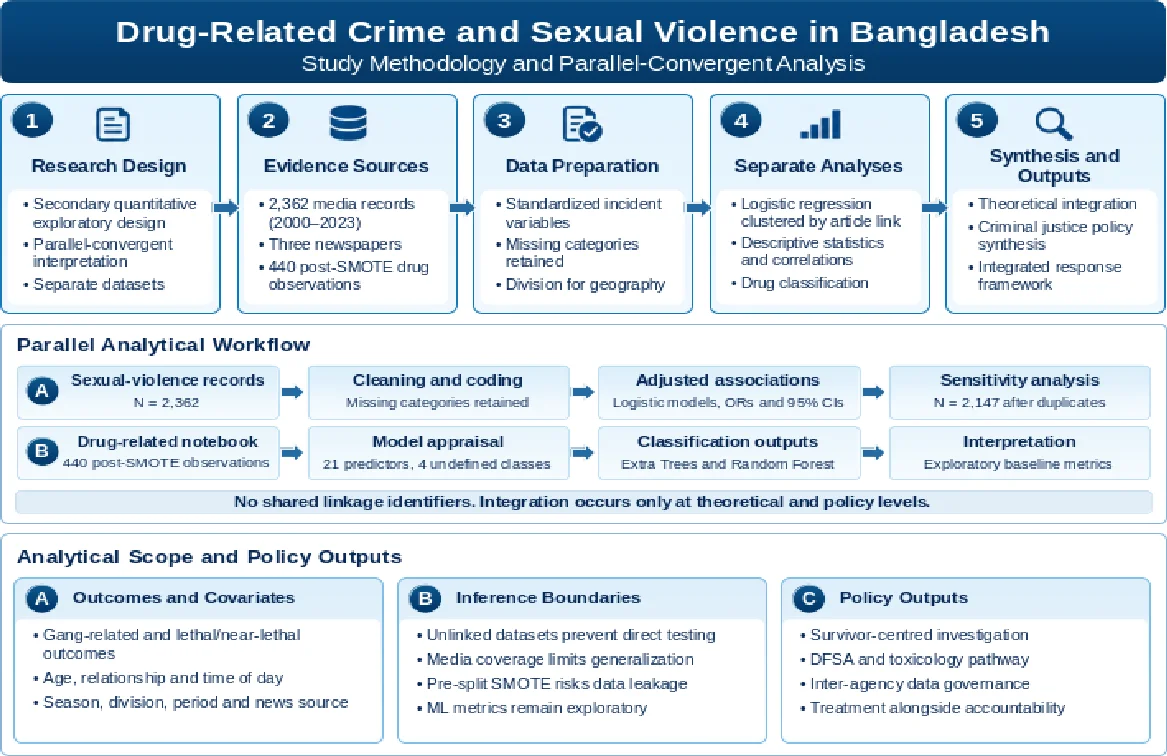
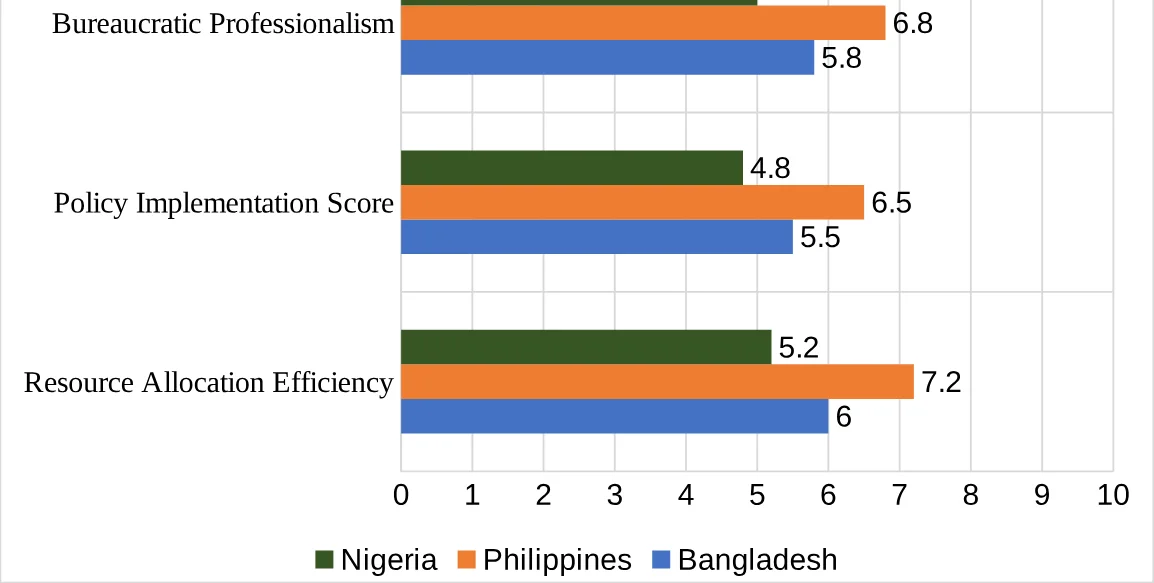
Although treatment and rehabilitation are acknowledged within the Bangladeshi narcotics-control framework, criminal-justice responses are still very enforcement-driven and are not linked to a standardised clinical diversion continuum. This study creates a framework for eligible dependence linked cases based on evidence and maintains conventional prosecution for serious trafficking and violence. A convergent mixed-evidence design was used, which included doctrinal legal analysis, structured integrative review, and secondary DNC administrative analysis. Descriptive statistics and segmented regression analyses provided finite-sample-corrected Newey-West inferences on public treatment-centre utilisation in 2011-2025 and on the number of drug cases and accused persons in 2018-2022. The pre-2020 treatment slope was +2,623 records annually (95% CI [1,486, 3,760]) and the post-2020 slope was -1,698 (95% CI [-3,156, -240]). Enforcement saw an average of 103,159 cases and 134,950 accused persons per year. There was a strong five-year treatment-case correlation (r = .968), but this was considered only exploratory ecological evidence. There is a partial non-custodial basis in existing probation law, but no standardised clinical pathway. The seven-pillar framework is a result of proportional triage, independent assessment, stepped care, prison-health continuity, reintegration, differentiated services, and accountable governance.
Research ArticleCriminology and Public HealthIn progress
Reforming Criminal Justice Responses to Drug Addiction in Bangladesh: An Evidence-Based Policy Framework for Treatment, Rehabilitation, and Social Reintegration
Correspondence: mdbazlurrahman186@gmail.com
Abstract
Keywords Bangladeshdrug use disordercriminal justicediversionrehabilitationsocial reintegrationnarcotics policy
Abbreviations: DNC, Department of Narcotics Control; DUD, drug use disorder; MOHFW, Ministry of Health and Family Welfare; OAT, opioid agonist treatment; UNODC, United Nations Office on Drugs and Crime; WHO, World Health Organization.
1. Introduction
Drug policy is at the nexus of public health, criminal justice, social protection and human rights. One punitive response is unable to tell the difference between organised trafficking and violence and minor behaviour that is materially associated with a drug use disorder (DUD). While supply control and rigorous enforcement are still needed in the case of high level offending, the same cannot be said of dependence-related low level offending, where the question is one of which lawful response is most likely to minimise future health and public-safety harm?
International advice has progressively moved towards a differentiated approach. However, the World Drug Report 2026 also reveals that treatment coverage in the world remains low and Asia is one of the regions with low coverage (UNODC, 2026). The practical challenges is thus not only to support treatment in principle, but to develop a justice to care pathway that can operate at police stations, courts, prisons, health facilities and communities.
A legal framework for differentiated reform is already in place in Bangladesh. The Narcotics Control Act 2018 acknowledges treatment and rehabilitation and the rules under it in 2021 govern private treatment and counselling centres (DNC, 2021). The Narcotics Control (Amendment) Act 2026 enhances the specialized enforcement and adjudication (Government of Bangladesh, 2026). Reform can thus modernise treatment and reintegration and not just enforcement.
This balance is supported by Bangladeshi evidence. Arrest, incarceration, family conflict, stigma, peer pressure, depressive symptoms and unstable living conditions are relevant recovery conditions in relapse studies (Hawlader et al., 2022; Maehira et al., 2013; Nabi et al., 2022). Harm-reduction access was also reported to be impacted by the anti-drug operation and injecting practice reported as riskier in the ethnographic work in 2018 (Khan et al., 2021). While these studies do not provide national causal effects, they do demonstrate that justice contact, social conditions and access to services can interact.
This study aims to answer two questions: (1) How can Bangladesh reform its criminal justice system response to drug addiction to include treatment, rehabilitation, and social reintegration, while retaining its effectiveness for serious drug-related offences? (2) What is the evidence based policy framework to support a coordinated justice-to-care pathway for those impacted by drug use disorders? The study has two aims: to review the existing legal, administrative and treatment-response system in Bangladesh; and to propose a feasible legal reform agenda that connects proportional justice responses with evidence-based treatment and recovery pathways. It is novel because it brings together and integrates criminal justice, public health, rehabilitation and social reintegration in one evidence-based policy. The title has been left as “drug addiction” as per the policy and person first language has been used wherever clinically appropriate.
2. Bangladesh's Drug-Control, Treatment and Reintegration Landscape
2.1. A dual legal mandate, but an uneven operational balance
The Narcotics Control Act 2018 is not punitive in nature. It also specifies the social aspect of rehabilitation, which is the restoration of a person to a normal family and social life. Section 61 authorizes the government treatment and rehabilitation centres and approves the private centres (Government of Bangladesh, 2018). Grant policy for private centres is more recent, and suggests that government already has one lever for service development, which is financing (DNC, 2025).
Bangladesh already has non-custodial authority. There are published decisions that demonstrate the application of this power in narcotics cases, such as one from 2024 that ordered offenders to undergo supervised probation for the first time (Judiciary of Bangladesh, 2024). The 2026 amendment bolsters the enforcement and adjudication of drug offences. The reform gap is therefore not between the lack of alternatives, but between the lack of a continuous linkage between justice and treatment from police, prosecution, courts, prisons, and community services.
2.2. Treatment capacity and the specialist bottleneck
The public treatment facilities in Bangladesh are still small in comparison to the size and spread of the demand. A system that is largely residential also runs the risk of equating treatment with admission when many individuals can be treated more effectively and less costly in outpatient, primary-care and community settings.
The overall mental-health system is an example of the limitation and an opportunity. WHO's Bangladesh mhGAP materials highlight the high level of shortage of specialists among healthcare providers and the importance of handling mental, neurological and substance-use disorders in non-specialist health care settings (WHO, 2022). A justice-diversion model should be based on decentralization of the health system, not a parallel treatment bureaucracy under the control of law-enforcement agencies.
2.3. Relapse is social as well as clinical
Bangladesh relapse studies indicate recovery is influenced by more than detox. Family conflict, peer influence, depressive symptoms, craving, unstable housing, stigma, and damaged social relationships are common across studies (Hawlader et al., 2022; Maehira et al., 2013; Nabi et al., 2022) These findings lend themselves to a recovery model where medication and counselling are available together with housing, family, social and continuity of care supports.
This is where the difference between treatment and reintegration is policy-relevant. The goal of treatment is to decrease drug and alcohol-related symptoms and damages. Rehabilitation builds up functioning and recovery capacities. Reintegration issues are about sustained engagement in family, community, education, work and civic life. Social reintegration must therefore be viewed as a public-safety intervention, rather than an optional welfare add-on.
2.4. New drug markets require adaptive, not only harsher, responses
Bangladesh is also experiencing shifts in the drug market, such as methamphetamine type stimulants and the emergence of new psychoactive substances. Different clinical approaches are necessary for stimulant-use disorders, opioid dependence, sedative misuse and polysubstance use. The criminal-justice response to the behavior should thus be distinct from the clinical picture of the individual.
| Domain | Current Bangladesh foundation | Key implementation gap | Proposed reform response |
|---|---|---|---|
| Law and proportionality | Narcotics Control Act 2018; Probation of Offenders Ordinance 1960; Amendment Act 2026; documented judicial use of probation in narcotics cases | Alternatives exist but remain discretionary and fragmented; no standardized clinical diversion continuum across justice stages | Build on probation authority with multi-stage eligibility rules, independent DUD assessment, stepped treatment and review; serious trafficking/violence remain in conventional prosecution |
| Treatment authority | Section 61 permits public centres and approved private facilities; 2021 private-centre rules | Treatment is not routinely connected to criminal-justice triage; residential care can become the default | Independent assessment and stepped-care referrals across primary, outpatient, intensive and residential levels |
| Public capacity | One 124-bed central treatment centre plus seven divisional treatment centres in current DNC structure | Specialist bottleneck and geographic mismatch | Hub-and-spoke network using DNC specialist hubs, health services, mhGAP-trained non-specialists and accredited providers |
| Prison care | Custodial health services exist within prison administration | Risk of fragmented DUD treatment and weak transition at release | Entry screening, evidence-based pharmacotherapy, mental-health care and 90-day pre-release continuity protocol |
| Rehabilitation | Law recognizes rehabilitation as restoration to family/social life | Housing, employment, family, stigma and case management are not systematically linked to justice outcomes | Recovery case management and funded reintegration package |
| Quality and data | DNC licensing/regulation of private centres; grant policy | Variable clinical quality; limited outcome reporting; risk of data being used punitively | Outcomes-based accreditation, independent complaints, privacy firewall and national aggregated dashboard |
2.5. Institutional fragmentation is itself a policy problem
Table 1:Bangladesh legal and service baseline: existing foundations, implementation gaps and reform response
Note. Author synthesis from Government of Bangladesh (2018, 2026), DNC (2021, 2025, 2026), Judiciary of Bangladesh (2024), Probation of Offenders Ordinance, 1960, and WHO (2022).
Drug cases pass through institutions with varying mandates, information systems and incentives. If there is no agreed pathway, then each institution can do their job properly and the person still drops through the cracks. These are not only failures of goodwill. Proposed reform thus focuses on the protocols for referral, named case responsibility and on interoperable data – protected by privacy, as core infrastructure.
3. Evidence Base for a Treatment-Oriented Criminal-Justice Response
3.1. Why punishment alone is an incomplete response to dependence
DUDs are recurring, heterogeneous disorders influenced by biological susceptibility, learning, mental health, family dynamics, social context and drug supply. The key organising principle is therefore proportionality: severe trafficking, violence, exploitation and/or organised supply should be prosecuted with robust responses, while minor, non-violent behaviour which is materially connected to DUD should be considered for treatment and supervision which might be more effective at reducing future harm than short term incarceration (Csete et al., 2016).
3.2. Diversion before conviction
Diversion can be implemented at various stages (police, prosecutors, courts, sentencing) where eligibility is clear, services are available, and safeguards against coercion and discriminatory selection are in place (WHO & UNODC, 2018). Justice exposure has been found to be reduced in the police-based diversion reviews, but there is significant heterogeneity in implementation (Blais et al., 2022). Eligibility should be based on a mix of offence seriousness, clinical need and public-safety risk, not on possession alone, which should not be an automatic gateway into intensive treatment.
Net-widening is a large design risk. The availability of a diversion programme should not be used as a reason to send people who might otherwise receive a warning, bail or a dismissal, into months of compulsory treatment. WHO has issued a joint statement on the need to reject compulsory drug detention, which reiterates the difference between therapeutic care and drug detention given a new name (WHO, 2020).
3.3. What works during incarceration
Some people with DUD will remain in custody because of offence seriousness or legal ineligibility for diversion. In that setting, evidence is strongest for clinically indicated care that continues after release. Prison health should therefore be treated as part of the national treatment continuum rather than as a separate, temporary system.
Psychosocial prison programmes show more variable effects. The policy implication is not that residential rehabilitation is ineffective; it is that the label 'rehabilitation' cannot substitute for evidence, accreditation, individualized treatment planning, and outcome monitoring.
3.4. Release is a high-risk clinical transition
Release is a predictable high-risk transition. A minimum Bangladesh release package should therefore include a confirmed treatment appointment, medication continuity where indicated, identification documents, an assigned case manager, overdose-risk counselling, and referral for housing, employment, and social protection before the release date.
3.5. Reintegration and the determinants of repeat contact
Re-entry evidence is in support of integration of clinical and psychosocial care, along with practical reintegration supports. Reintegration needs therefore should not be seen as an add-on social service but as an integral component of the public-safety package.
Stigma can manifest itself as family rejection, employer discrimination, self-stigma and negative professional attitudes. It is important that this training be provided to the police, prosecutors, judges, prison staff, clinicians and case managers on confidentiality, non-discrimination, language of recovery, and limits of use of clinical information in an evidentiary setting.
3.6. Gender and other differentiated needs
Formal neutrality does not necessarily translate to equal access. This is also in line with the Bangkok Rules and WHO/UNODC standards for trauma-informed, individualized pathways (United Nations General Assembly, 2010; WHO & UNODC, 2020). Equity needs to be assessed at the four stages of referral, acceptance, retention, and outcome, and not simply inferred from neutral eligibility language.
3.7. The relevant outcome is combined health and public-safety value
One of the requirements for a sustainable reform is that it must demonstrate health and justice and social worth. There are no panaceas (and no single mechanism in the literature), but there are mechanisms that can be combined to create a coherent pathway: clinically appropriate medication for opioid dependence; structured psychosocial treatment; aftercare; re-entry support; and proportionate diversion from unnecessary justice (Blais et al., 2022; Hedrich et al., 2012; Macdonald et al., 2024).The single positive drug test should not thus be taken as a measure of failure of the programme, nor should completion of treatment itself be considered a measure. This assessment system, described later in this article, therefore uses a combination of clinical, justice, reintegration, equity, and process indicators rather than a single abstinence/completion indicator.
Table 2. Evidence-to-policy matrix for treatment, diversion and reintegration.
| Evidence area | Main finding | Policy translation for Bangladesh | Evidence caveat |
|---|---|---|---|
| Police/justice diversion | Diversion can reduce criminal-justice exposure and facilitate service linkage when referral systems and implementation are strong (Blais et al., 2022; WHO & UNODC, 2018) | Create pre-charge/prosecutorial/judicial options tied to real treatment capacity | Programme effects vary; poorly designed diversion can widen the control net |
| Opioid agonist treatment | OAT reduces illicit opioid use and mortality; continuity through incarceration and release is particularly important (Hedrich et al., 2012; Macdonald et al., 2024; Santo et al., 2021) | Enable OAT based on clinical criteria in community and prison settings with confirmed post-release linkage | Applicable to opioid dependence, not all DUDs |
| Therapeutic communities | Many studies report lower recidivism/reincarceration, especially with aftercare (De Andrade et al., 2018; Galassi et al., 2015). | Use structured psychosocial residential programmes selectively and combine with community aftercare. | Effects are heterogeneous and may weaken in larger/more rigorous trials. |
| Psychological prison programmes | Overall effects on recidivism are modest/uncertain after small-study correction; continuity and risk-targeting matter (Beaudry et al., 2021). | Do not treat generic counselling as sufficient; measure fidelity and transition outcomes. | International prison settings may differ from Bangladesh. |
| Bangladesh relapse evidence | Family unrest, peer pressure, depression, craving, unstable housing and gender-specific vulnerabilities are associated with relapse (Maehira et al., 2013; Nabi et al., 2022). | Make housing, family/mental-health support and gender-responsive services part of recovery plans. | Observational samples cannot establish causal effects. |
| Re-entry | Psychosocial/health programmes can reduce recidivism; vocational effects are more mixed (Negi et al., 2026). | Bundle work/skills support with health, housing and case management. | Programme models and outcome definitions vary. |
| Stigma | Professional stigma can reduce quality of care; education/contact approaches show promise (Livingston et al., 2012; Van Boekel et al., 2013). | Train justice and health personnel; adopt person-first communication and anti-discrimination standards. | Most evidence is from non-Bangladesh settings. |
Note. Author synthesis of cited systematic reviews, meta-analyses, Bangladesh studies and WHO/UNODC guidance.
4. Methodology
4.1. Research design and epistemic strategy
The study used a convergent mixed-evidence policy-analysis design with three analytically distinct streams: (1) doctrinal analysis of Bangladesh narcotics law, treatment regulation, prison and administrative materials; (2) a structured integrative synthesis of Bangladesh-specific studies, systematic reviews, meta-analyses, and WHO/UNODC standards; and (3) secondary statistical analysis of aggregate administrative series. The study is neither a causal policy evaluation nor a registered systematic review; its purpose is to produce a transparent, empirically constrained reform architecture for Bangladesh.
4.2. Analytical questions and units of analysis
The analysis was conducted in four questions: What gaps exist between current law and practice regarding enforcement and treatment? What do administrative series say about the use of services and the workload of justice? What are the most promising treatment, diversion, prison-health, and reintegration mechanisms in terms of evidence? What are the implications of these mechanisms for law and administration that can be put into practice? No person specific dataset was produced and no person-specific inferences were made regarding the likelihood of relapse, offending or treatment response.
4.3. Administrative data sources, extraction, and quality control
Two official series of the DNC were used for the quantitative component. The Treatment and Rehabilitation Wing activity table reported the number of people receiving public treatment at treatment centres annually for 2011-2025, plus a breakdown by inpatient/outpatient status and a male/female and/or child reporting category in 2024 that aligns with the detailed Treatment and Rehabilitation Wing profile (DNC, 2026). The treatment and enforcement files were not person-level aggregated as they represent different populations and institutional events.
4.4. Legal and institutional evidence
The primary legal sources that establish authority and institutional design include the Narcotics Control Act 2018, Probation of Offenders Ordinance, 1960, private treatment-centre rules, Narcotics Control (Amendment) Act 2026 and DNC organizational materials (DNC, 2021; Government of Bangladesh, 2018, 2026; Probation of Offenders Ordinance, 1960). The 2026 amendment was considered the modern legal norm and not the result of policy impact.
4.5. Research evidence identification and selection
A systematic search was performed to identify research evidence which was updated on 30 August 2026. The main biomedical and drug-policy database was PubMed, with Google Scholar to supplement retrieval in criminology, social-policy, and Bangladesh, followed by backward citation checking. The searches focused on human evidence after 2009 and kept older material only if legally controlling or methodologically fundamental. The final substantive set included 18 peer-reviewed publications, six of which were from Bangladesh and 12 from other countries that were reviews or analyses. They were supplemented by nine Bangladesh legal/administrative sources and nine international normative/technical documents, of which three were used only for analytic procedures. Unstable search-engine hit totals are not reported as PRISMA denominators because this is an integrative policy review, not a systematic review.
The screening was carried out in two phases. Titles and abstracts were included if they focused on justice contact or diversion, effectiveness of treatment or continuity, relapse or reintegration, or a Bangladesh-specific institutional mechanism. Design, population, outcome relevance and added value were then confirmed by full text or detailed abstract verification. Duplicated reports/commentary without any empirical or normative claim were excluded, and bibliographic data and DOI data were verified before citing with the publisher or PubMed report.
4.6. Evidence appraisal and structured extraction
Each retained source was coded on the following dimensions: Design, Population, Setting, Exposure/Intervention, Outcome Domain, Direction of Effect, Bangladesh Relevance, and Principal Limitation. Weighting was based on methodological strength, contextual directness, transferability, and implementation risk. If there were no evidence to support stronger inference, international evidence was transferred at the level of mechanism. A problem-to-evidence matrix subsequently connected system failures—whether they were the absence of triage, aftercare, or gender mismatch, whether they were the conflict with enforcement services or fragmented data—to candidate reforms and measurable indicators.
A single numerical quality score was not used since the evidence included a mix of qualitative studies, observational studies, systematic reviews, statutes and technical standards. Rather, appraisals were task oriented. This source-function matching was performed at the time of synthesis and is indicated in Table 2 and Figure 1. Recommendations were downgraded where the strength of evidence for effectiveness was greater than the strength of evidence for local deliverability.
4.7. Statistical analysis
Careful limitations were made in the quantitative analysis. A segmented model with a prespecified change in the system-level in 2020 was used: Yt = beta0 + beta1(Time) + beta2(Post2020) + beta3(TimeAfter2020) + et (Lopez Bernal et al., 2016) The slope after 2020 was beta1 + beta3, and OLS was performed with one-lag Newey-West standard errors with finite-sample correction, and t-based inference was used (Newey & West, 1987)The break point is descriptive only and not to be interpreted as a causal impact of COVID-19 or a policy.
The mean, SD, CV, annual change and accused-per-case ratio were calculated for enforcement data for 2018–2022. Leave-one-year-out correlations were used to test co-movement. The calculations were repeated using Python 3.13.5, NumPy 2.3.5, SciPy 1.17.0, and statsmodels 0.14.6. The analysis is not about risk, it's about system activity and co-movement, it's about treatment and impact of enforcement.
4.8. Triangulation, ethics, and reproducibility
Triangulation initially used only the statistical patterns as system-activity evidence, and subsequently mapped legal rules and intervention evidence to justice-to-recovery decision points. Recommendations were tested for public safety, proportionality, clinical ethics, feasibility, equity, measurability and net-widening. Recommendations were qualified if there was material risk due to indirect evidence, limited capacity, coercion, discrimination, confidentiality or provider incentives. No identifiable human data was accessed, only public aggregate statistics were analysed and thus ethics approval was not required.
Table 3:Data Sources, Variables, Analytical Roles, and Inferential Boundaries
| Evidence/data stream | Period or scope | Variables / material | Analytical role | Primary inferential boundary |
|---|---|---|---|---|
| DNC public treatment-centre series | 2011-2025 | Annual total treated; 2024 inpatient/outpatient and reporting categories | Descriptive statistics; segmented time-trend model; service-profile analysis | Utilisation is not prevalence, incidence, unmet need, or treatment effectiveness |
| DNC all-LEA enforcement series | 2018-2022 | Drug-related cases; accused persons | Counts, variability, annual change, accused-per-case ratio; exploratory cross-series association | Enforcement counts are affected by policing intensity, charging practice, market conditions, and disruption |
| Legal and research evidence | Law 1960-2026; research 2009-30 Aug 2026 | 18 substantive peer-reviewed publications (6 Bangladesh, 12 international); 9 Bangladesh legal/administrative sources; 9 international normative/technical documents; 3 methodological sources | Doctrinal analysis; structured evidence coding; mechanism-to-policy mapping; source-specific appraisal | Legal authority does not prove implementation; international effects are not assumed to transport unchanged; integrative review is not an exhaustive systematic review |
Note. DNC = Department of Narcotics Control; LEA = law-enforcement agency. Evidence streams were kept analytically distinct until the triangulation stage.
| EVIDENCE IDENTIFICATION, ELIGIBILITY AND FINAL ANALYTIC SET | |||
|---|---|---|---|
| PEER-REVIEWED EVIDENCE PubMed + Google Scholar + citation chaining; updated 30 Aug 2026 18 substantive sources: 6 Bangladesh + 12 international | BANGLADESH LAW / ADMINISTRATION Probation Ordinance 1960; Narcotics Act 2018/2026; treatment rules; DNC/BFIU; published probation decision 9 legal/administrative sources | INTERNATIONAL STANDARDS WHO/UNODC treatment and justice guidance; Bangkok and Mandela Rules; global drug-policy evidence 9 normative/technical sources | METHODS + QUALITY CONTROL 3 methodological sources; dated search blocks; eligibility criteria; study coding; transcription and source verification |
| ANALYTICAL STAGE: doctrinal interpretation + structured evidence coding + descriptive statistics + segmented trend with finite-sample-corrected HAC inference + exploratory ecological correlation | |||
| TRIANGULATION: identify convergence, contradiction, implementation constraints, equity/rights risks, transferability limits and measurable decision points | |||
| LEGAL TRIAGE | CLINICAL PATHWAY | REINTEGRATION | GOVERNANCE + EVALUATION |
| Proportional alternatives built on existing authority | Independent assessment + stepped care | Housing, work, family + case management | Accreditation, privacy, linked indicators + staged scale-up |
Figure 1: Convergent Mixed-Evidence Methodology and Evidence-to-Decision Workflow
Figure 1 distinguishes between Evidence and Inference. Those boundaries are preserved before triangulation. Policy elements are not eliminated on the basis of evidence alone, but only if evidence also indicates that they are not feasible, not proportional, do not promote equity, do not protect rights, or are not measurable.
4.9. Sensitivity, robustness, and reproducibility checks
Sensitivity and Robustness procedures were listed prior to policy interpretation. Using the 2020 term as an example of an actual structural change did not make it an effective causal intervention, as the data deprives the ability to differentiate between the impact of pandemic restrictions, changes to the capacity of services, differences in referrals, and changes in reporting practice or even demand. Given the few observations in the annual administrative series, inference focused on magnitude of the coefficient, confidence intervals and a graphical evaluation of the fit.
Correlation was taken more literally between a cross-series. Leave-one-year-out estimates were consistently high (r = .953-.985), indicating that direction is no product of one observation – this does not reduce ecological confounding issues. The policy conclusion also is not influenced by statistical significance: it is impossible to understand, based on parallel aggregate counts, if a particular individual moved between systems, why and if treatment altered later justice contact.
Finally, the policy synthesis used a predefined evidence-to-decision rule. Recommendations were downgraded if evidence was indirect, when the intervention relied on specialist capacity that was not available, or when the intervention had the potential to result in high coercion or inequity or in any net-widening and/or breach of confidentiality. This process results in methodological triangulation which statistically describes activity and contexts for the system, puts this in a Bangladeshi context with plausibility according to the Bangladesh studies, and according to the international evidence, identifies mechanisms, and according to the legal analysis, sets institutional feasibility. Nothing was enhanced by virtue of one of the administrative coefficients being statistically "conventional".
To improve the repeatability, the parameters representative of the source data were separated from the statistics calculated by the authors and the annual observations exposed by DNC and BFIU were retained. Treatment, enforcement, and fitted values and paired correlation observations were verified in the source tables. This will help to avoid confusion over administrative definitions, capacity, and counting practice, and changes in disease burden or the effectiveness of policies.
5. Secondary Administrative Data Results
5.1. Public treatment-centre utilisation: descriptive pattern and segmented trend
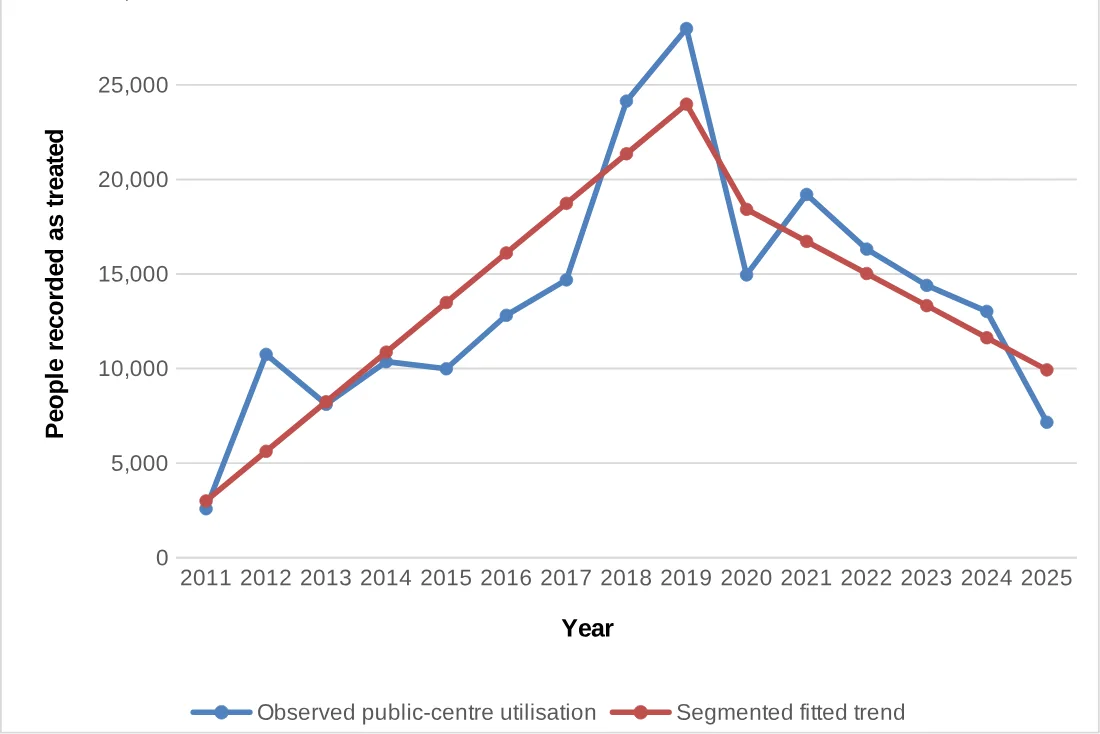
Across 2011-2025, DNC public treatment-centre utilisation averaged 13,765 records annually (median = 13,024; SD = 6,468; CV = 47.0%), rising from 2,585 in 2011 to 27,983 in 2019 before falling to 7,159 in 2025 (DNC, 2026). The pre-2020 fitted slope was +2,623 records/year (HAC SE = 517, 95% CI [1,486, 3,760], p < .001). Recalled service activity is reflected in these estimates; pandemic effect and prevalence of DUD are not described, but are estimated to be present in most settings.
Figure 2 shows that there was a strong acceleration in the observed utilisation through 2019, and a fitted trajectory which turned around after 2020. The reduction in reported activity in public centres over time is a call for service capacity and access investigation, but may also be indicative of referral and reporting reducing the figure for population DUD burden.
5.2. Enforcement caseload remained high despite substantial annual variation
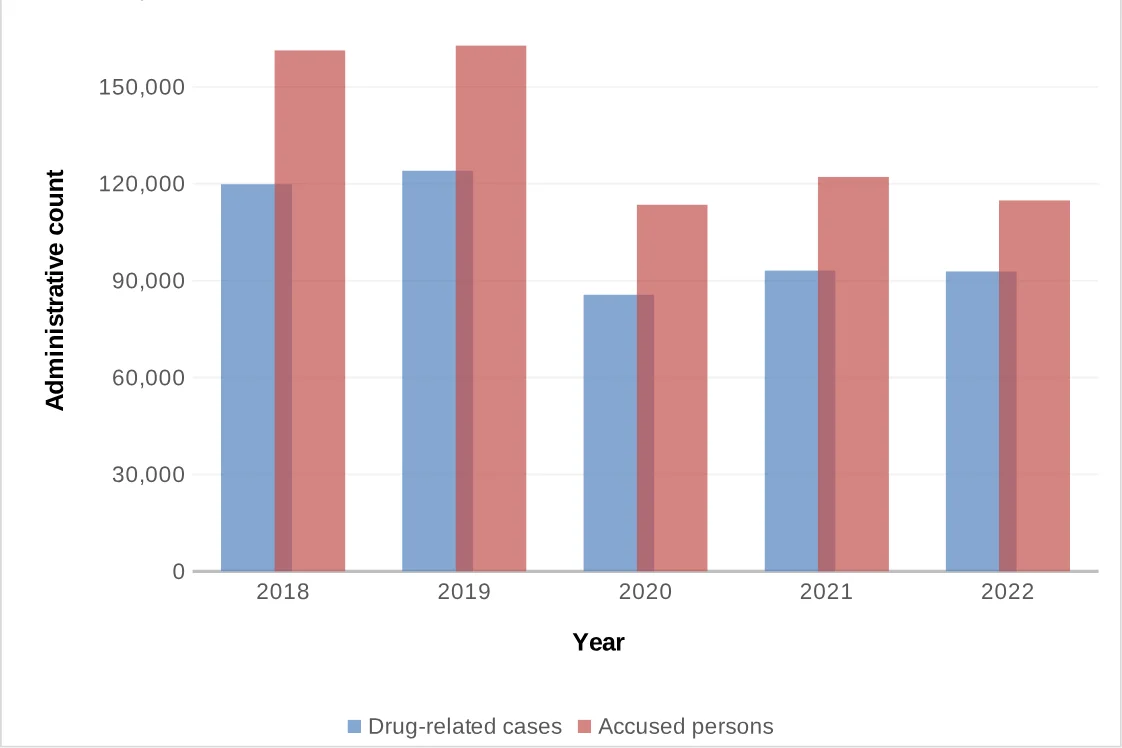
The national enforcement series averaged 103,159 drug-related cases per year (SD = 17,511; CV = 17.0%) and 134,950 accused persons (SD = 24,992; CV = 18.5%) during 2018-2022 (DNC, 2023). For the 2018-2021 period, BFIU also reproduces the DNC values and this helps to have confidence in the transcription for these years. Changes in workload reported for the series cannot be separated into the effects of changing offending patterns and the effects of changing detection, enforcement intensity, charging practice and/or operational disruption.
Rather than a collapse in the number of cases being tackled by the justice sector, the 2020 dip led to a recovery of a still significant justice workload, as shown in figure 3. Indeed it cannot be considered as a prevalence curve since recorded cases are a result of both the underlying conduct and enforcement practice.
5.3. Exploratory association between treatment utilisation and enforcement activity
Across the five overlapping years, treatment utilisation and drug-case counts moved together (r = .968, 95% CI [.586, .998], p = .007, n = 5). Leave-one-year-out correlations remained high (.953-.985), so the pattern was not created by one year. The p value is therefore descriptive. The finding only demonstrates why parallel administrative counts cannot replace linked person-level data on referral, treatment exposure, and later justice outcomes.
In Figure 4 the ecological limitation will be made explicit. Leave-one-year estimates imply on-going descriptive co-movement, not causality. Future assessments will thus need person-level linkage with privacy protection and explicit denominators of the eligible-population rather than-linked parallel aggregate counts.
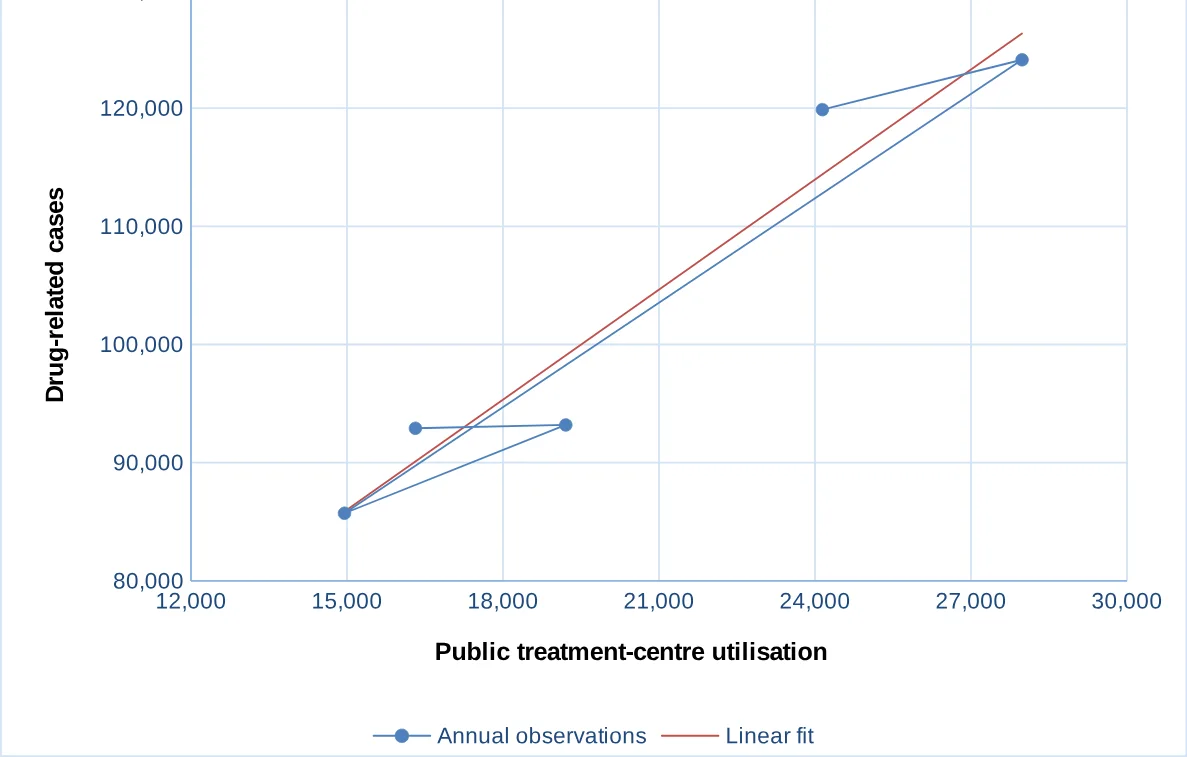
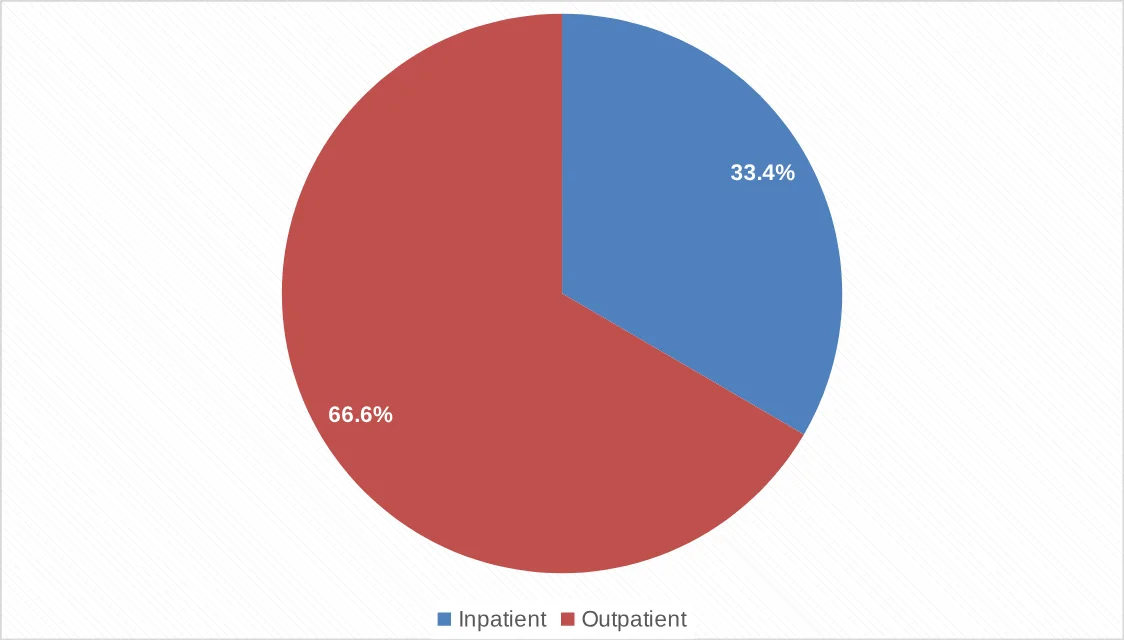
Figure 5 illustrates the distribution of the public treatment centre activity between inpatient and outpatient in 2024. This chart shouldn't be used to measure the quality of treatment or a need for treatment, only to estimate the possible need for more assessment, counselling, medication or follow up.
5.4. The 2024 public-centre profile highlights service configuration and equity-data limitations
In 2024, the detailed DNC data showed that there were 13,024 contacts with people for public-centre treatment, including 4,118 males and 234 people in combined female and child for inpatient treatment and 8,198 males and 474 people in combined female and child in outpatient treatment (DNC, 2026). The percentages are not prevalence estimates. If job-related fields don't differentiate women from the younger people, a justice to treatment system can not evaluate whether there's fairly accessible.
5.5. Integrated statistical interpretation
There are three bounded conclusions reached by the results of the statistics content. Recorded public treatment activity has varied markedly and demonstrates a step change in its trajectory in the period since 2020, though the level difference across the one year is not precise. There is thus a central evidence gap that is followed by outcomes that relate directly to the governance pillar below: offence type, eligible to diversion, clinical evaluation, treatment and release, reintegration, and return-to-justice contact status(Chandler et al., 2009).
Table 4. Table 4:Statistical Summary of Administrative Series
| Analysis | Estimate | Uncertainty / variability | Interpretation | Limit |
|---|---|---|---|---|
| Treatment utilisation, 2011-2025 | Mean 13,765; median 13,024; peak 27,983 (2019) | SD 6,468; CV 47.0% | High variation in recorded public-centre activity | Not prevalence or treatment effectiveness |
| Pre-2020 treatment slope | +2,623/year | HAC SE 517; 95% CI [1,486, 3,760]; p < .001 | Strong upward pre-2020 trend | Annual aggregate series |
| 2020 estimated level shift | -8,185 | HAC SE 4,439; 95% CI [-17,956, 1,585]; p = .092 | Large negative point estimate, but interval includes no level change | Not a causal COVID estimate |
| Post-2020 treatment slope | -1,698/year | HAC SE 662; 95% CI [-3,156, -240]; p = .026; model R² = .794 | Downward fitted post-2020 trajectory | Short post-period; administrative reporting |
| Drug cases, 2018-2022 | Mean 103,159/year | SD 17,511; CV 17.0% | Persistently high justice workload | Sensitive to enforcement practice |
| Accused persons, 2018-2022 | Mean 134,950/year | SD 24,992; CV 18.5% | Large annual case-processing burden | Not individual recidivism |
| Treatment-case correlation, 2018-2022 | r = .968 | 95% CI [.586, .998]; p = .007; n = 5; leave-one-year r = .953-.985 | Strong ecological co-movement only | Very small n; shared shocks, secular trends and ecological bias; no causal inference |
Note. All estimates are author calculations from DNC administrative series and are interpreted as system-level indicators.
6. An Evidence-Based Policy Framework for Bangladesh
6.1. Pillar 1 - proportionality, statutory triage and diversion
The first pillar distinguishes between the severity of the offence and clinical need. Exiting probation authority gives a certain judicial dimension; it is needed under a modern pathway to have a system of screening, clinical referral, safeguard and review, from which options of acting earlier, in a legally permissible manner, can be discussed (Judiciary of Bangladesh, 2024; Probation of Offenders Ordinance, 1960). With the guidance of WHO/UNODC (WHO & UNODC, 2018), conditions shall remain proportionate and modifiable if relapse is due to clinical setback - not evasion.
6.2. Pillar 2 - independent clinical assessment and voluntary, ethical treatment
Use of brief screens is permitted by the justice system, with diagnosis and treatment planning remaining clinically independent. Based on clinical judgment, not court or provider incentives, clinicians should identify the lowest level needed and appropriate treatment. Records related to treatment should NOT be part of intelligence systems, and intelligence agencies should only be given information necessary for running the legal pathway (WHO & UNODC, 2020).
6.3. Pillar 3 - a stepped-care treatment continuum rather than a residential default
A residential default model in Bangladesh should be eliminated and a stepped care matching with severity should be introduced. WHO's mhGAP constitutes a foundation for supervised task sharing in the absence of specialists, and for specialists to concentrate on the more serious issue of comorbidity and acute risk (WHO, 2022, 2023).
6.4. Pillar 4 - prison health equivalence and continuity of care
Evidence-based treatment does not belong at the outskirts of care and not for an individual who is not diverted. All patients should be assessed for DUD, withdrawal, overdose history, infectious disease, mental-health risk upon entering prison and treated at or above community level. There is strong evidence in support of creating pathways to continuity of care for treatments across periods of incarceration and release, especially for opioid agonist treatment (Hedrich et al., 2012; Macdonald et al., 2024)
6.5. Pillar 5 - rehabilitation and social reintegration as core public-safety functions
Release cannot mean going back to a life of homelessness, family violence, stigma, and unemployment. Reintegration outcomes should thus involve maintaining housing, employment / education, family functioning and treatment retention in addition to drug use and justice outcomes; peer navigation and anti-stigma efforts may also complement formal case management.
6.6. Pillar 6 - gender-responsive, youth-sensitive and trauma-informed pathways
Equality can be reproduced through uniform pathways. A limitation for equity monitoring is the combination of women and children into a single reporting category for DNC's 2024 public-centre table. Automated alternatives to custody should be special focus in cases eligible for non-custodial sentencing, as per the Bangkok Rules (UN General Assembly, 2015).
6.7. Pillar 7 - governance, accreditation, financing and accountable data
There needs to be mutual accountability between Home Affairs, Health, DNC, prisons, police, prosecution, courts, social service, legal aid and certified providers. Many unnecessary admissions to residential facilities can be avoided by removing incentives in public purchasing. As can be demonstrated by the administrative findings in Section 5, the reason why is that system activity is measured but cross-system outcomes are not connected.
| GOAL: PUBLIC SAFETY THROUGH RECOVERY, PROPORTIONALITY AND LOWER REPEAT HARM | |
|---|---|
| PILLAR 1: Proportionality + diversion | |
| PILLAR 2: Independent clinical assessment | |
| PILLAR 3: Stepped-care treatment continuum | |
| PILLAR 4: Prison health equivalence + continuity | |
| PILLAR 5: Rehabilitation + social reintegration | |
| PILLAR 6: Gender/youth/trauma-responsive pathways | |
| PILLAR 7: Governance + accreditation + financing + accountable data |
Figure 6:Seven-Pillar Evidence-Based Policy Framework for Bangladesh
The pillars are mutually dependent: diversion without treatment capacity, or treatment without reintegration and governance, is unlikely to produce durable public-safety effects (Hedrich et al., 2012; Macdonald et al., 2024); World Health Organization & United Nations Office on Drugs and Crime, 2018, 2020).
Figure 6 summarizes the paper's principal policy contribution. For example, expanding diversion without accredited treatment capacity would simply move pressure from courts to weak services, while treatment without housing, employment, and follow-up support would leave major relapse mechanisms unchanged(Csete et al., 2016).
| POLICE / FIRST CONTACT | -> | PROSECUTOR / COURT | -> | CLINICAL ASSESSMENT |
|---|---|---|---|---|
| Minor/non-violent + positive screen | -> | Diversion eligibility review | -> | Independent DUD diagnosis + needs/risk plan |
| Serious trafficking/violence/high harm | -> | Conventional prosecution | -> | Prison health pathway if convicted |
| DIVERTED CASE | -> | STEPPED TREATMENT | -> | RECOVERY CASE MANAGEMENT |
| Community monitoring | -> | Housing + family + work + health | -> | REINTEGRATION / REDUCED REPEAT CONTACT |
Figure7 :Bangladesh Justice-to-Recovery Continuum With Differentiated Legal and Clinical Pathways
Serious high-harm offences remain prosecutable (Government of Bangladesh, 2018, 2026; Probation of Offenders Ordinance, 1960; WHO ,2020 & UNODC, 2018).
Figure 7 is the core decision architecture of the proposed reform. This separation preserves conventional prosecution for serious harm while creating a proportionate route to care for eligible lower-level cases.
Table 5:Proposed diversion eligibility logic and safeguards
| Decision dimension | Presumptive diversion-compatible | Presumptive conventional prosecution | Safeguard |
|---|---|---|---|
| Offence | Minor possession/use-related or low-level non-violent offence | Serious trafficking, organized supply, violence, coercion, corruption or exploitation | Written reasons for eligibility/exclusion |
| Clinical link | Screen suggests DUD and assessment finds material relationship to offending | No DUD or conduct unrelated to clinical need | Diagnosis by independent clinician, not police |
| Risk | Low-to-moderate public-safety risk manageable in community | High risk of serious violence or substantial organized-market harm | Structured risk review and periodic judicial oversight |
| Consent | Person receives legal advice and accepts proportionate treatment/supervision | No meaningful consent or clinically inappropriate treatment | Ability to challenge conditions; no forced residential placement simply for non-compliance |
| Ability to pay | Irrelevant to eligibility | Never a reason for exclusion | Publicly funded or contracted treatment slots |
| Relapse/non-adherence | Triggers reassessment, stepped-up care or revised plan | New serious offence or deliberate repeated refusal after supportive adjustments | Relapse alone should not automatically trigger incarceration |
| Equity | Same eligibility standard for gender, income and geography | N/A | Monitor offer/acceptance/completion by sex, age, district and socioeconomic indicators |
Note. Proposed policy criteria derived from proportionality, WHO/UNODC alternatives-to-conviction guidance and implementation safeguards discussed in the text.
7. Implementation Roadmap: From Pilot to National Scale
7.1. Phase I: legal design and readiness (0-12 months)
The emphasis in the first year should be on rules, capacity and safeguards. Trainings should be customized for police, prosecutors, judges, prison staff, clinicians, social workers and Legal-aid lawyers, resulting in some shared content on DUD, stigma, confidentiality, and purpose of diversion.
7.2. Phase II: controlled pilots (12-36 months)
Bangladesh should trial the pathway in a handful of the jurisdictions in metros and districts where there are sufficient cases and services ready. For prospective evaluations, outcomes need to be measured at 3, 6 and 12 months, and should assess treatment initiation/retention, new arrests, number of custody days, health emergencies, housing, employment/education, family functioning and quality of life, when possible, with a defined comparison group.
These "mired in failure" actions: disproportionate referral of poor or not-to-be-seen street populations, lower access for women (lack of appropriate services), unnecessary residential placement, punitive testing, breaches of confidentiality, and provider profiteering, should be deliberately tested by pilots. When net-widening, coercive treatment, material inequity, unsafe care, and/or misuse of clinical information are demonstrated in monitoring, operation should scale back or be reconceptualized.
7.3. Phase III: scale-up and institutionalization (36-60 months)
The pilot thresholds should be reached before the national expansion. Five-year goal: Not all drug cases are to be diverted, but evidence-based triage will be a routine for eligible cases as well as ensuring the prevention of clinically appropriate orders being lost because no treatment slot is available.
7.4. A national performance dashboard
A small dashboard is an effective way of avoiding symbolic reform. Custody days and supervision completion shall be included in Justice measures in addition to new arrests/convictions. Group results should be made available on a yearly basis as a minimum.
Table 6:Proposed national justice-to-recovery performance dashboard
| Domain | Core indicators | Suggested reporting interval | Why it matters |
|---|---|---|---|
| Access | % eligible cases screened; % assessed; % offered/accepting diversion; median days to treatment | Quarterly | Shows whether legal reform produces real treatment access |
| Treatment | Retention at 30/90/180 days; step-down/step-up; medication continuity; patient-reported functioning | Quarterly/6-month | Measures clinical continuity rather than simple programme completion |
| Justice | New arrests/convictions; custody days; serious reoffending; supervision completion | 6/12 months | Tests public-safety effect and proportionality |
| Reintegration | Stable housing; employment/education; family/social support; identity/social-protection linkage | 3/6/12 months | Captures recovery conditions linked to relapse and desistance |
| Safety | Deaths; overdose/severe intoxication; self-harm; serious treatment-facility incidents | Immediate + annual | Detects high-consequence failures |
| Equity | Diversion and outcomes by sex, age, district, income proxy, disability and rural/urban residence | 6/12 months | Identifies unequal access or hidden discrimination |
| Quality/rights | Complaints; substantiated abuse; unplanned discharge; confidentiality breaches; accreditation findings | Quarterly/annual | Prevents treatment from becoming coercive or unsafe custody by another name |
Note. Author-proposed implementation indicators. Definitions should be standardized before pilot launch and published with disaggregated equity reporting.
8. Discussion
All the evidence points to an approach of differentiation and not to general decriminalisation or increased punishment. This imbalance becomes more significant with the introduction of an amendment in the Act in 2026, which enhances the powers of enforcement and adjudication. Administrative data also include a capacity warning: public treatment activity has shrunk from its peak in 2019, with enforcement remaining high in 2022, making alternatives implemented without extension of treatment capacity that could result in waiting lists, inappropriate residential placement, or nominal referrals(Hasan, 2024).
This segmented model is more informative than simply comparing before and after, and is still a relatively short series over a period of one year. Thus, confidence intervals are more useful than significance labels. In future, a method of evaluating justice cases should correlate with eligible justice cases' exposure to treatment and subsequent outcomes, involve a prearranged comparison approach, and safeguard clinical data against evidentiary reuse.
The most robust evidence is related to particular mechanisms, not a generic programme. Diversion also requires implementing part (Blais et al., 2022). While not quantifying national policy impacts, the anti-drug drive in Bangladesh resulted in the documentation of displacement through ethnographic research in the 2018 harm-reduction outreach and riskier injecting practices (Khan et al., 2021). These results help to address stepped care, harm reduction continuity, and monitoring for unintended consequences.
The risk of implementation can result in an absence of intended benefits. There is a scarcity of specialist capacity and inconsistencies in the quality of private providers in Bangladesh (DNC, 2026; WHO, 2022). This can take the form of coercion, either when there is no alternative to residential care or when a person is incarcerated as a result of their own relapse. Further risks are overpricing of services, corrupt providers' selection of referral provider, inappropriate referral according to gender, stigma and confidentiality violations. Public funds, open-source eligibility, legal counsel, outside audits, accreditation, grievance procedures, privacy walls, and penalties for noncompliance are thus fundamental protections.
Another problem of implementation is the issue of the relationship between therapy flexibility and legal security. The proposed framework therefore makes a distinction between clinical relapse and new high harm offending, and enables a step up in interventions before the triggering of punitive interventions as well as maintaining conventional prosecutions where public safety is breached. This dichotomy should be prospectively tested since the legitimacy of communities, justice officials, patients, and treatment professionals will stimulate or prevent the consistent utilization of the diversion pathway.
The following are the limitations in this study. This evidence synthesis is source-counted and structured but does not presume to be comprehensive or a registered systematic review and no effects were pooled. A legal possibility, and not whether a strategy has enough equity or is effective, is evident in published probation outcomes. Public datasets, to date, have failed to connect offence seriousness to DUD diagnosis, treatment, reintegration, recurrence of justice contact. These factors set the minimum data architecture required for a credible pilot evaluation.
Future assessments should therefore develop an advance registration of eligibility criteria and primary outcomes, develop and provide a data dictionary prior to enrolment and report both health and justice outcomes with equity stratification. This would take the current policy approach and turn it into an action program which could be tested.
9. Conclusion & Future Work
The development of a coordinated criminal justice system with the involvement of public safety, treatment, rehabilitation and social reintegration can improve the drug policy responses in Bangladesh. The results indicate that the enforcement and treatment systems are now functioning at low levels of outcomes integration and that capacity in the treatment system alone does not necessarily easily integrate with justice referrals unless there is more robust inter-institutional coordination.
The proposed seven-pillar framework: proportional diversion, independent assessment, evidence-based treatment, prison-health continuity, social reintegration, differentiated pathways and accountable governance, offers a solution to strike a balance between prevention and responses of enforcement and recovery- oriented nature.
Future research needs to advance evidence to longitudinally, at the individual level, connect justice contact with treatment engagement, treatment outcomes, and reoffending. The effectiveness of diversion pilots, gender-responsive services, youth pathways and integrated justice–health monitoring systems will need to be evaluated to inform future policy development and conceptual understanding.
Ethics and Data Availability
Ethics approval: Not required. Public sources of legal, policy, scholarly, and administrative units from which data was obtained were used in the study, and no identifiable participant data was used.
Data availability: No dataset at the individual level was used, whilst the aggregate data of the DNC and BFIU series for the statistical analysis is available publicly from the sources cited in the reference list.
Declaration of Generative AI in the Writing Process
ChatGPT was used to assist with language correction, proofreading, and targeted organization of this manuscript. The authors retain responsibility for reviewing the assisted revisions and for the accuracy and integrity of the final manuscript.
References
- Beaudry, G., Yu, R., Perry, A. E., & Fazel, S. (2021). Effectiveness of psychological interventions in prison to reduce recidivism: A systematic review and meta-analysis of randomised controlled trials. The Lancet Psychiatry, 8(9), 759–773. https://doi.org/10.1016/S2215-0366(21)00170-X
- Blais, E., Brisson, J., Gagnon, F., & Lemay, S.-A. (2022). Diverting people who use drugs from the criminal justice system: A systematic review of police-based diversion measures. International Journal of Drug Policy, 105, 103697. https://doi.org/10.1016/j.drugpo.2022.103697
- Chandler, R. K., Fletcher, B. W., & Volkow, N. D. (2009). Treating Drug Abuse and Addiction in the Criminal Justice System: Improving Public Health and Safety. JAMA, 301(2), 183. https://doi.org/10.1001/jama.2008.976
- Csete, J., Kamarulzaman, A., Kazatchkine, M., Altice, F., Balicki, M., Buxton, J., Cepeda, J., Comfort, M., Goosby, E., Goulão, J., Hart, C., Kerr, T., Lajous, A. M., Lewis, S., Martin, N., Mejía, D., Camacho, A., Mathieson, D., Obot, I., … Beyrer, C. (2016). Public health and international drug policy. The Lancet, 387(10026), 1427–1480. https://doi.org/10.1016/S0140-6736(16)00619-X
- De Andrade, D., Ritchie, J., Rowlands, M., Mann, E., & Hides, L. (2018). Substance Use and Recidivism Outcomes for Prison-Based Drug and Alcohol Interventions. Epidemiologic Reviews, 40(1), 121–133. https://doi.org/10.1093/epirev/mxy004
- Galassi, A., Mpofu, E., & Athanasou, J. (2015). Therapeutic Community Treatment of an Inmate Population with Substance Use Disorders: Post-Release Trends in Re-Arrest, Re-Incarceration, and Drug Misuse Relapse. International Journal of Environmental Research and Public Health, 12(6), 7059–7072. https://doi.org/10.3390/ijerph120607059
- Hasan, M. (2024). New Psychoactive Substances in Bangladesh: The Urgent Need for Evidence-based Policy and Prevention Measures. Emerging Trends in Drugs, Addictions, and Health, 4, 100096. https://doi.org/10.1016/j.etdah.2023.100096
- Hawlader, M. D. H., Nabi, M. H., Hussain, A., Al Amin, S. U., Zaman, S., & Masud, I. (2022). Legal and social consequences of substance use: Results from a nationwide study in Bangladesh. Journal of Ethnicity in Substance Abuse, 21(4), 1327–1337. https://doi.org/10.1080/15332640.2020.1846008
- Hedrich, D., Alves, P., Farrell, M., Stöver, H., Møller, L., & Mayet, S. (2012). The effectiveness of opioid maintenance treatment in prison settings: A systematic review. Addiction, 107(3), 501–517. https://doi.org/10.1111/j.1360-0443.2011.03676.x
- Khan, S. I., Irfan, S. D., & Khan, M. N. M. (2021). “I held on to the police’s leg for mercy”: Experiences of adversity, risk and harm among people who inject drugs during an anti-drug drive in Dhaka, Bangladesh. International Journal of Drug Policy, 92, 103299. https://doi.org/10.1016/j.drugpo.2021.103299
- Livingston, J. D., Milne, T., Fang, M. L., & Amari, E. (2012). The effectiveness of interventions for reducing stigma related to substance use disorders: A systematic review. Addiction, 107(1), 39–50. https://doi.org/10.1111/j.1360-0443.2011.03601.x
- Lopez Bernal, J., Cummins, S., & Gasparrini, A. (2016). Interrupted time series regression for the evaluation of public health interventions: A tutorial. International Journal of Epidemiology, dyw098. https://doi.org/10.1093/ije/dyw098
- Macdonald, C., Macpherson, G., Leppan, O., Tran, L. T., Cunningham, E. B., Hajarizadeh, B., Grebely, J., Farrell, M., Altice, F. L., & Degenhardt, L. (2024). Interventions to reduce harms related to drug use among people who experience incarceration: Systematic review and meta-analysis. The Lancet Public Health, 9(9), e684–e699. https://doi.org/10.1016/S2468-2667(24)00160-9
- Maehira, Y., Chowdhury, E., Reza, M., Drahozal, R., Gayen, T., Masud, I., Afrin, S., Takamura, N., & Azim, T. (2013). Factors associated with relapse into drug use among male and female attendees of a three-month drug detoxification–rehabilitation programme in Dhaka, Bangladesh: A prospective cohort study. Harm Reduction Journal, 10(1), 14. https://doi.org/10.1186/1477-7517-10-14
- Nabi, M. H., Masud, I., Humaira, T., Hussain, A., Naz, F., Chakraborty, P. A., & Hawlader, M. D. H. (2022). Reasons of relapse and pattern of drug use among the substance users in Bangladesh: A nationwide study. Journal of Ethnicity in Substance Abuse, 21(3), 876–885. https://doi.org/10.1080/15332640.2020.1801549
- Negi, S., Chatterjee, D., Tripathy, S., Udhaya, E., Kumar, D., & Mehta, V. (2026). Rehabilitation and Re-entry Programmes for Justice-Involved Individuals and Their Effectiveness in Social Reintegration: A Systematic Review. International Journal of Offender Therapy and Comparative Criminology, 70(9), 1037–1057. https://doi.org/10.1177/0306624X251409814
- Newey, W. K., & West, K. D. (1987). A Simple, Positive Semi-Definite, Heteroskedasticity and Autocorrelation Consistent Covariance Matrix. Econometrica, 55(3), 703. https://doi.org/10.2307/1913610
- Santo, T., Clark, B., Hickman, M., Grebely, J., Campbell, G., Sordo, L., Chen, A., Tran, L. T., Bharat, C., Padmanathan, P., Cousins, G., Dupouy, J., Kelty, E., Muga, R., Nosyk, B., Min, J., Pavarin, R., Farrell, M., & Degenhardt, L. (2021). Association of Opioid Agonist Treatment With All-Cause Mortality and Specific Causes of Death Among People With Opioid Dependence: A Systematic Review and Meta-analysis. JAMA Psychiatry, 78(9), 979. https://doi.org/10.1001/jamapsychiatry.2021.0976
- Van Boekel, L. C., Brouwers, E. P. M., Van Weeghel, J., & Garretsen, H. F. L. (2013). Stigma among health professionals towards patients with substance use disorders and its consequences for healthcare delivery: Systematic review. Drug and Alcohol Dependence, 131(1–2), 23–35. https://doi.org/10.1016/j.drugalcdep.2013.02.018 Department of Narcotics Control. (2026, February 16). Treatment and rehabilitation wing activity statistics. Government of the People's Republic of Bangladesh. https://dnc.gov.bd/site/page/cf927c87-d9ea-4ce7-8776-436fb5a878a1/ Government of Bangladesh. (2026). Narcotics Control (Amendment) Act, 2026 (Act No. 101 of 2026). Bangladesh Gazette, Extraordinary. Government of the People's Republic of Bangladesh. Judiciary of Bangladesh. (2024). T.R. (Jibannagar G.R.) Case No. 278/2024: Probation order. Bangladesh Judiciary. https://decision.bdcourts.gov.bd/ *Probation of Offenders Ordinance, 1960 (Ordinance No. XLV of 1960). Government of the People's Republic of Bangladesh. United Nations General Assembly. (2015). United Nations Standard Minimum Rules for the Treatment of Prisoners (the Nelson Mandela Rules) (A/RES/70/175). United Nations. https://www.unodc.org/documents/justice-and-prison-reform/Nelson_Mandela_Rules-E.pdf. United Nations Office on Drugs and Crime. (2026). World drug report 2026. United Nations Office on Drugs and Crime. https://data.unodc.org/wdr2026 World Health Organization. (2022). mhGAP intervention guide for mental, neurological and substance use disorders in non-specialized health settings: Bangladesh version 2021. World Health Organization. https://www.who.int/publications World Health Organization. (2023). Mental Health Gap Action Programme (mhGAP) guideline for mental, neurological and substance use disorders (3rd ed.). World Health Organization. https://www.who.int/publications/i/item/9789240084278 World Health Organization. (2024, March 20). Scaling up mental health care and reducing stigma: Bangladesh primary-level mental health services. World Health Organization. https://www.who.int World Health Organization & United Nations Office on Drugs and Crime. (2020). International standards for the treatment of drug use disorders: Revised edition incorporating results of field-testing. World Health Organization. https://www.who.int/publications/i/item/international-standards-for-the-treatment-of-drug-use-disorders Department of Narcotics Control. (2021). Rules for the establishment and operation of private drug addiction treatment centres, drug addiction rehabilitation centres and drug addiction counselling centres, 2021 (S.R.O. No. 348-Law/2021, 16 November 2021). Government of the People's Republic of Bangladesh. Department of Narcotics Control. (2023). Annual drug report of Bangladesh 2022. Government of the People's Republic of Bangladesh. https://dnc.gov.bd/sites/default/files/files/dnc.portal.gov.bd/annual_reports/37a9ace4_624d_4650_80ad_9f4041db6b2b/2023-05-10-07-21-ca4e1390829fc7f031c5df30419878f6.pdf Department of Narcotics Control. (2025). Government grant policy for private drug addiction treatment and rehabilitation centres, 2025. Government of the People's Republic of Bangladesh. Government of Bangladesh. (2018). Narcotics Control Act, 2018 (Act No. 63 of 2018), enacted 14 November 2018 and brought into force 27 December 2018. Government of the People's Republic of Bangladesh. World Health Organization, & United Nations Office on Drugs and Crime. (2018). Treatment and care for people with drug use disorders in contact with the criminal justice system: Alternatives to conviction or punishment.https://www.who.int/publications/i/item/treatment-and-care-for-people-with-drug-use-disorders-in-contact-with-the-criminal-justice-system-alternatives-to-conviction-or-punishment World Health Organization. (2020, June 1). Compulsory drug detention and rehabilitation centres: Joint statement.https://www.who.int/news/item/01-06-2020-compulsory-drug-detention-and-rehabilitation-centres United Nations General Assembly. (2010). United Nations Rules for the Treatment of Women Prisoners and Non-custodial Measures for Women Offenders (the Bangkok Rules), A/RES/65/229. United Nations.
CITE THIS ARTICLE
Rahman, M. B. (2026). Reforming Criminal Justice Responses to Drug Addiction in Bangladesh: An Evidence-Based Policy Framework for Treatment, Rehabilitation, and Social Reintegration. https://www.bazlurrahman.com/article/0114fe69-1bae-4483-a33d-2861c9b0d49b
M. B. Rahman, “Reforming Criminal Justice Responses to Drug Addiction in Bangladesh: An Evidence-Based Policy Framework for Treatment, Rehabilitation, and Social Reintegration,” 2026. [Online]. Available: https://www.bazlurrahman.com/article/0114fe69-1bae-4483-a33d-2861c9b0d49b
Rahman, M. B. (2026) ‘Reforming Criminal Justice Responses to Drug Addiction in Bangladesh: An Evidence-Based Policy Framework for Treatment, Rehabilitation, and Social Reintegration’. Available at: https://www.bazlurrahman.com/article/0114fe69-1bae-4483-a33d-2861c9b0d49b
Rahman, Md. Bazlur. “Reforming Criminal Justice Responses to Drug Addiction in Bangladesh: An Evidence-Based Policy Framework for Treatment, Rehabilitation, and Social Reintegration.” 2026, https://www.bazlurrahman.com/article/0114fe69-1bae-4483-a33d-2861c9b0d49b.
Md. Bazlur Rahman. “Reforming Criminal Justice Responses to Drug Addiction in Bangladesh: An Evidence-Based Policy Framework for Treatment, Rehabilitation, and Social Reintegration.” (2026). https://www.bazlurrahman.com/article/0114fe69-1bae-4483-a33d-2861c9b0d49b.
Rahman MB. Reforming Criminal Justice Responses to Drug Addiction in Bangladesh: An Evidence-Based Policy Framework for Treatment, Rehabilitation, and Social Reintegration. 2026. https://www.bazlurrahman.com/article/0114fe69-1bae-4483-a33d-2861c9b0d49b
@misc{article_0114fe691bae4483a33d2861c9b0d49b,
  title = {Reforming Criminal Justice Responses to Drug Addiction in Bangladesh: An Evidence-Based Policy Framework for Treatment, Rehabilitation, and Social Reintegration},
  author = {Md. Bazlur Rahman},
  year = {2026},
  url = {https://www.bazlurrahman.com/article/0114fe69-1bae-4483-a33d-2861c9b0d49b},
}
TY - GEN AU - Md. Bazlur Rahman TI - Reforming Criminal Justice Responses to Drug Addiction in Bangladesh: An Evidence-Based Policy Framework for Treatment, Rehabilitation, and Social Reintegration PY - 2026 UR - https://www.bazlurrahman.com/article/0114fe69-1bae-4483-a33d-2861c9b0d49b ER -