Narcotics crime poses continuous threats to the health, security and stability of the state of developing countries because of institutional frailty, lack of resources, and divided governance, the effective implementation of the rule is a challenge in most criminal cases. This paper looks at the importance of governance capacity in the formation of the institutional responses towards narcotics crime using Bangladesh as the main case study and Philippines and Nigeria as point of comparison. It also seeks to measure administrative professionalism, coercion ability, geographical coverage, institutional integrity and coordination between agencies and find out political, social and economic variables that moderate policy results. The mixed-methods research design was used, which involved semi-structured interviews with policymakers, law enforcement agencies and NGOs and quantitative analysis of governance indicators, drug seizure statistics and operational performance. The results have shown that Bangladesh is moderate in its ability to govern in all aspects leading to partial success in the drug control activities, and the political, social, and economic factors also affect the success. Comparative analysis reveals that better governance as witnessed in the Philippines is related to better operational performance whilst poor governance is related to poor enforcement as witnessed in Nigeria. The research has theoretical implications in connecting the multidimensional capacity to governance with operational outcome to fill gaps in the previous studies that had been mainly concerned with the content of the policy. It also gives practical suggestions to the policy makers that can be implemented such as; enhancing inter-agency coordination, better resource allocation, greater transparency and accountability to realize more effective and sustainable narcotics control in the developing states.
Research ArticleCriminology and Public AdministrationIn progress
Governance Capacity and Drug Control: Institutional Responses to Narcotics Crime in Developing States
Correspondence: mdbazlurrahman186@gmail.com
Abstract
Keywords Governance capacitynarcotics controlinstitutional effectivenessBangladeshinter-agency coordinationdeveloping states
1. Introduction
The international narcotics trafficking is a dynamic and enduring problem of the population health, security, and state sovereignty. Drug trafficking is a universal problem but its manifestation and ability of states to counter it is broadly different. The third world countries tend to be placed at the heart of producing, trafficking, or consuming narcotic drugs, and thus they are especially threatened by the destabilizing economic, social, and political effects of narcotics networks (Nabila Oktavia Lestari, 2025). Such states are often characterized by poor institutional frameworks, insufficient resources and divided systems of governance, which hamper the adoption and enforcement of drug control policies (Fazey, 2003). It is thus essential to understand the connection between the governance capacity and drug control effectiveness and implement the intervention that is realistic, sustainable, and context-sensitive (Snapp et al., 2019).
Narcotics crime is enhanced by weak governance and institutional inefficiencies. The process of law enforcement may be hampered by corruption, political sabotage and lack of resources, which undermine the efforts of the judiciary and enable organized crime groups to take advantage of systemic loopholes. The traditional policy responses, which frequently are modelled after the frameworks of the developed countries or those, which are propagated by international treaties, can fail when the administrative, coercive, and legal institutions are not up to the task to execute them (Flores-Macías, 2018; Gledhill & Bright, 2019). This is because a purely enforcement-focused approach could create unintentionally increased power on the side of criminal rings by not recognizing the underlying vulnerabilities that these rings take advantage of. Therefore, a change in perspective where policy content is considered crucial in drug control and institutional capacity is required to ensure effective application of the polices (Nabila Oktavia Lestari, 2025).
In this research, the term governance capacity will mean the capacity of a state to develop, adopt, and execute policies at administrative, territorial, and social levels in an authoritative way. It encompasses administrative ability that is seen in proper resource management and a professional bureaucracy, coercive ability that is seen in effective police and judicial systems, territoriality which implies the ability to exercise power outside big cities, and institutional integrity which is seen in the ability to withstand corruption and political capture (Amon et al., 2014; Pambudi & Redi, 2024). All these dimensions are directly challenged by the narcotics cartels who rival with the state to dominate the territory, breach the law enforcement and political institutions and take advantage of the weak points in the judicial and logistical systems. Thus, the effectiveness or ineffectiveness of counter-narcotics is a strong indicator of the effectiveness and strength of the overall governance (Lessing & Willis, 2019).
This research contributes to theoretical and practical knowledge by defining institutional capacity as one of the essential determinants of drug control efficacy. It enhances a governance-based analytical approach that incorporates criminology, public health, and security research findings. Being an empirical inquiry, it not only offers the comparative evidence of the role of various dimensions of governance capacity in policy outcomes, but also offers some practical advice to policymakers wishing to design more sustainable, context-sensitive, and effective strategies of drug control in developing states.
1.1 Research Gaps
Although there is a lot of research on the political economy of drug dealing and sociology of organized crime, there are still two gaps. To begin with, the literature on drug policy effectiveness frequently lacks unification, as the perspectives of criminology, international security, or even on the health of the population are usually considered independently of each other without developing a systemic approach to governance. Second, although there is a wealth of case-based studies on particular nations, or criminal groups, there is no generalized, but subtle, model that shows a connection between particular aspects of institutional capacity to quantifiable drug control outcomes like rates of interdiction, market disarray, or decreases in criminal violence. This research paper fills these gaps by the provision of a combined governance capacity framework to examine institutional reactions in developing countries.
1.2 Research Objectives
This study aims to achieve the following objectives:
To determine the capacity of governance in drug control.
To investigate institutional measures that are used to prevent and combat narcotics crime.
To establish the major implementation issues and suggest the evidence-based policy recommendations.
1.3 Research Questions
To achieve these goals, the following research questions will be answered in this study:
How does the governance capability affect the success of drug control measures?
What institutional mechanisms are the best in prevention and control of narcotics crime?
What effect do the political, economic, and social variables have on institutional responses in the developing states?
2. Literature Review
The governance and drug control literature have indicated that the importance of institutional capacity in the policy outcome of the developing states is critical. According to the previous research, the inability of the states to work out the measures of controlling drugs and counteracting their trafficking plays a role in the continuity of the narcotics trafficking, corruption, and social unrest due to weak governance. This review summarizes the studies within four main fields governance capacity and public policy, drug control policies in developing states, institutional responses to narcotics crime, and issues in these settings.
2.1 Governance Capacity and Public Policy.
The governance capacity concept has been a focus of the study of the public policies, particularly in areas where states have been found to have difficulties in controlling the complex social issues such as narcotics crime. The concept of governance capacity is typically seen as the capacity of a state to plan, execute, and enforce policies by use of effective institutions, transparent procedures, and intergovernmental effort (Domorenok et al., 2021). The good governance systems consider factors like administration effectiveness, rule of law, accountability, transparency, and inter-agency coordination as indicators of good governance. Governance capacity has become a common term contrasted with state capacity and policy capacity in the study of public policy, where institutional performance and quality of implementation are the current focus, and the focus is not on the existence of formal rules (Grindle, 2004).
Administrative competence as referring to professional bureaucracy, effective resource distribution, and effective service delivery has been repeatedly associated with improved governance research. To illustrate this, professional and merit-based systems are more likely to establish complex and consistent regulation systems than patronage systems (Amon et al., 2014; McPherson & Sauder, 2013). On the same note, compliance with the rule of the law and independence of the judiciary are mentioned as a key factor towards the realization of the policies being put into practice without discrimination and in a sustainable manner. Corruption, political interferences, and poor legal controls have a direct negative impact on the governance capacity by undermining trust, compliance, and misappropriation of resources to the wrong priorities. Accountability can also be brought about by transparency and inter-agency coordination, which can more easily respond to complex issues such as organized crime and drug trafficking (Carmenta et al., 2021; Pambudi & Redi, 2024).
The measurement of governance capacity also consists of both structural (e.g., rule of law indicators, measures of bureaucratic capacity) and functional (e.g., policy implementation performance, agency coordination) indicators. As an illustration, the rule of law, quality of regulations, control of corruption and effectiveness of government are also measured in international indices on the rule of law, such as the World Justice Project, Rule of Law Index, and the Worldwide Governance Indicators, and can be compared to analyse the regulatory contex (UNDP, 2025; United Nations, 2024). The rationale is based on this literature that governance capacity is a multidimensional construct that is essential in explaining how states address complex issues of the state, such as drug control.
2.2 Developing State Drugs Control Policies
The policy of drug control is influenced by domestic interests as well as the international legal regulations. On the international level, the Single Convention on Narcotic Drugs (1961), as well as the Convention on Psychotropic Substances (1971) and the United Nations Convention against Illicit Traffic in Narcotic Drugs and Psychotropic Substances (1988), create the global regime that is aimed at limiting the production, traffic, and misuse of drugs (U.S. Department of State, 1998). These treaties hold the parties state parties and bind them to control the production, manufacturing, distribution, and use of controlled substances and collaborate in enforcing the treaties, in extradition and sharing of intelligence. The most significant international drug control treaty, the Single Convention, is normative in nature, but does not specify how it should be applied, particularly in the area of possession as personal use (Ahiaba et al., 2025; UNDP, 2025).
Although this is a well-organized structure, its practice in developing states is very diverse. Competing priorities in the national drug policies are between enforcement, public health and socio-economic concerns. The WHO guidelines create a sense of balance between enforcement and treatment, rehabilitation and harm reduction measures to control on both supply and demand side of drug issues (fouad, 2017). Nevertheless, a number of developing countries still stay preoccupied with preventive, prohibitive strategies, which are often influenced by global pressure and domestic security needs. These methods have proven varied, severe enforcement may drive markets out, create unwanted violence, and saturate the justice system with no meaningful decrease in drug supply and consumption (Fazey, 2003; Gipperth & Elmgren, 2005).
Policy implementation successes are associated with better governance institutions, which are more coordinated and where enforcement is combined with other health interventions, community, and judicial action. On the other hand, policy failures do tend to arise in the circumstances when there is poor governance that compromises enforcement, corruption prospects, and imbalanced territorial domination (Lessing & Willis, 2019; Ratanawijitrasin et al., 2001). According to scholars, frameworks based on prohibition and harsh punishment fail to consider structural reasons that can be social inequality, economic opportunity, and treatment access factors that tend to dominate the continuity of the drug trade (Islam et al., 2025).
2.3 Institutional Narcotics Crime Response
Interventions of institutions in fighting drug trafficking and abuse are achieved in several arms of the state, which include law enforcement, courts, and social institutions. The most conspicuous players in drug control are law enforcement agencies like police, anti-narcotics, and border control who have the responsibility of interdiction, surveillance, and arrest. These agencies in most developing states are hampered by scarce resources, insufficient training and corruption, which diminishes their effectiveness and may undermine trust in them (Amon et al., 2014; Sadman Nafis, 2025).
The responses of the judicial system, such as the sentencing policies and the handling of the cases, must contribute to the achievement of the goals of the fair and efficient adjudication of the persons caught committing the crimes of narcotics (Robins, 2009). Nevertheless, the backlog in the courts, uneven interpretation of the law, and the inability of the judiciary to serve the entire population often undermine the results in the developing states. Lack of deterrence effect of legal frameworks through delays in prosecution, absence of special drug courts, and lack of legal assistance can undermine the deterrent effect of legal frameworks. Proportional sentencing and rehabilitation paths are also among the effective responses of the judiciary, which balance between punitive and reintegration strategies(Domorenok et al., 2021; Symes, 1999).
Enforcement and judiciary are only some of the institutional responses which also involve inter-agency efforts with health, education sectors, and social welfare sectors. Demand can be reduced by integrating the use of community outreach, treatment, and harm reduction methods to promote sustainable outcomes in terms of public health. The national policy of drug policy of WHO suggests that the enforcement agencies and the health agencies should work closely to attain full control of the drug (fouad, 2017; Unick & Ciccarone, 2017). Nonetheless, the inability to organize such collaboration is the issue of many developing states because of silos in the governmental systems and a lack of coordination tools.
2.4 Developing State challenges
There are numerous obstacles to successful drug control in developing states, and most of them have to do with governance capacity. It is well known that corruption is one of the biggest stumbling blocks and it influences law enforcement, judicial integrity and administrative control. Corruption may involve bribery in order to escape prosecution, colluding with criminal participants and authorities, as well as controlling the enforcement agenda to benefit a political aspiration. These problems are also augmented by political interference, which compromises the independence of institutions and misbalances the execution of policies (Domorenok et al., 2021).
Financial and human resource constraints restrain institutions to have effective operations. Most of these developing states have the drug control agencies with a tight budget which leads to poor training, lack of sufficient equipments and low logistic support. Enforcement is reactive and disjointed without proper investments and is not seen as strategic or sustained. The narcotics environment is also dictated by social and economic factors (Regilme, 2023; Underhill, 2008). Poverty, unemployment, and marginalization provide the conditions within which drug production and trafficking could even thrive. In places where the substitutes are few, drug markets can provide some form of economic incentive, and criminal networks of organized crime can take advantage of this to enlist and grow. These issues are compounded by poor monitoring and accountability systems that see loopholes in the enforcement continue and develop over time. According to the literature, these issues can be solved through enhancing the capacity of governance as a whole that would enhance administrative competence, improve transparency and accountability, reinforce the rule of law, and create inter-sectoral cooperation (Collins, 2021; UNDP, 2025; Unick & Ciccarone, 2017).
3. Theoretical Framework
The theoretical basis of the present research is based on the Public Administration Theory and specifically, the capacity performance nexus with references to the models of governance and institutional resilience. Institutional capacity and policy outcomes are the focus of the Public Administration Theory that states that the effectiveness of any public policy depends on the capacity of state institutions to implement formal rules and plans into practice (Wang et al., 2025). This view in the context of drug control is associated with the way bureaucratic competency, organizational frameworks and inter-agency liaisons dictate the success of anti-narcotics policies in place or its failure to meet its goals. The main idea of capacity performance nexus is that high-capacity institutions, which are typified by skilled workforce, procedural clarity, and efficient use of resources, are likely to deliver superior results, whereas low-capacity institutions are likely to be unproductive, corrupt, and have implementation loopholes (Grindle, 2004).
The governance and institutional resilience models supplement this view by reminding us of the way institutions change and react to internal and external shocks such as organized crime, policy pressures, and political instabilities. Institutional resilience is defined as the capacity of governance systems to survive, be adjusted and resilience to adverse shocks and enabling the continuity of its core functions (Regilme, 2023). In drug control, resilience can be described as the ability of law enforcement, judicial, and administrative agencies to continue functioning in spite of corruption, infiltration of cartels, or lack of resources. The other important aspect of this framework is the focus on redundancy, flexibility, and inter-organizational collaboration to protect institutions against systemic vulnerability (Moury & Escada, 2023).
This paper theorizes governance capacity as a multidimensional concept by integrating capacity-performance lens with the resilience theory, which includes administrative competence, coercive capacity, territorial reach, and institutional integrity. These dimensions offer testable proxies of the reaction of states towards the narcotics crime, and the way institutional structure differences influence policymaking. As an illustration, a state can be characterized by the high coercive capacity but low administrative integrity; although in the short run, the state may be successful in its interdiction efforts, its long-term drug control efforts could be undermined by corruption and ineffectiveness. Conversely, harm linked to narcotics can be slowed but permanently reduced in those states which invest in judicial integrity and bureaucratic professionalism.
This theoretical framework does not only inform the operationalization of the governance capacity in the context of this study but also informs the choice of case studies and measuring metrics. Placing the anti-narcotics policies in the context of the greater dynamics of institutional performance and resilience, the framework highlights the significance of determining the structural and the adaptive capacity of the developing states in their response to organized drug crime.
4. Methodology
This paper is of a mixed methodology research design that focuses on the role of the capacity to govern in institutional reactions to narcotics crime in Bangladesh. The methodology incorporates both the structural and functional aspects of governance and connects the performance of the institutions with the drug control outcome measures. Through a qualitative and quantitative approach, the study offers a subtle insight into the relationship between state capacity and policy effectiveness and how Bangladesh is doing in comparison with other developing states like the Philippines and Nigeria.
5.1 Research Design
To discuss the differences in the success of drug control and its strategies in Bangladesh, Philippines, and Nigeria, a comparative case study design is used. The comparative case studies are especially appropriate to consider the complex social phenomena in which local setting and institutional structures influence the effectiveness of the policies. This design will enable the study to investigate the effect of the variation in the governance capacity in determining the anti-narcotics strategy. Through the chosen example of Bangladesh, the study evaluates the particular challenges and institutional capabilities of the nation and compares the performance of the nation with other developing states which are subjected to the same dynamics of drug trafficking.
5.2 Data Sources
The research employs both the primary and secondary sources of data to achieve the triangulation and strength. Primary data will be gathered using semi-structured interviews with the policymakers, law enforcers, judicial managers, and representatives of the non-governmental organization in Bangladesh, the Philippines and Nigeria. In Bangladesh, the officials of the Department of Narcotics Control (DNC), the local police departments, and harm reduction and community outreach NGOs were interviewed. These interviews were found to give a reflection on the challenges in implementation of policies, institutional strength and operational strategies in dealing with narcotics crime.
Secondary sources are the government reports, UNODC datasets, and peer-reviewed publications. The quantitative data include volumes of drug seizures, interdiction, arrests and prosecutions, and governance indices. The cross-country comparison was facilitated by the international standards of the UNODC crime statistics and World justice Project Rule of Law Index. By using these sources, it was possible to assess both structural and functional aspect of governance capacity in Bangladesh, relative to the Philippines and Nigeria.
5.3 Sampling Strategy
The sampling method is purposive whereby countries, institutions and respondents are selected. Bangladesh is selected as the main target since it is a strategic location in the regional trafficking networks of the narcotics and the institutional capacity difficulties are reported. Philippines and Nigeria are used as the comparative countries to give regional and cross-continental perspective.
In every country, the institutions are chosen depending on their roles in controlling drugs. In Bangladesh, these include the department of narcotics control and specialized police and the judiciary personnel in the matters related to narcotics. Non-governmental organizations that are engaged in harm reduction and community-based actions were also represented. This sampling makes sure that the cases under study are a variety of governance arrangements, practice of operation, and responses of the institution, and that comparative analysis of these becomes meaningful.
5.4 Data Collection Methods
The data will be gathered by using a mix of semi-structured interviews, surveys, and analysis of documents. Semi-structured interviews mean that respondents can give detailed accounts of institutional capabilities, operational issues and the effectiveness of policies. The interviews in Bangladesh were held with the central and district-level officials to ensure that the national priorities on policies and the dynamics of implementation were captured at the local levels.
Surveys Surveys were sent to middle officials and NGO employees in Bangladesh so as to capture some wide trends, which allowed quantitative summary of perception of governance and operational restrictions.
Document analysis entails the consideration of national policies, legislative acts, court decisions, program reports and international agreements. The approach enabled the confirmation of the assertions of interviews and surveys and has enabled the contextualization of the drug control activities in Bangladesh in the regional and international contexts.
This push-pull method makes the findings more robust through the combination of qualitative insights and quantitative measures to have a comprehensive perspective of the institutional responses in Bangladesh to narcotics crime.
5.5 Data Analysis
Thematic content analysis is used to analyze qualitative data that comes in the form of interviews and documents. Coding of transcripts took place to determine the themes, patterns and deviations of governance capacity, institutional performance, and policy outcomes. Codes were successively built up so as to build on the theoretical framework, including administrative competence, coercive capacity, territorial reach and institutional integrity.
Quantitative information is provided with the help of governance and drug control indexes to test associations between the institutional capacity and outcomes, which can be interdiction rates, volumes of seizures, or decrease in organized crime. Regression analysis is used where appropriate in order to examine strength of association between dimensions of governance and drug control effectiveness. This mixed method enables the examination of the role of governance capacity of Bangladesh in the effectiveness of the anti-narcotics related policies implemented in the country and the findings are compared to the situation in the Philippines and Nigeria, which would put the results in the regional perspective.
5.6 Ethical Considerations
Since drug control and organized crime is a sensitive issue, stringent ethical measures were adhered to. In Bangladesh, the Philippines, and Nigeria, the respondents were assured confidentiality by eliminating personal identification of transcripts and datasets. All participants gave informed consent, as they fully understood the purpose of the research, the use of their data, and their right of withdrawal. The handling of sensitive data was done as per the guidelines of the institutional review board and therefore, participants and source of information was not endangered with any potential risks. Certain operational information particularly in Bangladesh was anonymized lest the operational law enforcement would be jeopardized.
5. Results
This area explains the findings of the study with a major emphasis on Bangladesh but comparative understanding on the Philippines and Nigeria. The findings combine quantitative data on government and UNODC reports with the qualitative data on interviews with policymakers, law enforcement agents, as well as NGOs. The type of measurement (score, percentage and ratio) and the sampling information is specified in each table, and transparency and consistency with the mixed-methods design presented in Section 5 are guaranteed. All the performance scores on the tables are provided on the 0-10 scale where 0 implies very low performance, mediocre or average performance, and 10 high or very efficient institutional functioning. This scale is applicable across the board on administrative competence, coercive capacity, territorial reach, institutional integrity and coordination effectiveness in the Results section.
5.1 Administrative Competence
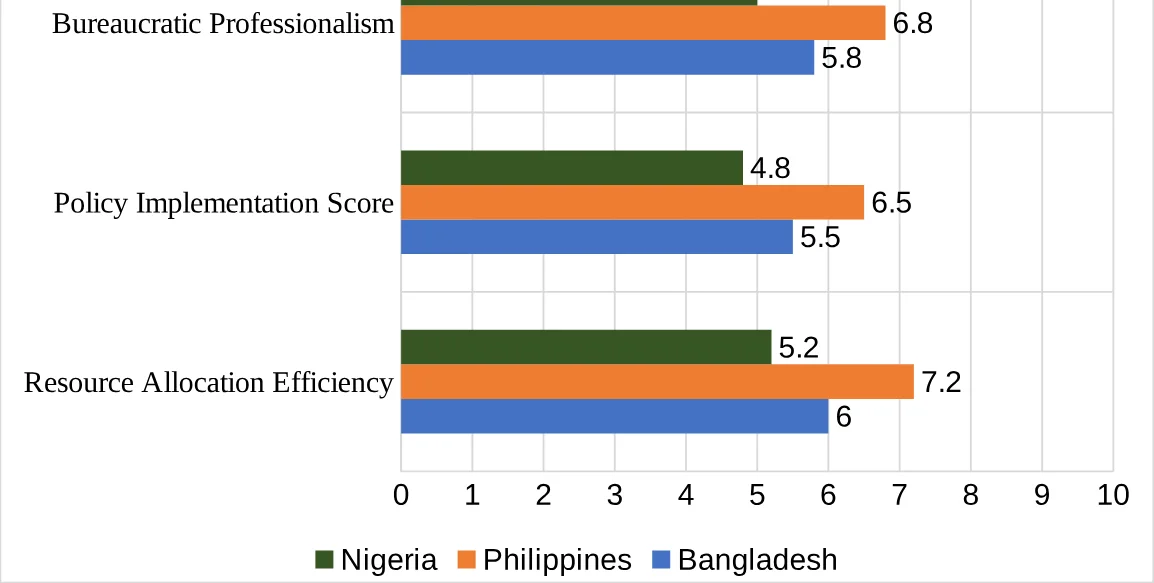
Administrative competence is the efficiency of bureaucratic operations, policy implementation, resource management competence in the institutions of the state bodies that manage drugs. The administrative competency in Bangladesh was assessed in this research based on score obtained by semi-structured interviews (n=15), records of policy implementation and the UNODC governance indicators. Every dimension became a 010 scale in which 0 means there is extremely poor performance, 5 means moderate and average performance, and 10 means excellent performance or highly efficient institutional functioning. This point system enabled a common comparison of the countries and also ensured both qualitative knowledge and quantitative performance measures.
Figure 1 compares the administration competency in Bangladesh, the Philippines, and Nigeria in three aspects namely; bureaucratic professionalism, implementation of policies and efficiency in resource allocation. Bangladesh scores moderately (5.5 -6.0) and this means that it has functional yet sometimes limited administrative processes. The Filipinas score tops in all dimensions indicating the existence of simplified processes and greater institutional capacity whereas Nigeria scores lower indicating weaknesses in bureaucracy and policy implementation. This shows how administrative proficiency may have a role to play on the success of drug control activities.
5.2 Coercive Capacity
The effectiveness of law-enforcement agencies, the lack of justice, and the anti-narcotics units are evaluated through coercive capacity to address the illicit drug operations. In Bangladesh, police coverage records, prosecution success rates and expert analyses of unit efficiency were used to measure this. Police officers and prosecutors were interviewed and their operational strengths and weaknesses were mentioned such as staffing, training Sufficiency, and logistical capacity.
Table 1. Coercive Capacity Indicators
| Country | Police Coverage (%) | Prosecution Success Rate (%) | Anti-Narcotics Unit Efficiency |
|---|---|---|---|
| Bangladesh | 70 | 62 | 6.2 |
| Philippines | 82 | 76 | 8.0 |
| Nigeria | 64 | 51 | 5.1 |
Table 1 shows the coercive power of the state institutions in Bangladesh, the Philippines and Nigeria. Police Coverage (%) is the percentage of the population covered by the police and the percentage of the population covered by the police is 70 in Bangladesh which is moderate. Prosecution Success Rate (Percent) is the degree to which the judicial system pursues arrests and Bangladesh scored 62. Anti-Narcotics Unit Efficiency (6.2/10) is used to reflect the effectiveness in the functioning of special units. The Philippines has a better coverage, success in prosecution, and unit efficiency than Bangladesh, and Nigeria has less capacity on all three indicators, which reduces its capability in effective enforcement of narcotics control.
5.3 Territorial Reach
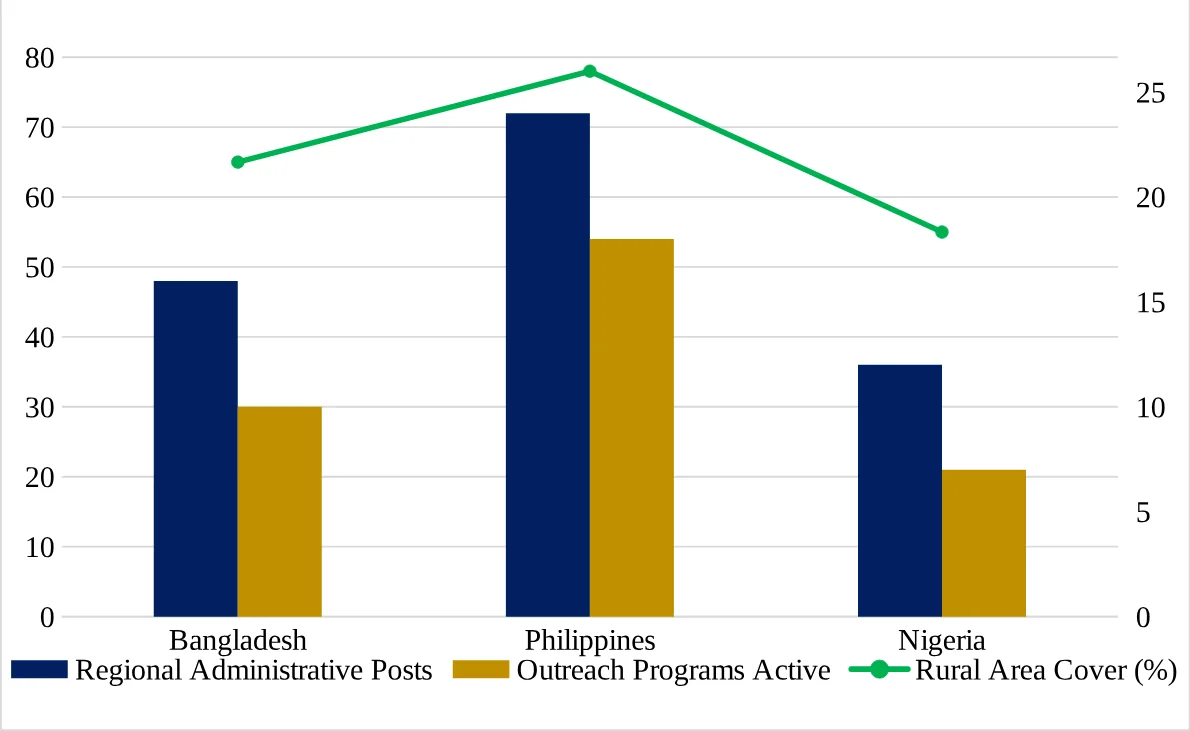
Territorial coverage indicates how the state can enforce the governance and control measures that are not located in the urban centers such as in rural districts and the high-risk areas of the traffic. In Bangladesh, it was measured using Law enforcement coverage on a district level, regional administrative coverage, and coverage on the outreach programs. Figure 2 presents the geographical reach of state institutions and programs in the case of Bangladesh, Philippines, and Nigeria. The Rural Area Coverage (%) shows how many rural districts have law enforcement presence and Bangladesh has 65% which is moderate coverage. Regional Administrative Posts quantify the physical presence of the government offices whereas Outreach Programs Active quantify operational presence in the communities; Bangladesh has 16 posts and 10 programs and this means that institute capacity is moderate and outreach is low. The Philippines is more covered and engaged whereas Nigeria is lesser in territorial and operational coverage, which leaves more regions to be under the control of the limited state.
5.4 Institutional Integrity
The institutional integrity measures the strength of state institutions in terms of resisting corruption, political encroachment, and penetration by criminal networks. Bangladesh scores were based on interviews, corruption perception indices and infiltration incidents report.
Table 2. Institutional Integrity (Score/Count)
| Country | Corruption Perception Index (0–100) | Political Interference Frequency | Infiltration Reports (No./Year) |
|---|---|---|---|
| Bangladesh | 48 | Medium | 8 |
| Philippines | 70 | Low | 3 |
| Nigeria | 45 | High | 12 |
The institutional integrity of Bangladesh, Philippine, and Nigeria as institutions is presented in Table 2. Corruption Perception Index shows that Bangladesh is at 48, which means moderate integrity. Political Interference Frequency reveals an irregular impact on the decision-making process, and the Infiltration Reports (8 per year) indicate the weaknesses against criminal infiltration. Comparatively, Philippines has better integrity with CPI of 70, little political interference and few incidences of infiltration whereas Nigeria has poor integrity, high political interference, and more incidences of infiltration which hinders drug control activities
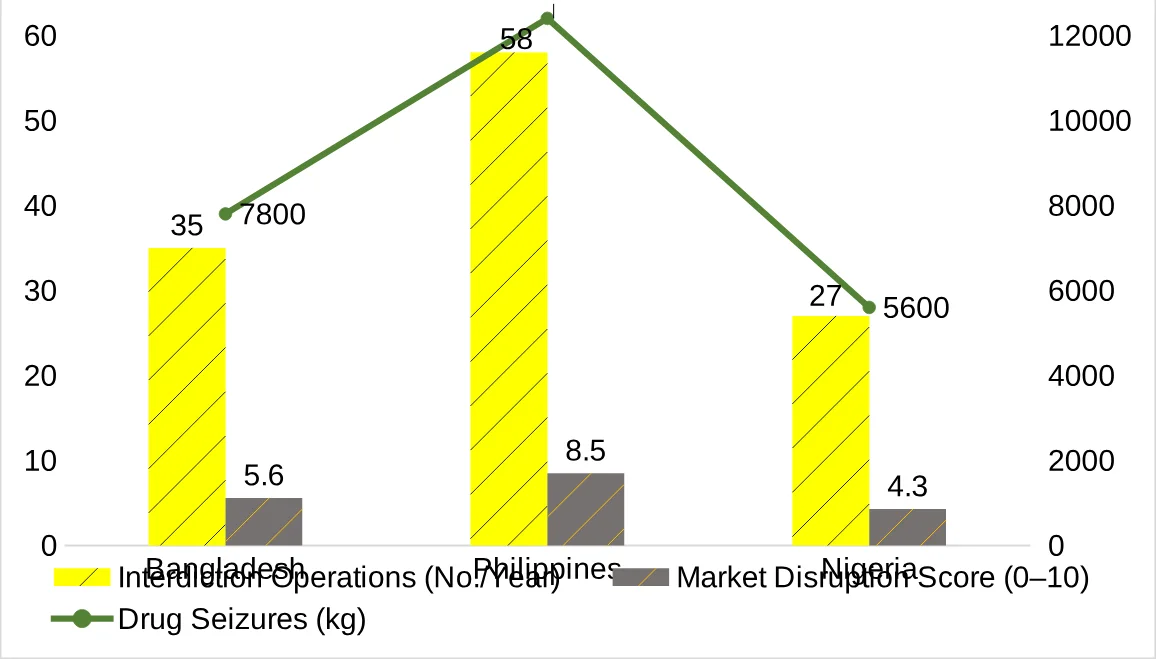
5.5 Drug Seizure and Interdiction Results
The drug control performance was evaluated based on the drug seizure volumes, the interdiction operations and the market disruption score. In the case of Bangladesh, the information was obtained based on the UNODC statistics and domestic enforcement reports.
According to Figure 3, Bangladesh used 35 interdiction operations, confiscated 7,800kg of drugs, and scored 5.6 in the market disruption indicator, which indicated moderate effectiveness. Comparatively, the Philippines had high volumes, more operations, and higher disruption score and Nigeria had low results in all the three measures. These variances emphasize the contribution of governance capacity and institutional effectiveness towards the determination of national outcomes in the process of drug control.
5.6 Inter-agency Coordination
Narcotics control can only be effective when there is good coordination of law enforcement, the judiciary and the public health services. The level of inter-agency coordination in Bangladesh was measured with three indicators, namely, the number of joint operations carried out every year, the number of running multi-agency task forces, and a measure of the overall effectiveness of coordination, rated by an expert, based on the interviews with officials. These actions mirror operationalization and stratification of the institutions in the implementation of the anti-narcotics policies. Bangladesh, as demonstrated in Table 3, operated 14 joint operations, had three task forces in operation, and ranked 6.0, which is moderate collaboration. The Philippines is more coordinated with 22 joint operations, five task forces and score of 8.3 and Nigeria has poor performance with eight operations and two task forces with a score of 4.1. These results highlight the importance of well-organized inter-agency cooperation in enhancing the results of enforcement and efficiency in operation to combat narcotics.
Table 3. Inter-agency Coordination
| Country | Joint Operations (Annual) | Task Forces Active | Coordination Effectiveness (0–10) |
|---|---|---|---|
| Bangladesh | 14 | 3 | 6.0 |
| Philippines | 22 | 5 | 8.3 |
| Nigeria | 8 | 2 | 4.1 |
5.7 Composite Governance vs. Drug Control Performance.
To reflect the linkage between the capacity to govern and the results of drug control, Table 4 offers an aggregate picture of all the dimensions of governance and performance indicators. The composite table brings out that, Bangladesh has moderate capacity in all the dimensions and this is consistent with its moderate drug control results. Greater governance competence in the Philippines is associated with greater interdiction, coordination and market breakdown and lower capacity in Nigeria makes it perform poorly.
Table 4. Composite Governance Capacity vs Drug Control Performance (Score/Scale)
| Country | Administrative Competence | Coercive Capacity | Territorial Reach | Institutional Integrity | Drug Control Performance |
|---|---|---|---|---|---|
| Bangladesh | Medium | Medium | Medium | Medium | Medium |
| Philippines | High | High | High | High | High |
| Nigeria | Low | Low | Low | Low | Low |
6. Discussion
The results of the present work give a subtle insight into the role of governance capacity in contributing to the development of institutional reaction to the narcotics crime in the developing countries, with special reference given to Bangladesh. The mediocre displays of Bangladesh in terms of administrative competence, coercive capacity, territorial reach, institutional integrity and inter-agency coordination demonstrate the intricate interaction between the structure and results of governance
6.1 Governance Capacity and Institutional Effectiveness.
The capacity to govern became one of the key factors that defined institutional performance in relation to narcotics control. Administrative effectiveness in Bangladesh is moderate, and bureaucratic procedures are usually effective, but limited by the resources, staff, and poor reporting connections. These constraints decrease the uniformity and rapidity of the policy execution and partly justify the average results in the areas of administrative competence (6.0/10), coercive capacity (6.2/10), and inter-agency coordination (6.0/10).
There is also a moderate coercive capacity, such as the police coverage, the efficiency of prosecution and the activity of anti-narcotics units. Although enforcement agencies have an active presence throughout major urban and semi-urban regions, the scope of influence on narcotics networks is also limited by operational restrictions. There is also a limitation on territory coverage; average territorial coverage of the rural area and incomplete outreach programs enable the traffickers to exploit the areas where the state institutions have not yet succeeded in controlling. The coherence and believability of enforcement activities is also affected by institutional integrity which is manifested in moderate corruption perception and occasional political interference. On the whole, these results demonstrate that the institutional effectiveness is closely connected to the governance capacity in many aspects, and the weaknesses of any of the aspects may have a great influence on the operational performance.
6.2 Intermediating Political, Social and Economic Factors.
Governance capacity and operational effectiveness have a significant relationship mediator that is dependent on political, social and economic factors. There are sometimes priorities of enforcement and allocation of resources in Bangladesh influenced by politics, which make the intensity of operations varying within districts. Social factors, including poverty and low access to education in high-risk zones, make the process of joining the trafficking networks easier and decrease the preventive impact of the enacted actions. The economic limitations, such as the inadequate financing of staff, equipments, and operation support also lower the capacity of institutions to conduct synchronized operations, especially in the rural districts.
These local circumstances contribute to the understanding that the higher interdiction rates or market disruption is not possible in Bangladesh, although its governance capacity is moderate. Districts which are more socio-economically vulnerable are less successful in their enforcement despite the presence of anti-narcotics units, implying that the governance capacity also combines with social and economic realities to influence the outcomes. The results accentuate the significance of localizing the interventions and targeting the origins of the problems and efforts of enforcement.
6.3. Comparison to Theoretical Insights.
The findings are consistent with the overall theoretical knowledge in terms of governance and institutional resilience. Administrative strength, professional bureaucracies, and actively organized enforcement are key features in the attainment of policy results. The moderate performance of Bangladesh on the dimensions of governance has resulted in the partial operational success, which proves that institutional capacity directly correlates with the results.
The phenomenon of institutional resilience is reflected in the fact that the local task forces and collaborative efforts could remain more or less effective even when systems were constrained. Some of the districts demonstrate better coordination and greater volumes of seizures, so that even a moderate capacity of local governance and resources distribution can yield positive outcomes. Relative to other more successful states, such as the Philippines, comparisons assist us to understand that with effective and well-coordinated governance, enhancement, greater reach and more enduring disruption of narcotics networks can be achieved. On the contrary, poorer performing states, such as those in Nigeria, point to effects of weak state, poor coordination and low territorial coverage.
Surprising results are that there are localized successes in Bangladesh. In those districts where the task forces were more autonomous and focused on strategies, the outcomes of interdiction were higher than anticipated which indicates that situational and adaptive strategies can enhance the performance of moderately competent institutions. This observation is critical in allowing it to design flexible and responsive structures of governance that can respond to the realities of operation on the ground.
6.4 Policy and Law Enforcement Practical Implications.
The research has a number of policy implications to the policy makers and the law enforcement agencies in Bangladesh. To begin with, making administrative systems more efficient through better streamlining of processes, better reporting systems as well as resource allocation can enhance uniformity and expediency with which programs are implemented. Second, to increase the use of coercive capacity in interdiction, specific training, operational assistance, and better coordination among the law enforcement agencies and the judiciary can raise the results of interdiction and prosecution effectiveness.
The ability to expand the territory is important as well. More enforcement and administration units in rural and high-risk districts will decrease safe havens of the traffickers. Moreover, institutional integrity should be enhanced by implementing transparent control, the accountability system, and the reduction of the political influence on the enforcement activities to enhance the credibility and efficiency of the enforcement efforts.
There is a need to pay specific attention to inter-agency coordination. Standard communication procedures, strategic planning processes, and shared surveillance may support operational synergy in the law enforcement departments, the judiciary, and the civil health systems. Good coordination would not only enhance operational performance, but will also ensure that the available limited resources are used optimally using an action plan that does not replicate efforts.
Lastly, the results point to the fact that governance improvements cannot be effective in the case when social and economic circumstances are not taken into account. Combining the harm reduction programs, community involvement and socio-economic development programs with the enforcement efforts can control the causes of narcotics crime which will result in establishing a more sustainable and comprehensive solution to drug control.
7. Conclusion
This paper explored the influence of the governance capacity in the institutional reactions in narcotics crime in developing countries particularly in Bangladesh but comparatively in the Philippines and Nigeria. The study measured administrative competence, coercive capacity, territorial reach, institutional integrity, and the coordination of agencies using a mixed-methods approach that involved semi-structured interviews with policymakers, law enforcement officials, and NGOs, and quantitative data on the same using government reports and UNODC datasets. The findings suggest that Bangladesh has moderate governance capacity on all dimensions that are associated with partial performance of the drug control operation, in terms of moderate quantities of seizure, outreach in rural districts, and inter-agency cooperation. The analysis also indicated that institutional effectiveness is mediated by political, social, and economic reasons where poverty, low resources, and political interference at times work against the effectiveness of enforcement strategies.
The results of these studies fill the gaps in the literature by linking multidimensional governance capacity with policy outcomes that can be seen in developing countries, and it provides a more combined model as compared to earlier work which tended to either examine the content of a policy or specific institutional elements. In practical terms, the research points out some practical suggestions: enhancement of inter-agency coordination by use of formal communication channels and joint planning, better resource allocation and institutional capacity to support enforcement and outreach to the rural areas and better transparency, accountability and monitoring in order to reduce corruption and political interference. Although the study presents useful insights, it has its limitations such as its use of a few case study countries, the possibility of biases during the reporting of the study through interviews, and the use of available indicators of governance that might have not reflected all the nuances of institutional performance.
A future study might enlarge the comparative frame and cover more developing states, use longitudinal designs to examine how governance and policy performance change over time, and could add more fine-grained information that is based on the district level to measure the local differences in capacity and performance. In general, the study is relevant to theory and practice as it illustrates the importance of governance capacity in developing the institutional efficacy and policy formulation, as well as providing a roadmap to the better narcotics control in Bangladesh and other similar settings.
References
- Ahiaba, A. A., Joseph, L. F., Azuaba, E., Ohwadua, O. E., & Akanji, A. R. (2025). Application of optimal control strategies to drug-gang modeling. Ife Journal of Science, 27(1), 309–319. https://doi.org/10.4314/ijs.v27i1.5s
- Amon, J. J., Pearshouse, R., Cohen, J. E., & Schleifer, R. (2014). Compulsory drug detention in East and Southeast Asia: Evolving government, UN and donor responses. International Journal of Drug Policy, 25(1), 13–20. https://doi.org/10.1016/j.drugpo.2013.05.019
- Carmenta, R., Cammelli, F., Dressler, W., Verbicaro, C., & Zaehringer, J. G. (2021). Between a rock and a hard place: The burdens of uncontrolled fire for smallholders across the tropics. World Development, 145, 105521. https://doi.org/10.1016/j.worlddev.2021.105521
- Collins, J. (2021). Evaluating trends and stakeholders in the international drug control regime complex. International Journal of Drug Policy, 90, 103060. https://doi.org/10.1016/j.drugpo.2020.103060
- Domorenok, E., Graziano, P., & Polverari, L. (2021). Introduction: Policy integration and institutional capacity: theoretical, conceptual and empirical challenges. Policy and Society, 40(1), 1–18. https://doi.org/10.1080/14494035.2021.1902058
- Fazey, C. S. J. (2003). The Commission on Narcotic Drugs and the United Nations International Drug Control Programme: Politics, policies and prospect for change. International Journal of Drug Policy, 14(2), 155–169. https://doi.org/10.1016/S0955-3959(03)00004-5
- Flores-Macías, G. (2018). The Consequences of Militarizing Anti-Drug Efforts for State Capacity in Latin America: Evidence from Mexico. Comparative Politics, 51(1), 1–20. https://doi.org/10.5129/001041518824414647 fouad, I. (2017). International drug control system and the United Nations General Assembly Special Session (UNGASS) on the world drug problem: An overview. https://www.emro.who.int/emhj-volume-23-2017/volume-23-issue-3/international-drug-control-system-and-the-united-nations-general-assembly-special-session-ungass-on-the-world-drug-problem-an-overview.html
- Gipperth, L., & Elmgren, R. (2005). Adaptive Coastal Planning and the European Union’s Water Framework Directive: A Swedish Perspective. AMBIO: A Journal of the Human Environment, 34(2), 157–162. https://doi.org/10.1579/0044-7447-34.2.157
- Gledhill, J., & Bright, J. (2019). Studying Peace and Studying Conflict: Complementary or Competing Projects? Journal of Global Security Studies, 4(2), 259–266. https://doi.org/10.1093/jogss/ogz001
- Grindle, M. S. (2004). Good Enough Governance: Poverty Reduction and Reform in Developing Countries. Governance, 17(4), 525–548. https://doi.org/10.1111/j.0952-1895.2004.00256.x
- Islam, F., Ullah, M. K., & Khan, Z. (2025). Institutional Challenges and Capacity Development in a Newly Established Crime Control Department: Evidence from Punjab, Pakistan. Social Science Review Archives, 3(4), 3813–3821. https://doi.org/10.70670/sra.v3i4.1486
- Lessing, B., & Willis, G. D. (2019). Legitimacy in Criminal Governance: Managing a Drug Empire from Behind Bars. American Political Science Review, 113(2), 584–606. https://doi.org/10.1017/S0003055418000928
- McPherson, C. M., & Sauder, M. (2013). Logics in Action: Managing Institutional Complexity in a Drug Court. Administrative Science Quarterly, 58(2), 165–196. https://doi.org/10.1177/0001839213486447
- Moury, C., & Escada, M. (2023). Understanding successful policy innovation: The case of Portuguese drug policy. Addiction, 118(5), 967–978. https://doi.org/10.1111/add.16099 Nabila Oktavia Lestari. (2025). Pidana Terhadap Pelaku Pengulangan (Residive) Tindak Pidana Peredaran Narkotika dalam Perspektif Hukum Penitensier. Majelis: Jurnal Hukum Indonesia, 2(3), 240–245. https://doi.org/10.62383/majelis.v2i3.1104
- Pambudi, I., & Redi, A. (2024). Criminal Law Politics and Reform to Strengthen Law Enforcement Roles in Indonesia in Combatting Narcotics Crimes. Asian Journal of Social and Humanities, 3(3), 660–672. https://doi.org/10.59888/ajosh.v3i3.467
- Ratanawijitrasin, S., Soumerai, S. B., & Weerasuriya, K. (2001). Do national medicinal drug policies and essential drug programs improve drug use?: A review of experiences in developing countries. Social Science & Medicine, 53(7), 831–844. https://doi.org/10.1016/S0277-9536(00)00390-7
- Regilme, S. S. (2023). State Violence in Narcotic Drug Governance: A Call for Harm Reduction and Human Rights Protection. Journal of Perpetrator Research, 5(1). https://doi.org/10.21039/jpr.5.1.131
- Robins, P. (2009). Public policy making in Turkey: Faltering attempts to generate a national drugs policy. https://doi.org/10.1332/030557309X397937 Sadman Nafis. (2025). DNC Narcotics Control Board report. https://doi.org/10.13140/RG.2.2.23693.65769
- Snapp, Z., Tinasti, K., & Herrera Valderrabano, J. (2019). Regulation of illegal drugs: State control and fragile institutional capacity. Journal of Illicit Economies and Development (JIED), 1(3), 255–261. https://doi.org/10.31389/jied.22
- Symes, A. (1999). Creating public value: Strategic management in government (Cambridge, MA: Harvard University Press) by Mark Moore. International Public Management Journal, 2(1), 158–167. https://doi.org/10.1016/S1096-7494(00)87438-3
- Underhill, J. B. (2008). The Politics of Crisis Management: Public Leadership under Pressure – By Arjen Boin, Paul ‘t Hart, Eric Stern, and Bengst Sundelius Lessons on Leadership by Terror: Finding Shaka Zulu in the Attic – By Manfred F. R. Kets de Vries. Political Psychology, 29(1), 139–143. https://doi.org/10.1111/j.1467-9221.2007.00619.x UNDP. (2025). Development Dimensions of Drug Policy: Assessing New Challenges, Uncovering Opportunities, and Addressing Emerging Issues. UNDP. https://www.undp.org/publications/development-dimensions-drug-policy-assessing-new-challenges-uncovering-opportunities-and-addressing-emerging-issues
- Unick, G. J., & Ciccarone, D. (2017). US regional and demographic differences in prescription opioid and heroin-related overdose hospitalizations. International Journal of Drug Policy, 46, 112–119. https://doi.org/10.1016/j.drugpo.2017.06.003 United Nations. (2024). World Drug Report 2024. United Nations : Office on Drugs and Crime. //www.unodc.org/unodc/en/data-and-analysis/world-drug-report-2024.html U.S. Department of State. (1998). International Narcotics Control Strategy Report, 1997: Washington, D.C., March 1998. Trends in Organized Crime, 4(2), 68–77. https://doi.org/10.1007/BF02900343
- Wang, W., Bai, Y., Xu, J., & Li, T. (2025). Collaborative governance of China-ASEAN maritime drug control: Mechanisms, challenges, and improvements. Ocean & Coastal Management, 261, 107548. https://doi.org/10.1016/j.ocecoaman.2025.107548
CITE THIS ARTICLE
Rahman, M. B. (2026). Governance Capacity and Drug Control: Institutional Responses to Narcotics Crime in Developing States. https://www.bazlurrahman.com/article/b7e788fd-7555-4069-afb7-ef8f44638e01
M. B. Rahman, “Governance Capacity and Drug Control: Institutional Responses to Narcotics Crime in Developing States,” 2026. [Online]. Available: https://www.bazlurrahman.com/article/b7e788fd-7555-4069-afb7-ef8f44638e01
Rahman, M. B. (2026) ‘Governance Capacity and Drug Control: Institutional Responses to Narcotics Crime in Developing States’. Available at: https://www.bazlurrahman.com/article/b7e788fd-7555-4069-afb7-ef8f44638e01
Rahman, Md. Bazlur. “Governance Capacity and Drug Control: Institutional Responses to Narcotics Crime in Developing States.” 2026, https://www.bazlurrahman.com/article/b7e788fd-7555-4069-afb7-ef8f44638e01.
Md. Bazlur Rahman. “Governance Capacity and Drug Control: Institutional Responses to Narcotics Crime in Developing States.” (2026). https://www.bazlurrahman.com/article/b7e788fd-7555-4069-afb7-ef8f44638e01.
Rahman MB. Governance Capacity and Drug Control: Institutional Responses to Narcotics Crime in Developing States. 2026. https://www.bazlurrahman.com/article/b7e788fd-7555-4069-afb7-ef8f44638e01
@misc{article_b7e788fd75554069afb7ef8f44638e01,
  title = {Governance Capacity and Drug Control: Institutional Responses to Narcotics Crime in Developing States},
  author = {Md. Bazlur Rahman},
  year = {2026},
  url = {https://www.bazlurrahman.com/article/b7e788fd-7555-4069-afb7-ef8f44638e01},
}
TY - GEN AU - Md. Bazlur Rahman TI - Governance Capacity and Drug Control: Institutional Responses to Narcotics Crime in Developing States PY - 2026 UR - https://www.bazlurrahman.com/article/b7e788fd-7555-4069-afb7-ef8f44638e01 ER -