The potential overlaps in sexual violence and drugging are an important criminal justice concern in Bangladesh, but are understudied because of the lack of coordination of data across law enforcement, forensic, health, and narcotics-control institutions. This paper is an examination of these gaps in the evidence in the context of a parallel-convergent quantitative evidence synthesis design with two separate, unlinked datasets. The primary dataset analysed was comprised of 2,362 media-documented sexual violence incidents between 2000 and 2023, descriptively analysed and using cluster-robust multivariable logistic regression. An additional 440 post-SMOTE drug-related observations were reviewed separately for indicators of behaviour, social, familial and criminal justice outcomes but without linkage identifiers or sexual violence outcomes.
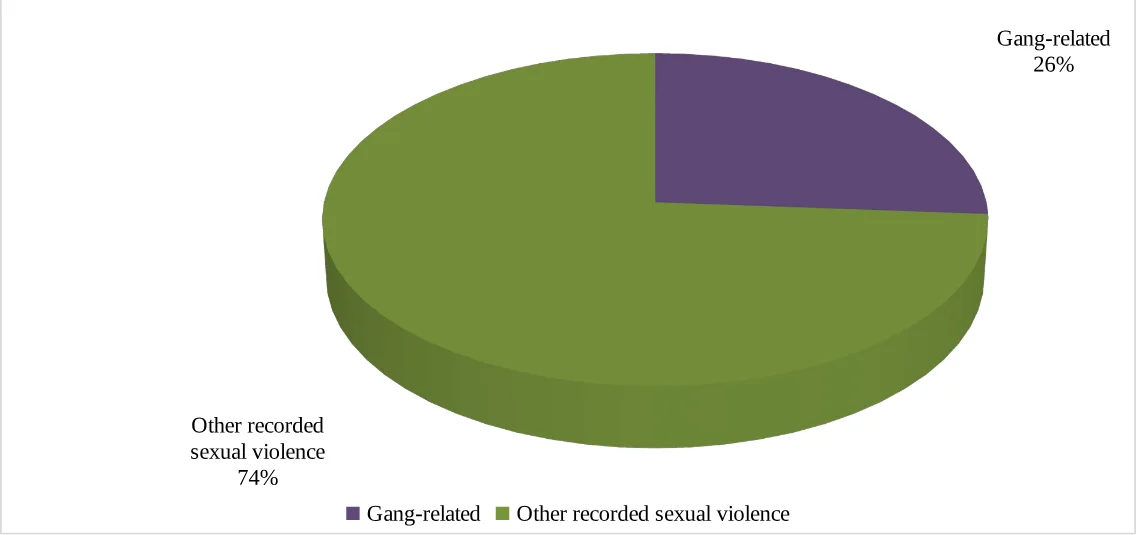
Of reported incidents, 26.1% were defined as being "gang related". In the adjusted analyses, the odds of gang-related sexual violence (OR = 2.78, 95% CI: 2.21–3.48) and lethal/near-lethal outcomes (OR = 1.72, 95% CI: 1.25–2.36) were higher for unacquainted-offender incidents than for acquainted-offender incidents. Evening/night incidents were associated with higher odds of gang-related classification (OR = 2.51, 95% CI: 1.91–3.31). The exploratory findings of the drug-related dataset showed social and behavioural indicators, but the results from the machine learning were treated as exploratory baseline metrics because SMOTE was applied before the train/test split, creating a risk of data leakage.
The study is not causal, and cannot conclude that drug use causes sexual violence or that sexual violence causes drug use. Rather it argues that institutional data fragmentation is a major impediment to evidence-based investigation and policy-making. A proposed Integrated Drug–Sexual Violence Criminal Justice Response Framework is intended to enhance survivor-centred investigations, toxicology testing, inter-agency coordination, treatment pathways and criminal justice data governance.
Keywordsdrug-related crimesexual violencegang rapedrug-facilitated sexual assaultcriminal justiceforensic toxicologyBangladesh
1. Introduction
Bangladesh’s criminal justice response to drug-related crime and sexual violence operates through largely separate institutional systems involving police, forensic services, healthcare providers, narcotics-control agencies, and courts. The absence of integrated case-level information prevents researchers and practitioners from examining whether, when, and through which mechanisms substance-related conditions intersect with sexual violence incidents. Therefore, rather than attempting an unsupported direct linkage between unrelated datasets, this study examines parallel evidence streams to identify institutional gaps, criminological patterns, and opportunities for improved criminal justice coordination. Sexual violence is at the same time a violation of bodily autonomy, an expression of gendered power, a public-health crisis, and a fundamental criminal-justice issue. The 2024 Violence Against Women Survey found significant levels of intimate-partner and non-partner violence among 27,476 women aged 15 years and older in Bangladesh, and that there are ongoing challenges to disclosure and formal legal action (Bangladesh Bureau of Statistics and United Nations Population Fund, Violence Against Wom-En Survey 2024.
Dhaka, Bangladesh: BBS and UNFPA, 2025. - Google Search, n.d.). According to the survey, 16% of women had suffered physical or sexual violence from someone other than their partner in their lifetime and at least 300,000 women and girls suffered non-partner sexual violence in the previous 12 months (Bangladesh Bureau of Statistics and United Nations Population Fund, Violence Against Wom-En Survey 2024. Dhaka, Bangladesh: BBS and UNFPA, 2025. - Google Search, n.d.). These population estimates are not a reflection of police statistics or media reports, but instead provide a broader context in which sexual-violence cases are introduced or not introduced into the justice system.
A second challenging policy area is drug-related crime (Azizul & Hossain, 2017; Deb, 2026). It encompasses drug-defined offences (possession, production, distribution, trafficking), drug-related offences in the setting of illegal drug markets, dependence-related acquisitive offences, and criminal-justice contact between persons with drug-use disorders. Lumping these phenomena together hides the important distinctions between responsibility, health care requirements, market structure, and violence potential. Studies on the issue also reveal that there is a social and gender disparity in drug involvement in Bangladesh (Rahman & Kabir, 2025). A comparative study revealed gendered trajectories into the use and peddling of drugs and recommended gender-sensitive prevention, treatment, and rehabilitation (Rahman & Kabir, 2025). The same study compiled secondary data from the Bangladesh Peace Observatory (BPO) on the number of drug-related violent incidents in 2014-2021, which included 42 reported rape cases of drug peddlers or users and 131 domestic violence cases of drug-addicted family members (Rahman & Kabir, 2025).
These statistics reflect reported co-occurrence, but do not provide a causal effect of drugs on sexual violence at the person level. Drugs and violence are not always linked in the same manner or always inevitable. There are three pathways to drug-violence, namely psychopharmacological, economic-compulsive and systemic (The Drugs/Violence Nexus: A Tripartite Conceptual Framework - Paul J. Goldstein, 1985, n.d.). Psychopharmacological mechanisms refer to behavior changes caused by intoxication, withdrawal or chronic drug use; economic-compulsive mechanisms relate to offending in connection with drug or resource acquisition; and systemic mechanisms are related to the organization of the illicit drug market, such as territorial conflict, retaliation, debt enforcement, and lack of legitimate dispute resolution (The Drugs/Violence Nexus: A Tripartite Conceptual Framework - Paul J.
Goldstein, 1985, n.d.). This is important because a violent incident that occurs as a result of drugs does not necessarily mean that the person was intoxicated, and a person who is dependent on drugs is not necessarily a violent offender.
This is the same warning that is essential to research on sexual violence. Substance involvement can affect opportunity structures, decision-making, memory, or conditions of evidence, but these are not enough to explain sexual aggression. Research into alcohol and sexual aggression indicates that intoxication may be a factor that exacerbates existing hostile attitudes or cognitive distortions, or situational factors, rather than causing sexual aggression on its own (Caamaño-Isorna et al., 2018). The findings of meta-analytic studies also suggest links between drug-related problems and intimate-partner aggression, but do not provide evidence for a universal causal relationship between drug use and sexual violence (Shahjahan & Haque, 2024). A scientific study in Bangladesh should therefore be able to differentiate between association, facilitation, co-occurrence and causation (Astle et al., 2023; Burke et al., 2023).
In the context of drug-facilitated sexual assault (DFSA), a more direct connection is seen. Proactive DFSA is when a perpetrator intentionally gives an intoxicating substance to make it easier for them to commit an assault. Opportunistic DFSA is when a perpetrator takes advantage of a victim who is already drunk or intoxicated. Systematic toxicological reviews indicate that alcohol is often found in cases of DFSA, polysubstance use is common, and the popular notion of a single covertly administered ‘date-rape drug’ only covers a small part of the phenomenon (Handy, 2024). The criminal-justice needs of DFSA are therefore unique: access to care must be quick; informed consent must be obtained; specimens must be collected in a timely fashion; the chain of custody must be secure; the laboratory method must be sensitive, and the interpretation must be expert.
While Bangladesh scholarship has covered several areas including drug use, trafficking, gender-based violence, rape, medico-legal evidence and access to justice, these streams are not integrated (Akhter & Zillur, 2024; Thomson, 2020). A comparative drug-crime study highlights gendered involvement in drug use and trafficking (Azizul & Hossain, 2017), and a field-based study in Rohingya camps illustrates the impact of patriarchy, statelessness, poverty, informal justice, and limited access to justice on gendered violence (M. R. Islam, 2025a). The latter also presents camp-level police data for 2017-2022 of some 2,441 cases, of which 1,644 were drug-related offences and 88 rape cases, as well as evidence gathered during interviews, which indicates that drugs are easily available and that insecurity is linked to trafficking in the camp (M.
R. Islam, 2025a). These data confirm that serious drug and sexual offenses are co-located in a high-risk setting but do not provide any information about a common offender or a causal mechanism. The resulting gap is not just descriptive, however, but relates to the lack of evidence at the case level and coordinated criminal-justice analysis. This is reflected in the national evidence gap and the available datasets. The provided sexual-violence dataset includes a lot of information about victim age band, victim–offender relationship, time of day, season, geography, offence type, source and article link, but lacks a field for drug involvement. The drug-related notebook provided contains behavioral, familial, psychosocial, and criminal-justice variables such as prior drug experience, smoking, peer influence, co-residence with a drug user, mental/emotional problems, financial circumstances, and court-case involvement, but it does not include a sexual-violence outcome and does not include any geographic or temporal identifier that can be matched to the sexual-violence incidents.
The merging of the datasets would therefore be methodologically flawed, and it would be incorrect to attribute any of the recorded sexual offences to the characteristics of the drugs.
The evidence gap is addressed through a parallel-convergent exploratory design in this study. The word ‘nexus' is employed in a deliberately bounded way as it is understood as the potential intersection of drug-related behavioral, social and criminal-justice conditions and the empirically observed patterns of sexual violence, as seen through established criminological mechanisms and Bangladesh's institutional context. The study does not assume that drug use leads to rape and that individuals with drug use disorders are always sexually dangerous.
The study aims to achieve four objectives: (1) describe the temporal, relational, contextual, and severity pattern of the sexual-violence incidents documented in the media; (2) estimate adjusted associations with gang-related and lethal/near-lethal sexual-violence; (3) critically appraise the evidence provided by the supplied drug-related classification; and (4) translate the cross-stream evidence into an integrated criminal-justice policy framework for Bangladesh. The research questions that follow pertain to the patterns in the sexual-violence dataset, the factors that distinguish severe forms, what aspects of drug-related social and criminal-justice indicators are captured in the second dataset, where there is theoretically defensible convergence, and what changes are needed to improve prevention, investigation, victim protection, prosecution, treatment, and data governance.
The paper makes an empirical contribution by going beyond a mere frequency report to cluster-robust multivariable analysis of 2,362 incident records. It adds theoretically by incorporating the three-part drug-violence model (The Drugs/Violence Nexus: A Tripartite Conceptual Framework - Paul J. Goldstein, 1985, n.d.) and Routine Activity Theory (Shahjahan & Haque, 2024) and an ecological/feminist perspective on sexual violence (Beeler et al., 2024). It adds methodologically by making the lack of linkage between the datasets explicit, not creating a spurious correlation. Finally, it helps to inform policy with its proposed Integrated Drug–Sexual Violence Criminal Justice Response Framework, which maintains three principles: Survivor intoxication is never a sign of consent; Drug dependence is never a sign of sexual dangerousness; Clinically indicated treatment is not a substitute for accountability for serious sexual offenses.
2. Literature Review
2.1 Drug-related crime and differentiated mechanisms
Possession or trafficking of drugs is a narrower concept than is drug-related crime. It is helpful to differentiate between drug-defined offences, drug-motivated offences and offences in the drug market system. This difference is important for policy as the mechanisms that cause harm are different. The treatment and criminogenic needs of a person being prosecuted for low-level drug use and suffering from a drug use disorder differ from those of an organized trafficker who uses violence to control the market. (Treatment and Care for People with Drug Use Disorders in Contact with the Criminal Justice System: Alternatives to Conviction or Punishment, n.d.) therefore call for evidence-based treatment and proportionate alternatives to conviction or punishment for (appropriate) minor offences of persons with drug-use disorders, and for (ordinary) accountability for serious violent offending.
The paper's main drug–violence typology is based on the three-part typology provided by (The Drugs/Violence Nexus: A Tripartite Conceptual Framework - Paul J. Goldstein, 1985, n.d.). The psychopharmacological pathway involves acute or chronic effects of substances that could impact inhibition, cognition, threat perception, or aggression. The economic-compulsive pathway refers to offending behaviors committed to gain access to drugs and/or the money required to buy them. The systemic pathway is related to the violence that is part of the illicit economy. The framework was developed in a different era of the drug market but is still applicable as it helps avoid the empirical disappearance of different mechanisms. This is especially applicable in Bangladesh, where trafficking, dependency, criminal networks and street involvement with drugs may all be present, but need different interventions.
For Bangladesh, the framework therefore distinguishes intoxication or withdrawal, dependence-related resource acquisition, and coercion within trafficking networks as separate hypotheses for investigation; the present datasets do not test these mechanisms directly. A gender sensitive aspect is added by (Rahman & Kabir, 2025). They propose in their comparative secondary-data study that social and structural factors have an impact on women's participation in drug use and peddling and that traditional drug-control strategies have limitations in delivering evidence that is disaggregated by gender. They employ deviant-behavior theories that focus on the interaction between criminalization and social position. In this study, their involvement is not indicative of their being linked to sexual violence, but rather of the need to be aware of the gendered nature of vulnerability, agency, and offending to avoid a wrong drug policy.
The supplied drug-related notebook also includes individual and contextual predictors. Factors like peer influence, living with a drug user, family finances, mental/emotional problems, smoking, prior drug experience, and court-case involvement may apply to a larger criminological profile. However, these are classification characteristics, but not validated causal risk factors. They are important to mention in the current paper because they show the types of social, household, and justice variables that should be distinguished in the future integrated data system, but not as predictors of sexual violence.
2.2 Substance use and sexual aggression
There are several ways that substance can be involved in sexual violence, including intoxication, intentional intoxication, and a social environment where intoxication and coercion are intertwined. Experimental and observational studies have yielded clear effects of intoxication on attention, sexual misperception, risk assessment, and response to inhibitory cues in the literature for alcohol. But, as (Burke et al., 2023) notes, alcohol should not be viewed as a cause of sexual violence, but rather as a "facilitator" for some who are predisposed to violence. This is particularly important in cases of criminal-justice interpretation, where toxicology can help to explain what is going on during the incident, but cannot replace evidence of consent, coercion, intention, or participation (Astle et al., 2023; Burke et al., 2023).
(Azizul & Hossain, 2017) reviewed intimate partner drug abuse and aggression, and concluded that there was a positive overall association, although effect sizes differed by drug, methodology, and population. This type of work would help support the idea that substance-related issues may be related to interpersonal aggression, but that intimate-partner aggression is more than just sexual violence and cannot be used as a proxy for rape. Furthermore, common risk factors can be associated with substance abuse and violence. Therefore, a nexus study should be careful of the potential for confounding and reverse causality (Beeler et al., 2024; Guo et al., 2022; Zhong et al., 2020). Ethical and evidentiary issues are raised by victim substance use.
Voluntary consumption does not involve consent, and being intoxicated may make you more vulnerable because it may affect your ability to make decisions, move around, or remember things. It is important, then, that criminal-justice actors avoid victim-blaming interpretations and ensure that there is accurate forensic documentation. The question is not so much whether the victim took a substance but whether he or she was intoxicated, and whether the intoxication was used by the offender or was intentionally given by the offender.
2.3 Drug-facilitated sexual assault and forensic evidence
DFSA involves the use of substances to facilitate an assault or an offender taking advantage of a person’s existing intoxication; an offender’s drug-use history alone does not establish DFSA. In a systematic review of the literature conducted worldwide, (Anderson et al., 2017) discovered that alcohol was often detected and multiple substances were common. The short detection window, delayed reporting, amnesia, metabolism, and variety of agents involved in the crime make forensic interpretation difficult, as noted by (Dinis-Oliveira & Magalhães, 2013; Skov et al., 2022). Therefore, a negative toxicology result does not rule out substance facilitation, especially if it takes time to report. The results pose a policy question for Bangladesh.
A survivor-centered response must have a clear pathway for cases where someone has been suspected to be drugged, incapacitated, suffered memory loss, or unusual intoxication. Biological sampling should be conducted on time, with informed consent and be connected to a chain of custody. A toxicology result alone does not prove or disprove an assault. The forensic pathway also needs to be linked into the medical and psychosocial care pathway, and evidence gathering cannot be a further source of harm. In Bangladesh and the wider South Asian context, this highlights a need to connect DFSA evidence collection with the legal and service-access barriers discussed in Section 2.6; the present data cannot estimate the regional frequency of DFSA.
2.4 Routine activity, group offending, and situational opportunity
Routine Activity Theory suggests that when predatory offences occur, a motivated offender, a suitable target, and an absence of capable guardianship come together in time and space (Patoari, 2020). The theory is sometimes misinterpreted as a victim-centered theory. When applied correctly, it helps to focus on conditions in the environment and institutions: surveillance, transport, presence of bystanders, design of public space, group mobility, the possibility for offenders to act without interruption. Group sexual violence is particularly suitable for a situational analysis because there must be multiple offenders present and in position to take advantage of an opportunity. The setting of the scene may change the visibility, transport patterns, guardianship, police presence, and witnesses at the scene in the evening and at night. A correlation between nighttime and gang-related sexual violence would then apply to the prevention and investigation of sexual violence in the environment, but not that night causes sexual offending. Nor would it be justified to limit women's freedom of movement. It is important to note that the right policy focus is on offender opportunity and environmental safety, rather than on victim behavior (Havard et al., 2021).
2.5 Feminist, ecological, and structural explanations
Gender and power are not just part of a situational approach; they are essential. (Heise, 1998) ecological model situates violence against women at the level of the individual, relationships, community, and society. Gender norms and entitlement, coercive masculinity, economic dependency, social stigma, low accountability, and legal barriers are all factors that shape sexual violence. These drug-market or intoxication mechanisms do not exist outside of this ecology but exist as part of it. The study of Rohingya camps by Islam is an example of the importance of this approach in Bangladesh. The study identified patriarchy, statelessness, poverty, displacement, informal justice and limited access to formal justice as factors that impact the lived experience of gendered violence through interviews and expert engagement, as well as through field observation. Drug trafficking and the availability of drugs are also a security issue in the camp context. But the central contribution of the study is structural that is, institutions and social position mediate between violence and justice. This paper builds on this logic and poses the question of how drug-related conditions, situational opportunity, and justice-system capacity can be combined without diminishing sexual violence to substance use, beyond the camp context.
2.6 Bangladesh criminal-justice and service context
The government of Bangladesh's response to sexual violence is reflected in substantive criminal law, special laws for women and children, criminal procedure, evidence rules, forensic medicine, policing, prosecution, courts and services for victims. The Evidence (Amendment) Act 2022 further enhanced the formal recognition of physical and forensic evidence to give a legal basis for modern scientific evidence. The challenge is implementation capacity: timely examination, standardized documentation, lab access, chain of custody, coherent interpretation (Sexual Violence in South Asia: Legal and Other Barriers to Justice for Survivors, 2021; Sexual Violence in South Asia: Legal and Other Barriers to Justice for Survivors – 2024 Update, 2024).
The implementation gap is evident from the recent situation in Bangladesh. (M. Islam & Hossain, 2021) did a qualitative study in three cities of Dhaka, Dinajpur and Rangpur. They identified the continued use of the prohibited two-finger test in locations outside the capital, which was partly due to the beliefs of providers that the test is acceptable and to the acceptance of such findings by the courts. The study reveals that while legal reform is a necessary condition for the change of medico-legal practice, professional norms, training, expectations, and accountability mechanisms also play a role. The One-Stop Crisis Centres (OCCs) in Bangladesh offer an institutional space for holistic medical, psychosocial and legal assistance.
Through interviews with survivors and frontline providers, (Deb, 2026) found that there was limited awareness of services before seeking help, limited staffing and infrastructure, inconsistent privacy and dignity, fragmented coordination, and poor feedback mechanisms. The results of these studies are directly applicable to any new proposal for integration of toxicology or substance screening: integration must be designed to enhance the survivor pathway, not impose additional burdens in the form of bureaucracy (Saha et al., 2025). The drug-control mechanism has also been constantly changing. The Narcotics Control Act 2018 continues to be the main legislation. Any statutory claims should be checked against the consolidated current version when the article is submitted to the journal.
This policy argument is therefore principle-based: serious trafficking, deliberate drugging to facilitate assault, and sexual violence must be held accountable, whereas clinically diagnosed drug use disorders must be treated and continuity of care provided, in line with evidence.
2.7 Research gap and study positioning
Research is available from existing sources in Bangladesh that gives strong evidence of both sides of the problem with limited integrated analysis. Addressed through drug studies are issues of addiction, trafficking, the criminalization of drug use and abuse, treatment, gendered participation, and social vulnerability. Sexual-violence research focuses on prevalence, gender disparity, forensic practice, victim service provision, and access to justice. Rahman and Kabir (Rahman & Kabir, 2025) bring to light the gendered nature of drug-related crime, and (M. R. Islam, 2025b) brings to light the intersections between gendered violence, structural vulnerabilities, and justice mechanisms. The two studies don't directly consider the potential for convergence of drug-related criminogenic conditions with sexual violence, nor do they discuss how these systems should interact with one another when convergence is suspected. The present research paper aims to fill this gap and explicitly acknowledges the fact that these two data sets in and of themselves do not make a person-level causal link.
Table 1. Positioning of the present study relative to two closely related Bangladesh studies
Dimension
Rahman & Kabir [4]
Islam [15]
Present study
Central problem
Women’s drug use and drug-related offending
Crime, gender violence, and justice in Rohingya camps
Drug-related criminogenic conditions and sexual violence as an integrated criminal-justice policy problem
Research design
Mixed secondary-data analysis and secondary case studies
Qualitative field-based study with secondary triangulation
Parallel-convergent secondary quantitative analysis plus legal/policy synthesis
Primary empirical focus
Women and drug-related crime
Rohingya women/girls and justice mechanisms
2,362 sexual-violence records plus a 440-observation post-SMOTE drug-related notebook
Theory
Deviance, strain/anomie, conflict, labelling
Intersectionality/feminist and structural vulnerability
Gender-sensitive drug control, treatment, rehabilitation
Gender-sensitive justice reform and women’s participation
Integrated investigation, toxicology, victim protection, accountability, treatment, and data governance
Direct drug–sexual violence test
No
No
Parallel exploratory analysis; no direct drug–sexual violence association estimated
3. Theoretical and Analytical Framework
The paper combines three complementary frameworks. In this way, Goldstein's model illuminates potential (drug–) violence mechanisms, Routine Activity Theory situational opportunity, and the ecological/feminist framework gendered and structural conditions of sexual violence and justice. The frameworks are not mutually exclusive and all function at different levels.
3.1 Integrated nexus model
In the individual case, exposure to substances, problems related to dependence on substances, substance withdrawal, and psychosocial problems can be pertinent. Within the peer and relationship groups, group norms, peer influence, living with drug users, and exposure to criminal networks could be important. The situational level can influence opportunity through time of day, place, familiarity between victim and offender, guardianship, and victim incapacitation. The systemic level may be the source of coercion, debt, trafficking, and violence through the use of illicit markets. From a structural perspective, gender inequality, stigma, poverty, and institutional weakness impact on victimization and on access to justice. These pathways are not required in all cases; see the model. Rather, it offers a framework for evidence collection and for responses to policy.
4. Legal and Institutional Context in Bangladesh
There is a need for coordination in various areas in Bangladesh's existing legal system. The Narcotics Control Act 2018 is an Act to amend and regulate narcotics control, offences, enforcement, treatment and rehabilitation. Sexual violence is dealt with under the Penal Code and under special legislation relating to women and children – such as the Women and Children Repression Prevention Act – which has been amended in the past. In 2022 the Evidence Act was amended to include expert physical and forensic evidence. Such tools confer the legal authority, and successful implementation requires investigation, medicine, laboratories, prosecution, courts, and institutions for the support of victims to function together in a unified manner.
In the case of the topic for which I am writing this, there are three points of institutional contact. First, is the police/healthcare coordination at the time of disclosure and examination. The second one concerns the coordination of police–forensic–prosecution of biological, digital and toxicological evidence. The third is coordination by police and the DNC if there is a real drug-market, trafficking or drug-use-disorder problem. Coordination should not be automatic, but be triggered by evidence. Substance use should not be the focus of a sexual-violence investigation when it is the victim's choice and should not turn a sexual-violence case into a narcotics case; and someone who has a drug-use disorder should not be assumed to be a sexual threat.
The Evidence Act 1872, as amended in 2022, has provided for a more robust basis for scientific evidence, but flawed medico-legal practices that were recorded by (Akter et al., 2026) can have a lasting negative impact even after the formal reform of the law. The forensic modernization must thus involve the establishment of standardized procedures, training of professionals, laboratory quality control, judicial training and audit. DFSA can be urgent due to the evidence window being short. The OCC system provides an effective institutional framework for integrated care for the survivors. (Seid et al., 2021) identified the constraints of OCCs as being staffing, infrastructure, privacy, awareness and a lack of coordination.
A sexual-violence treatment plan ought to be integrated with the survivor pathway rather than be a disjointed system of agencies that survivors are expected to navigate on their own.
5. Materials and Methods
5.1 Research design
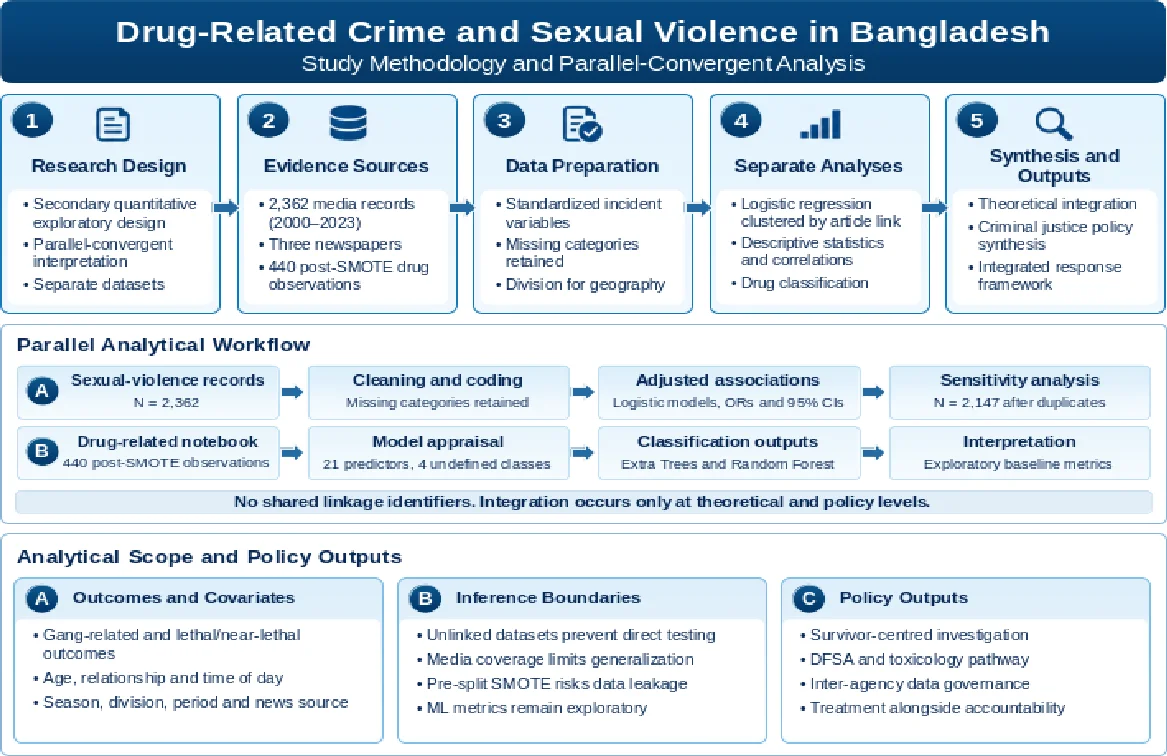
A secondary quantitative multi-source exploratory design with parallel-convergent interpretation was used in the research. Two different sets of data were obtained for the study, and they were considered as separate evidence streams. First, there was an incident-level dataset about media coverage of sexual violence incidents. Second, there was a Jupyter notebook with the preprocessed and balanced by SMOTE drug-related classification dataset and machine learning outputs. It was impossible to merge the datasets, since there was no common identifier like respondent, offender, victim, district-year, or any other valid linkage identifier present in both sets. The integration of the data took place only on the theoretical and criminal justice policy levels. Such a design was chosen due to institutional data siloing and the need to maintain inferential integrity. The statistical link required at least one common unit of analysis, such as offender-level substance use information in sexual violence cases or district-year drug crime indicators linked to district-year sexual violence indicators.
5.2 Sexual-violence incident dataset
The main file had 2,362 observations and 17 original variables, which included age band, an original victim classification, victim-offender relationship, upazila, district, division, time of day, incident date, year, month, day, temperature, season, sexual violence type, news source, and news article link. The observations spanned from about 2000 to 2023. There were three dominant sources of the data, namely Prothom Alo, The Ittefaq, and The Daily Star. Since there was no complete sampling frame of the country in the source file, observations are referred to as media-reported incident records. These records represent media coverage and may over-represent severe or urban incidents; they are not a population sample.
5.3 Data cleaning and quality assessment
Incident data were cleaned to standardize whitespace, division, age bands, relationship, time-of-day, and season. Missing data were kept, where appropriate. The original district field included 115 unique names – far more than the 64 districts in Bangladesh – which may indicate misspellings, geographic-level inconsistencies, or other coding issues, so analysis at the district level could not be pursued. The division variable was chosen as the geographic variable. A validated mapping of the 115 district labels to 64 official districts and eight divisions was not available; future district-level analysis requires an audited crosswalk, manual review of ambiguous labels, and retention of unresolved entries as missing. The original victim-type field was inconsistent with the age-band variable.
There were some observations in adult age bands categorized as children. So age band was used as the basis of age-based inference and the original victim-type variable was not considered as a legitimate child or adult category as defined by law. Missing data were found in time-of-day in 631 records, age-band in 153, upazila in 305, incident date in 226, and year in 17. These missing categories were kept in the adjusted models as nuisance variables so that complete case deletion does not delete much of the sample size. Repeated article links were not dropped automatically since one article could report on multiple victims or incidents. An aggressive exact duplicate pattern detection procedure found 215 redundant rows based on all original variables except the record identifier, leaving 2,147 unique patterns.
The primary models used all records and clustered standard errors by article link; the sensitivity analysis removed exact duplicate patterns and reran the key models.
5.4 Outcome definitions
Gang-related sexual assaults were coded 1 if there was gang rape or gang rape plus murder, while otherwise the code was 0. There were 617 instances of gang-related cases (26.1%). Here, “gang-related” denotes the recorded multi-offender offence categories and does not establish membership in an organized criminal gang. Lethal/ near-lethal sexual assault cases were coded 1 if there was rape plus murder, gang rape plus murder, murder during attempted rape, or rape with attempted murder. They amounted to 232 cases (9.8%). Rape plus suicide was not considered lethal or near-lethal since there was no way of knowing if the death had been inflicted by the offender.
5.5 Explanatory variables
The age category was assigned to 0-18 years, 19-35 years, 35+ years, or missing values, and 19-35 years was taken as the reference in the regression analysis. The victim-offender relation was coded to acquaintances, strangers, or missing values, where acquaintances were used as references. The reported results distinguish daytime, evening/night, and missing time categories. The season was categorized to winter, hot, rain, or missing. The division variable was coded categorically using Dhaka as the reference. Calendar year was grouped into 2000-2012, 2013-2018, 2019-2023, or missing.
5.6 Statistical analysis
Counts and percentages were used to express descriptive statistics. Binary logistic regression models were employed in the gang-related and lethal/near-lethal analyses. Standard errors were computed using clusters of news article links to correct for dependence among those observations that came from the same news article. Division was included as a covariate; standard errors were not clustered by district or division. Adjusted odds ratios (ORs), 95% confidence intervals (CIs), and two-sided p-values are presented. The goodness of fit of each model was described using AIC and McFadden’s pseudo-R². Since this is an observational study using media data, ORs should only be considered as conditional associations observed in the sample and not causal effects or population risk ratios. Correlations between selected incident-level variables were performed using pairwise-complete observations. Binary-binary correlations are phi-coefficients, whereas correlations including at least one continuous variable are Pearson correlations. Annual correlations were estimated between the percentage of incidents classified as gang-related and the percentage of incidents classified as lethal/near-lethal. This correlation analysis aims to describe the internal structure of the sexual violence data and not the correlation between drug crimes and sexual violence.
6. Results
6.1 Descriptive profile of documented sexual violence
There were 2,362 incidents included in the dataset. The most numerous age range was 0–18 years (1,404; 59.4%), followed by 19–35 years (691; 29.3%) and 35+ years (114; 4.8%); no age range was specified for 153 cases (6.5%). An acquaintanceship was noted in 1,473 cases (62.4%), whereas 857 (36.3%) reported unacquainted offenders. Evening/night was mentioned in 973 cases (41.2%), daytime – 758 (32.1%), unspecified time – 631 (26.7%).
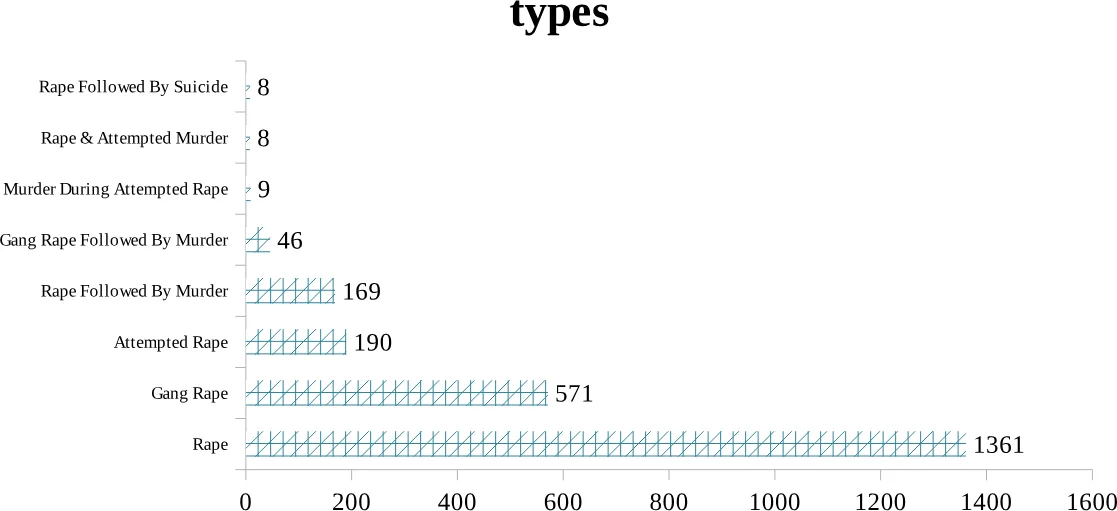
Rape was the most common category (1,361; 57.6%), gang rape – 571 (24.2%), attempted rape – 190 (8.0%), rape followed by murder – 169 (7.2%), gang rape followed by murder – 46 (1.9%), murder during attempted rape – 9 (0.4%), rape with attempted murder – 8 (0.3%), and rape followed by suicide – 8 (0.3%).
Table 2. Characteristics of media-documented sexual-violence incident records (N = 2,362)
Characteristic
n
%
Age band
0-18
1,404
59.4
19-35
691
29.3
35+
114
4.8
Missing
153
6.5
Victim-offender relationship
Acquaintance
1,473
62.4
Unacquainted
857
36.3
Missing
32
1.4
Part of day
Daytime
758
32.1
Evening/night
973
41.2
Missing
631
26.7
Season
Winter
888
37.6
Rainy
799
33.8
Hot
628
26.6
Missing
47
2.0
Division
Dhaka
717
30.4
Chattogram
470
19.9
Rajshahi
304
12.9
Khulna
252
10.7
Rangpur
170
7.2
Barishal
166
7.0
Mymensingh
163
6.9
Sylhet
115
4.9
Missing
5
0.2
6.2 Unadjusted patterns
Gang-related sexual violence had 617 cases (26.1%) in this sample. There were great differences in the distribution of this type of crime by age, offender-victim relationship, and hour of occurrence. In cases of sexual violence against victims between 19-35 years old, 41.2% were classified as gang-related, while 18.6% of the 0-18 years-old group and 20.2% of the 35+ age group were classified as gang-related. This finding is based on the condition that media cases were included. The greatest difference without adjustments can be seen with regard to the offender-victim relationship. Gang-related sexual violence made up 18.3% of the acquainted-offender cases but 39.4% of the unacquainted-offender cases.
6.3 Adjusted correlates of gang-related sexual violence
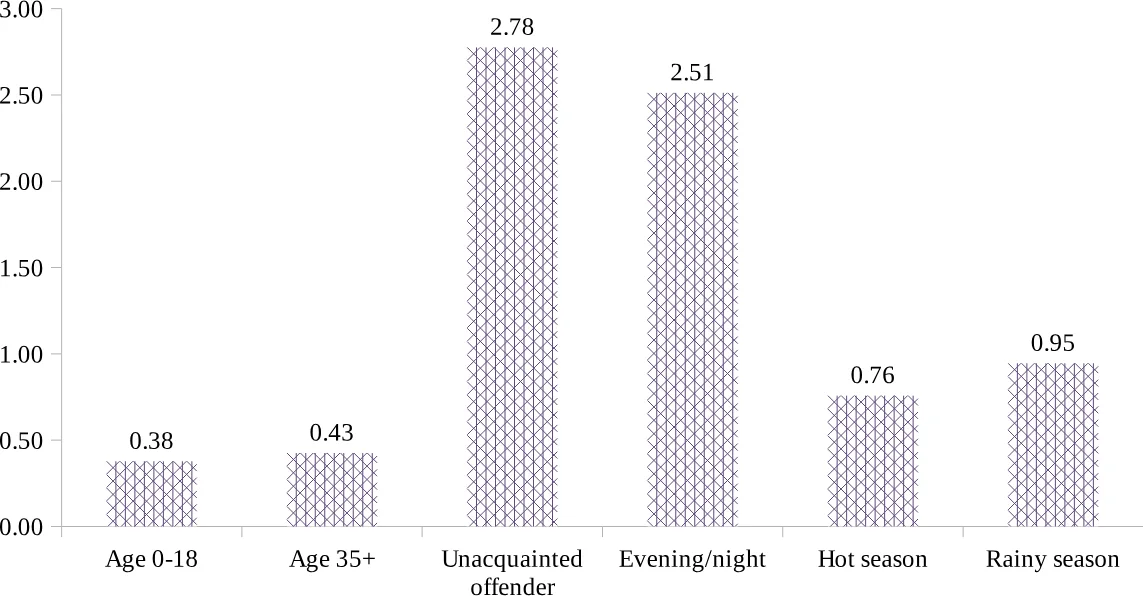
After controlling for age of victim, victim–offender relationship, time of day, season, division, period, and news source, events with unacquainted offenders had 2.78 times the odds of gang-related classification compared to events with known offenders (OR=2.78, 95% CI 2.21–3.48, p<.001). Events that took place in the evening/night had approximately 2.51 times the odds of gang-related classification compared with those that occurred during the day (OR=2.51, 95% CI 1.91–3.31, p<.001). Compared to the 19-35 reference group, events where victims were aged 0-18 had significantly lower odds of gang-related classification (OR=0.38, 95% CI 0.29-0.49, p<.001), as did events involving 35+ age of victims (OR=0.43, 95% CI 0.23-0.78, p=.005). Hot and rainy season coefficients were not significantly different from zero at the 5% level. Events from Rajshahi had lower adjusted odds of gang-related classification than those from Dhaka (OR=0.50, 95% CI 0.33–0.75, p=.001).
6.4 Adjusted correlates of lethal/near-lethal sexual violence
There was a different pattern associated with the lethal/near-lethal model. There were higher adjusted odds of being lethal/near-lethal for unacquainted offender incidents (OR=1.72, 95% CI 1.25–2.36, p=.001). On the other hand, there was no statistically significant adjusted association with the odds of lethal/near-lethal violence associated with evening/nighttime occurrences (OR=1.24, 95% CI 0.83–1.85, p=.299). It is possible to explain the association with nighttime occurrence in terms of the gang model rather than a general association between nighttime occurrence and seriousness. The records of 2000–2012 had higher adjusted odds of lethal/near-lethal classification than those of 2019-2023 (OR=2.13, 95% CI 1.38–3.29, p<.001). This finding cannot be considered a general national trend because of potential changes in newspapers' archives and the sources used.
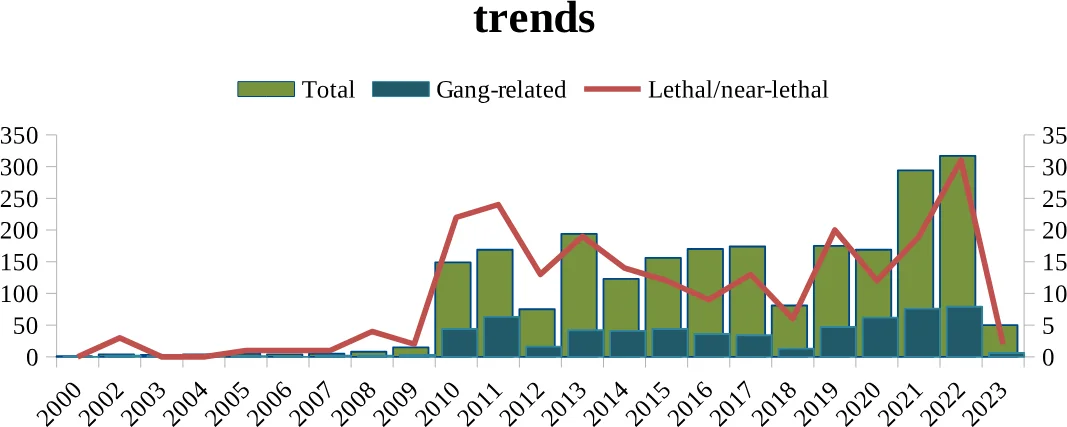
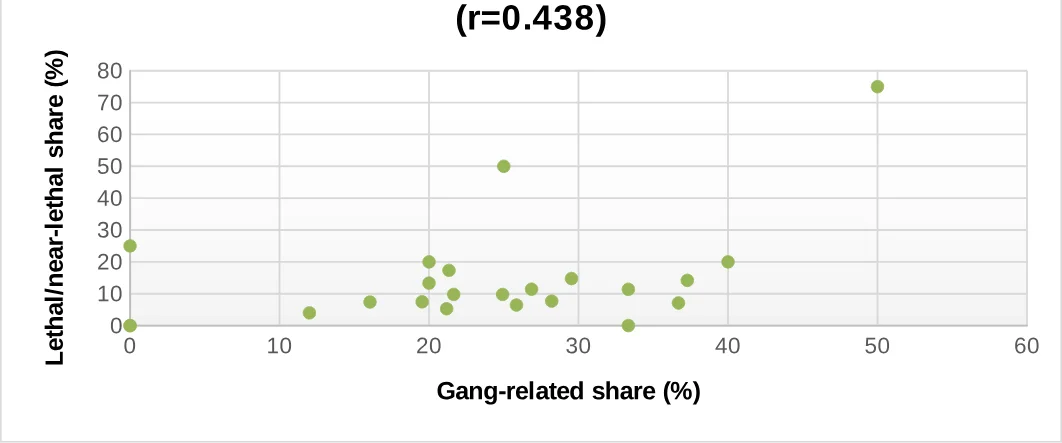
However, the number of reported cases was generally higher in the latter years, although this pattern should be viewed in the context of the changing composition of newspaper stories and not be construed as an incidence series for the whole country. The temporal structure within the dataset is illustrated by depicting the number of total, gang-related, and lethal/near-lethal cases annually. The correlation between gang-related and lethal/near-lethal share per year was positive and moderate (r=0.438). This measure is quite unstable due to small numbers in earlier years and is given here just for illustration purposes.
6.6 Sensitivity analysis
The removal of exact duplicate pattern cases reduced the sample from 2,362 to 2,147. There was no substantial change in the two gang-related associations reported below. The association between unacquainted-offenders and gang-related violence was consistent (OR = 2.76, 95% CI = 2.21 - 3.43), and so too was the association between night and the crime (OR = 2.49, 95% CI = 1.91 - 3.24). The lethal/near-lethal sensitivity estimate was incomplete in the supplied results and requires verification before it can be reported.
6.7 Drug-related classification evidence
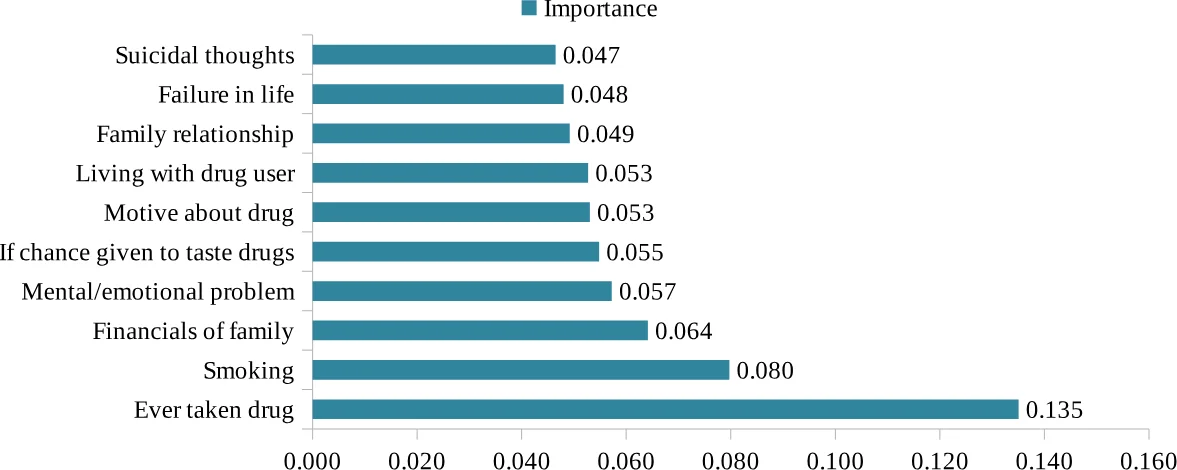
The provided drug notebook consisted of 440 observations after SMOTE and 21 predictors. Extra Trees importance showed that prior drug experience was the most important predictor (importance=0.135), followed by smoking (0.080), family financial situation (0.064), mental or emotional problems (0.057), willingness to experiment with drugs if the chance appeared (0.055), motive regarding drugs (0.053), living with a drug user (0.053), family relations (0.049), feeling like a failure in life (0.048), suicidal thoughts (0.047). Importance of friends' influence is 0.041 and court case involvement – 0.036.
The Random Forest classifier of the provided notebook achieved 90.9% test accuracy on 132 observations. Class-level F1 score varied between approximately 0.87 and 0.94. Such performance should not be considered as an indicator of external validity as there is no information about what the four outcome classes are, the dataset was balanced using SMOTE before splitting it into training and testing sets, and categorical synthetic values were apparently converted to integer numbers. The provided model should therefore be regarded as a description of the dataset only. Applying SMOTE before the split can leak information across training and test sets and inflate performance estimates. Consequently, these results are exploratory baseline metrics only. Future analysis must split the original observations first, restrict SMOTE to training folds, and evaluate on an untouched test set.
Table 5. Summary of the supplied drug-related computational dataset
Component
Observed result
Observations after SMOTE
440
Predictors
21
Outcome
Four-category Class variable; meanings not defined
Class balance
110 observations in each class after SMOTE
Train/test split
308 / 132
Top feature
Ever taken drug (0.135)
Smoking importance
0.080
Family finances importance
0.064
Court-case involvement importance
0.036
Reported Random Forest accuracy
90.9% (exploratory; pre-split SMOTE)
Interpretation
Exploratory baseline only; pre-split SMOTE risks data leakage; not a direct drug–sexual violence model
6.8 Cross-dataset convergence
The cross-dataset synthesis does not identify a particular variable in the drug dataset as explaining a sexual-violence record. Rather, it provides a set of indicators pointing to those domains where a unified justice system should consider standardizing certain data. Social network factors include peer influence and household drug use, while justice system contacts include court case involvement. Treatment needs may involve psychosocial and economic factors, and substance abuse history involves prior drug experience. On the other hand, the sexual violence dataset highlights the importance of knowing the offender, group offense, time, severity, and age. No such variables currently exist to be linked in either direction between files.
Table 6. Cross-dataset convergence matrix and inference boundaries
Drug-related evidence
Sexual-violence evidence
Theoretical/policy relevance
Inference boundary
Peer influence represented
26.1% of documented incidents gang-related
Group/peer processes merit targeted investigation
Does not show drug-using peers perpetrated gang rape
Prior drug exposure and living with drug users represented
No substance field in sexual-violence data
Create mechanism-specific substance screening
No direct exposure variable exists in sexual-violence records
Court-case involvement represented
Unacquainted incidents show higher gang and lethal odds
Integrated justice information systems
Court involvement is not necessarily a drug or violent offence
Financial and psychosocial variables represented
Heterogeneous severity and situational patterns
Differentiate treatment needs from offence accountability
Mental distress or poverty must not be equated with sexual dangerousness
Drug experience ranks highly in classification
No toxicology or DFSA variables
Build a DFSA/toxicology evidence pathway
Direct drug effect cannot be estimated from present data
7. Discussion
The study gives a differentiated description of the forms of sexual violence that have been documented and at the same time explains the evidentiary barriers between the forms of documented sexual violence and the direct link to drug-related crime. Gang-related sexual violence made up over one-quarter of the sample documented by the media and had a unique relational and temporal pattern. Incidents involving an unacquainted offender saw nearly three times the odds of classification as gang-related compared to acquainted-offender incidents, and the odds of classification as gang-related were about 2.5 times higher for incidents occurring during the evening/night hours than for those that occurred during the day. In contrast, the occurrence of the offence during the evening/night was not significantly associated with classification of the offence as lethal/near-lethal, indicating that multi-offender sexual violence may occur within opportunity structures that are unique from those associated with the severity of the offence more broadly.
This is not to be interpreted as strangers being the main perpetrators of sexual violence, as the majority of the data were of perpetrators who were acquaintance perpetrators. Instead, the adjusted models reveal that contexts of unacquainted offenders were significantly more likely to have been linked to gang-related and lethal/near-lethal types of contexts, given presence in this media-derived sample. Frequency and severity under conditions are thus two aspects of the problem. There is a match-up but no definitive proof of an evening/night setting and gang-related violence; however, a connection between the two is found. These factors may contribute to these events, but they need to be supported by individual cases to establish how often each of these factors is involved, where on the streets, in what context of transport, with what number of offenders, when digital communications are used, and in the presence of witnesses or in their absence, and how quickly the police arrive.
The lower adjusted odds for incidents involving victims aged 0-18 years to be classified as gang-related should be interpreted with caution as well. The result implies that there is no evidence of a lower overall level of victimization among children and adolescents; rather, it simply suggests different types of victimization in the media sample by age category, which could be a reflection of the coverage and reporting of victimization by age. In terms of the central drug–sexual violence linkage, the strongest inference that can be drawn is that the available data sets do not lend themselves to a direct estimate of an impact of drug involvement on sexual violence. There is no linkage identifier, substance-use or intoxication, toxicology, or drug-market variable included in the sexual-violence dataset, and there is no sexual-violence outcome or common linkage identifier in the drug-related dataset.
This restriction is significant not only because it is a reflection of the increasing fragmentation of criminal-justice, health, forensic and narcotics databases, but also in terms of the growing complexity and fragmentation of the data sources. Not linking should, therefore, be seen not just as a methodological limitation, but an institutional policy issue as well. The drug-related notebook points to other areas that may be of future interest for integrated assessment, such as prior drug exposure, smoking, economic factors, emotional or mental health issues, drug experimentation among family members, peer influence, and court involvement. These correlate generally with individual, family, peer, and criminal-justice factors in an ecological perspective. However, the feature-importance values reported above are not causal inferences of offending or sexual violence, and the data is synthetically balanced, so should not be interpreted as validated causal predictors of offending or sexual violence.
Future criminal justice recording should instead differentiate specific mechanisms due to the different evidentiary and policy implications they have. Whereas the offender has a history of drug dependence, giving the victim a sedative to facilitate assault is a different matter and victim intoxication does not lessen the responsibility of the offender and does not mean consent. Peer and group process is an important research priority, as well, based on the findings regarding gang-related violence. In some contexts, these may be intertwined with the dynamics of criminal groups and norms, and include mutual reinforcement, diffusion of responsibility, coercive masculinity, status competition, and/or norms regarding sexual violence. While it may be a useful hypothesis for crimes that form part of a drug market, it should only be used in cases where there is evidence on the case record to support this.
(Rahman & Kabir, 2025) reveal that social vulnerability can be gendered and structured in the context of drug economies, and (M. R. Islam, 2025a) demonstrates that within the context of the Rohingya camp, there is interplay between violence, insecurity, gender and justice mechanisms. These studies collectively confirm the importance of examining social organization around the commission of acts of rape, such as roles and dependencies, vulnerabilities, and informal enforcement, but at this time the evidence does not warrant a blanket hypothesis of the role of drug markets in the perpetration of gang rape in Bangladesh. Instead, it facilitates the building of justice databases that will be able to test this proposition in the presence of factual indicators.
Drug-facilitated sexual assault (DFSA) is the most obvious example of an overlap of the substance-use and sexual-violence systems. International reviews show that relevant substances are very different and that the time elapsed between the exposure and the biological sample is a critical factor for detection (Anderson et al., 2017; Skov et al., 2022). In the case of suspected drugging, unexplained incapacity, loss of memory, or unusual intoxication, Bangladesh therefore needs a quick and standardized process for the collection of toxicological samples, appropriate sample types, sample collection time frames, safe sample storage, chain of custody requirements, validated laboratory tests, and interpretation by experts. These procedures should be survivor-centered. Toxicological testing should be done to help piece together what has happened, and to preserve the evidence, not to police the victim's conduct or to call into question her or his credibility.
The informed consent procedure should give clear information about the nature of the samples being collected, the potential uses for the results, and who will have access to them. Wider evidence from Bangladesh also reveals a lack of capacity to implement statutory reform. (Akter et al., 2026) reported that in some districts the banned two-finger test continued to be used, and attributed this to police, clinician, forensic specialist, prosecutor and judicial beliefs; this demonstrates that even if there is a reform in the law and the legal system, a lack of shared scientific understanding amongst stakeholders can result in continued use of the banned test. Similarly, (Moonajilin et al., 2026) demonstrate that One-Stop Crisis Centers offer a potentially useful institutional platform for addressing the needs of the survivors and still have some challenges in terms of awareness, staffing, infrastructure, privacy, dignity, and inter-agency coordination.
Instead of establishing a new bureaucracy for substance-related sexual violence, policy should enhance the capacity of OCCs to receive a single disclosure from the survivor to get medical and psycho-social treatment; have evidence collected in a timely fashion; and then have the evidence moved securely between agencies without the survivor having to recount traumatic events multiple times. In addition, policy translation can't be done in a punitive way. But the potential link between drugs and violence does not warrant blanket crackdowns on narcotics and the presumption that drug users are sexually dangerous. Both highlight the need for evidence-based treatment and proportionate criminal-justice responses to drug-use disorders. Treatment-based alternatives are appropriate for low-level offences related to dependency, and can have a positive effect on health and lessen recidivism, while serious sexual violence, trafficking, intentional drugging and organized coercion demand proportional responsibility for the harm.
Therefore, it is differentiated accountability: If there is a serious sexual offence, criminal responsibility for the offence should be directed at that offence; if there is a clinically diagnosed drug-use disorder, then treatment should be available as a separate rehabilitative intervention. Clinically indicated treatment should be provided without diminishing responsibility for serious sexual offences, and a person's arrest for a minor drug offence should not automatically result in a stigma of being a potential sexual offender. The study, therefore, offers a multi-level theory suggesting that there are potential mechanisms of psychopharmacology, economic-compulsive, and systemic drug–violence mechanisms proposed by Goldstein; that environmental opportunity and guardianship may influence group offending as suggested by Routine Activity Theory; and that the central role of gendered power, coercion, social norms, structural inequality and institutional capacity are maintained by the ecological/feminist perspective.
None of the patterns is well captured by a single pattern. They also show the importance of having detailed information on how substance involvement and sexual violence occur within a specific mechanism, situational context, social relationships and justice environment to understand even a potential future statistically significant drug-related coefficient.
8. Integrated Criminal Justice Policy Framework
The empirical evidence and literature synthesis lend support for an Integrated Drug–Sexual Violence Criminal Justice Response Framework (IDSV-CJRF) not assuming that there is a proven causal relationship between drugs and rape, but rather to ensure that when substance involvement is a factor, the criminal-justice system can accurately identify the mechanism, preserve evidence, protect survivors, coordinate institutions and differentiate treatment needs from offence accountability. It starts with prevention and environmental risk reduction, with a focus on preventing sexual violence alongside specific safety measures, as opposed to blanket drug enforcement; the fact that the nighttime time period has been linked to gang-related incidents, should encourage the focus on safer public transport, better light levels, more privacy-focused surveillance, faster responses, bystander capacity, and risk-mapping, alongside youth interventions that focus on reducing the likelihood of coercive group norms, preventing harmful masculinity, and preventing substance-use.
It also mandates mechanism-specific substance screening on sexual-violence case forms, keeping in mind that the presence of victim substance use should never constitute consent, and recording suspected intoxication of the victim (voluntary or otherwise), deliberate drug administration, unexplained incapacitation, drug-market context, and absence of known involvement of drugs separately. Survivors should be provided immediate access to trauma-sensitive specimen collection, validated toxicological testing, a secure chain of custody and expert interpretation of results with protocols that outline trigger criteria and time sensitive collection windows, when drug-facilitated sexual assault is reasonably suspected. Standardized medico-legal evidence kits should include a toxicology pathway consistent with the expert-evidence provisions in sections 45 and 45A of the Evidence Act 1872, as amended in 2022; this is a policy recommendation, not a claim that the Act mandates universal toxicology testing.
Multi-offender cases should be pursued in a dedicated investigation process, which will quickly assess for co-offenders, record digital communications and CCTV footage, review transport and location evidence, consider how the offence relates to group movement and consider organized crime and/or drug-market links only based on the facts. While investigations are going on, survivor-centered care should be provided in tandem with: coordinated medical treatment; psychosocial support; legal assistance; protection of privacy; and safety planning, with One-Stop Crisis Centers being a logical institutional platform with the need for staffing, confidentiality, referral continuity and survivor feedback mechanisms to be strengthened, not duplicated, through parallel services. Effective implementation also depends on inter-agency coordination and co-operation between police, hospital, forensic laboratory, prosecutor and the Department of Narcotics Control, with the involvement of DNC based on evidence of narcotics offences, trafficking and/or relevant forensic questions and not simply because the victim or accused has used a substance.
Adult and juvenile correctional institutions should be required to provide access to age-appropriate, evidence-based assessment, treatment and rehabilitation for drug-use disorders, with informed consent and continuity of care during custody and after release. In cases of serious sexual offences, treatment should complement, not replace, criminal accountability. The framework also ensures integrated data governance by establishing an inter-agency registry linking narcotics and sexual-offence records through controlled case identifiers that can capture substance use, suspected drug-facilitated sexual assault, toxicology requests and results, offender–victim relationships, the timing and location of sexual violence, medical response times, forensic results, charges, prosecution and court outcomes, victim–offender referrals, and offenders' treatment. Access to identifiable linkage data should be restricted, with de-identified research extracts used for future direct testing of the drug–sexual violence nexus.
Finally, progress should be measured with concrete measures like the time of the medical exam or specimen collection, the completeness of the protocol, toxicology turnaround time, the preservation of digital evidence, the completion of the referral, the survivors' reported dignity and privacy, prosecution timelines, uptake of treatment and repeat offending so that the framework can be evaluated and adjusted based on performance and not assumed effectiveness.
Table 7. Evidence-to-policy implementation matrix
Evidence/problem
Recommended action
Lead/partner institutions
Illustrative indicator
Gang incidents associated with unacquainted offenders
Multi-offender investigation protocol
Police; prosecution; forensic units
% gang cases with structured co-offender investigation
Gang incidents associated with evening/night
Environmental and digital-evidence response
Police; local government
CCTV/digital evidence preservation rate
No substance field in sexual-violence data
Mechanism-specific screening field
Police; health; DNC when relevant
% case files with completed substance-involvement field
DFSA evidence vulnerable to delay
Rapid toxicology pathway in standardized evidence kits
Hospitals; forensic labs; police
Median report-to-specimen time
Forensic-law implementation gaps
Training, audit, and quality assurance
Health; judiciary; forensic institutions
Protocol compliance rate
OCC coordination gaps
Strengthen referral continuity and privacy
Health; social services; police
Referral completion and survivor-feedback indicators
Drug-use disorder may coexist with offending
Age-appropriate assessment, treatment and rehabilitation without removing accountability
Adult/juvenile corrections; health; DNC
Treatment initiation/completion
Data systems operate in silos
Inter-agency registry with controlled linkage and de-identified research extracts
Police; DNC; judiciary; health
Cross-agency data completeness
9. Implications for Research, Practice, and Policy
In terms of research, the study reveals the need for the next steps not to be another unconnected database but a common data architecture. The future case level research must document toxicology, substance use, number of offenders, victim-offender relationship, actual setting, drug market context, and justice outcomes. Future multicenter prospective studies through hospitals, OCCs, police, and forensic labs would allow for direct testing of psychopharmacological, situational and systemic mechanisms. In terms of practice, the research provides support for differentiated investigation. Cases suspected of DFSA will require quick toxicology; gang-involved cases will require multi-offender investigation methods; cases of acquaintance will require consideration of relationship coercion and safety; and substance abuse problems will require clinical evaluation.
A one-size-fits-all ‘drug-related rape’ category will ignore these differences and result in both false positives and false negatives. From a policy perspective, the essential point is that integration should be about coordination, not organizational fusion. Police, DNC, forensic labs, courts, hospitals, and services to victims all have different mandates. A well-functioning system integrates them when facts demand it, while preserving confidentiality and avoiding overlap. It is crucial, especially in a situation where survivors already face obstacles in disclosing their experience and taking legal actions (Bangladesh Bureau of Statistics and United Nations Population Fund, Violence Against Wom-En Survey 2024. Dhaka, Bangladesh: BBS and UNFPA, 2025. - Google Search, n.d.).
10. Limitations and Future Research
First and foremost, non-linkability limits the ability of both databases to estimate a statistical association between drug crime and sexual violence. The sexual-violence database lacks the drug variable, and the drug database has no sexual offending outcome. Second, the data of sexual-violence incidents have been gathered mostly through newspaper reports. Media coverage can be determined by severity, uniqueness, newsroom policy, geography, access to archives, and journalism ethics. The dataset does not estimate the national prevalence or incidence and may over-represent severe, urban, or unique cases. Third, yearly media coverage is very uneven. Coefficients that are temporal and the annual trend graphs only show the composition of the dataset and not the national time trend.
Fourth, many variables have missing values, especially time of day. While missing value indicators maintain the sample size, missingness of information cannot be taken care of if it is systematically connected to incident characteristics and reporting practice. Fifth, district coding was not consistent; hence, there is no justification for district-level spatial modelling. Future researchers should use standardized geocodes and denominators. Sixth, there is an inconsistency between the original victim type variable and age-band variable since age-band inference must take precedence. Future datasets should incorporate a validated age variable and child status variable. Seventh, the drug database is given post-SMOTE balancing, which has undefined outcome classes and synthetic fractional values for seemingly categorical variables followed by truncation into integers.
SMOTE was applied before the train/test split, creating a risk of data leakage; future resampling must be confined to training folds. The 90.9% accuracy reported cannot justify any external prediction claim. Eighth, court case involvement in the drug notebook database does not give the nature, stage, or resolution of the case. Hence, it cannot be taken to mean a drug offense, conviction, trafficking, violence, or sexual offending. Ninth, the adjusted associations are observational and conditioned by media documentation. Source selection bias, residual confounding, and measurement errors are still possible. Future research should focus on prospective data collection at the case level, forensic toxicology, linkage of police-health-court databases, offender and survivor research, geospatial analysis using standardized district-year data, and evaluation of the integrated response protocol.
A well-designed district-year panel might investigate whether official drug market indicators covary with sexual violence documentation after controlling for population, urbanization, socio-economic factors, policing, and fixed effects; however, ecological analysis would still require caution regarding individual-level inference.
11. Conclusion
The present study has investigated the hypothesized relationship between drugs and sexual violence in Bangladesh through parallel empirical evidence and criminal justice policy analysis. The main findings of the current research should be stated with appropriate qualifications. First, these unlinked datasets cannot test whether drugs cause sexual violence. Second, there is no evidence that the people who are identified in the drugs dataset committed those crimes. The data on sexual violence is, however, highly informative. It shows that 26.1% of the total 2,362 records in media are classified as gang-related sexual violence. Unacquainted-offender incidents had almost three times the adjusted odds of gang-related classification compared with acquainted-offender incidents, while evening/night incidents had two and a half times the adjusted odds compared with daytime incidents.
Unacquainted-offender incidents also had higher adjusted odds of lethal or near-lethal classification. The two reported gang-related associations remained similar after excluding exact duplicate incidents. The drug notebook provides a list of behavioral, social, family, and criminal justice variables that are necessary for an ecological view of drug involvement; however, it contains unidentified outcome categories and poor synthetic pre-processing. Its most useful contribution to the current research is showing what kind of variables could be used in an integrated system in the future. The connection established by this study is therefore institutional and evidentiary. Bangladesh needs a system that can determine which substance involvement is actually involved in committing a sexual offense, collect timely toxicological evidence, coordinate services for victims, investigate multiple offenders, distinguish substance use disorders from organized drug market violence, and connect treatment with – but not substitute for – offenders' responsibility.
The key guidelines for designing this system are: victim intoxication does not equal consent; substance dependence is not sexual dangerousness; and serious sexual violence is not determined by drugs alone.
Declaration of Generative AI in the Writing Process
ChatGPT was used to assist with language correction, proofreading, and targeted organization of this manuscript. The authors retain responsibility for reviewing the assisted revisions and for the accuracy and integrity of the final manuscript.
Ethics approval
This study used secondary datasets and publicly available documentary sources.
Figure 1.Integrated conceptual framework for the exploratory drug–sexual violence nexusFigure 2.Distribution of media-documented sexual-violence typesFigure 3.Gang-related share of media-documented sexual-violence incidentsFigure 4.Selected adjusted odds ratios for gang-related sexual violenceFigure 5.Annual trends in media-documented sexual-violence incidents. Total and gang-related counts use the left axis; lethal/near-lethal counts use the right axis.Figure 6.Exploratory annual correlation between gang-related and lethal/near-lethal sharesFigure 7.Top drug-dataset feature importance from the supplied notebook
References
[1] Bangladesh Bureau of Statistics and United Nations Population Fund, Violence Against Women Survey 2024. Dhaka, Bangladesh: BBS and UNFPA, 2025.
[2] M. A. Islam and M. F. Hossain, “Drug abuse and its impact on Bangladesh,” International Journal of Sociology and Anthropology, vol. 9, no. 11, pp. 143–156, 2017, doi: 10.5897/IJSA2016.0736.
[3] A. Deb, “Substance abuse in Bangladesh: A review,” Journal of Brahmanbaria Medical College, vol. 8, no. 2, 2026, doi: 10.3329/jbrmc.v8i2.91185.
[4] M. M. Rahman and M. H. Kabir, “Drug abuse and women’s involvement in drug-related crimes in Bangladesh and Indonesia: A comparative analysis,” Indonesian Journal of Criminal Law and Criminology, vol. 6, no. 3, pp. 119–130, Nov. 2025, doi: 10.18196/ijclc.v6i3.26595.
[5] P. J. Goldstein, “The drugs/violence nexus: A tripartite conceptual framework,” Journal of Drug Issues, vol. 15, no. 4, pp. 493–506, 1985, doi: 10.1177/002204268501500406.
[6] A. Abbey, “Alcohol’s role in sexual violence perpetration: Theoretical explanations, existing evidence and future directions,” Drug and Alcohol Review, vol. 30, no. 5, pp. 481–489, 2011, doi: 10.1111/j.1465-3362.2011.00296.x.
[7] T. M. Moore, G. L. Stuart, J. C. Meehan, D. L. Rhatigan, J. C. Hellmuth, and S. M. Keen, “Drug abuse and aggression between intimate partners: A meta-analytic review,” Clinical Psychology Review, vol. 28, no. 2, pp. 247–274, 2008, doi: 10.1016/j.cpr.2007.05.003.
[8] S. M. Astle, P. McAllister, C. M. Spencer, M. M. Rivas-Koehl, M. L. Toews, and K. M. Anders, “Mental health and substance use factors associated with sexual violence victimization and perpetration in university samples: A meta-analysis,” Sexuality Research and Social Policy, vol. 21, pp. 388–399, 2023, doi: 10.1007/s13178-023-00830-2.
[9] K. C. Basile, S. G. Smith, Y. Liu, A. Lowe, A. K. Gilmore, S. Khatiwada, and M. Kresnow, “Victim and perpetrator characteristics in alcohol/drug-involved sexual violence victimization in the U.S.,” Drug and Alcohol Dependence, vol. 226, Art. no. 108839, 2021, doi: 10.1016/j.drugalcdep.2021.108839.
[10] L. Burke, K. Dawson, W. Flack, S. O’Higgins, C. McIvor, and P. MacNeela, “Alcohol, drug use and experiences of sexual violence victimisation among first-year college students in Ireland,” Journal of Sexual Aggression, vol. 31, pp. 67–84, 2023, doi: 10.1080/13552600.2023.2216221.
[11] L. J. Anderson, A. Flynn, and J. L. Pilgrim, “A global epidemiological perspective on the toxicology of drug-facilitated sexual assault: A systematic review,” Journal of Forensic and Legal Medicine, vol. 47, pp. 46–54, 2017, doi: 10.1016/j.jflm.2017.02.005.
[12] R. J. Dinis-Oliveira and T. Magalhães, “Forensic toxicology in drug-facilitated sexual assault,” Toxicology Mechanisms and Methods, vol. 23, no. 7, pp. 471–478, 2013, doi: 10.3109/15376516.2013.796034.
[13] K. Skov, S. S. Johansen, K. Linnet, and M. K. K. Nielsen, “A review on the forensic toxicology of global drug-facilitated sexual assaults,” European Review for Medical and Pharmacological Sciences, vol. 26, no. 1, pp. 183–197, 2022, doi: 10.26355/eurrev_202201_27767.
[14] J. Ison, I. M. Wilson, K. Forsdike, J. Theobald, E. Wilson, A. Laslett, and L. Hooker, “A scoping review of global literature on alcohol and other drug-facilitated sexual violence,” Trauma, Violence, & Abuse, vol. 26, pp. 889–906, 2024, doi: 10.1177/15248380241297349.
[15] M. R. Islam, “An assessment on surging crime, gender violence, and justice mechanisms in the Rohingya camps in Bangladesh,” Women’s Studies International Forum, vol. 111, Art. no. 103122, 2025, doi: 10.1016/j.wsif.2025.103122.
[16] S. Akhter and K. Zillur, “Towards zero gender based violence by 2030: Progress and gaps in Bangladesh,” SN Social Sciences, vol. 4, 2024, doi: 10.1007/s43545-024-00899-5.
[17] World Health Organization and United Nations Office on Drugs and Crime, Treatment and Care for People with Drug Use Disorders in Contact with the Criminal Justice System: Alternatives to Conviction or Punishment. Geneva, Switzerland: WHO, 2018.
[18] World Health Organization and United Nations Office on Drugs and Crime, International Standards for the Treatment of Drug Use Disorders: Revised Edition Incorporating Results of Field-Testing. Geneva, Switzerland: WHO, 2020.
[19] P. G. Johnstad, “Does drug criminalization increase harmful drug use? A scoping review of underlying mechanisms,” Drug Science, Policy and Law, vol. 11, 2025, doi: 10.1177/20503245251348260.
[20] A. Song and J. Jiang, “Coercive rehabilitation and therapeutic control: How the police navigate the penal-welfare nexus in Chinese drug governance,” Policing and Society, vol. 35, pp. 1203–1218, 2025, doi: 10.1080/10439463.2025.2472642.
[21] S., N. Aswale, A. P. Mani, and M. Yadav, “Drugs and youth – growing nexus of crime and legal redressal,” Russian Law Journal, 2023, doi: 10.52783/rlj.v11i3s.732.
[22] M. K. Hasan and M. Khatun, “The investigation of the rising crime and the reason for people to indulge in the crime in Bangladesh,” Advances in Applied Sociology, vol. 10, pp. 421–434, 2020, doi: 10.4236/aasoci.2020.1010024.
[23] I. Sarker, “A study on juvenile delinquency in Bangladesh its causes and consequences,” East African Scholars Multidisciplinary Bulletin, 2023, doi: 10.36349/easjmb.2023.v06i04.001.
[24] M. Shahjahan and M. Haque, “Drug and its impact on students: A study on rural and urban perspective,” Archives of Community and Family Medicine, 2024, doi: 10.22259/2638-4787.0701001.
[25] S. Zhong, R. Yu, and S. Fazel, “Drug use disorders and violence: Associations with individual drug categories,” Epidemiologic Reviews, vol. 42, pp. 103–116, 2020, doi: 10.1093/epirev/mxaa006.
[26] S. Beeler, O. Gerrish, B. Aldred, A. A. BlackDeer, A. Curtis, and A. L. Spector, “Histories of violence among clients seeking substance use disorder treatment: A systematic mapping review,” Frontiers in Psychiatry, vol. 15, 2024, doi: 10.3389/fpsyt.2024.1307641.
[27] X. Guo, Z. Zhang, Y. Liu, C. Mei, and B. Yang, “The violent offending of drug users: The pathway from childhood maltreatment to violent arrests mediated by conduct disorder and crime age,” The Journal of Forensic Psychiatry & Psychology, vol. 33, pp. 267–290, 2022, doi: 10.1080/14789949.2022.2046134.
[28] L. E. Cohen and M. Felson, “Social change and crime rate trends: A routine activity approach,” American Sociological Review, vol. 44, no. 4, pp. 588–608, 1979, doi: 10.2307/2094589.
[29] T. Havard, J. A. Densley, A. Whittaker, and J. Wills, “Street gangs and coercive control: The gendered exploitation of young women and girls in county lines,” Criminology & Criminal Justice, vol. 23, pp. 313–329, 2021, doi: 10.1177/17488958211051513.
[30] L. L. Heise, “Violence against women: An integrated, ecological framework,” Violence Against Women, vol. 4, no. 3, pp. 262–290, 1998, doi: 10.1177/1077801298004003002.
[31] International Commission of Jurists, Sexual Violence in South Asia: Legal and Other Barriers to Justice for Survivors – 2024 Update. Geneva, Switzerland: ICJ, 2024, doi: 10.64185/pppp0092.
[32] International Commission of Jurists, Sexual Violence in South Asia: Legal and Other Barriers to Justice for Survivors. Geneva, Switzerland: ICJ, 2021, doi: 10.64185/pppp0038.
[33] N. Akter, M. S. R. Khan, K. G. M. Rahman, and R. T. Naved, “Implementation gaps in the two-finger test ban in medico-legal evidence collection on rape: A qualitative study in three districts of Bangladesh,” International Journal for Equity in Health, vol. 25, Art. no. 64, 2026, doi: 10.1186/s12939-026-02797-z.
[34] M. S. Moonajilin et al., “Survivor expectations and experiences of One-Stop Crisis Centres in Bangladesh: A qualitative study of health system responsiveness to gender-based violence,” Health Expectations, vol. 29, no. 2, Art. no. e70643, 2026, doi: 10.1111/hex.70643.
[35] S. Saha, A. Khandaker, A. Saha, and R. Ferdausi, “Evaluating the effectiveness of One Stop Crisis Centre in responding to gender-based violence in Bangladesh,” American Journal of Health Research, vol. 13, no. 3, 2025, doi: 10.11648/j.ajhr.20251303.12.
CITE THIS ARTICLE
Rahman, M. B. (2026). Drug-Related Crime and Sexual Violence in Bangladesh: Parallel Analyses of Unlinked Data and Implications for Policy. https://www.bazlurrahman.com/article/771ed040-0774-4ac9-9700-c6745794430b
M. B. Rahman, “Drug-Related Crime and Sexual Violence in Bangladesh: Parallel Analyses of Unlinked Data and Implications for Policy,” 2026. [Online]. Available: https://www.bazlurrahman.com/article/771ed040-0774-4ac9-9700-c6745794430b
Rahman, M. B. (2026) ‘Drug-Related Crime and Sexual Violence in Bangladesh: Parallel Analyses of Unlinked Data and Implications for Policy’. Available at: https://www.bazlurrahman.com/article/771ed040-0774-4ac9-9700-c6745794430b
Rahman, Md. Bazlur. “Drug-Related Crime and Sexual Violence in Bangladesh: Parallel Analyses of Unlinked Data and Implications for Policy.” 2026, https://www.bazlurrahman.com/article/771ed040-0774-4ac9-9700-c6745794430b.
Md. Bazlur Rahman. “Drug-Related Crime and Sexual Violence in Bangladesh: Parallel Analyses of Unlinked Data and Implications for Policy.” (2026). https://www.bazlurrahman.com/article/771ed040-0774-4ac9-9700-c6745794430b.
Rahman MB. Drug-Related Crime and Sexual Violence in Bangladesh: Parallel Analyses of Unlinked Data and Implications for Policy. 2026. https://www.bazlurrahman.com/article/771ed040-0774-4ac9-9700-c6745794430b
@misc{article_771ed04007744ac99700c6745794430b,
  title = {Drug-Related Crime and Sexual Violence in Bangladesh: Parallel Analyses of Unlinked Data and Implications for Policy},
  author = {Md. Bazlur Rahman},
  year = {2026},
  url = {https://www.bazlurrahman.com/article/771ed040-0774-4ac9-9700-c6745794430b},
}
TY  - GEN
AU  - Md. Bazlur Rahman
TI  - Drug-Related Crime and Sexual Violence in Bangladesh: Parallel Analyses of Unlinked Data and Implications for Policy
PY  - 2026
UR  - https://www.bazlurrahman.com/article/771ed040-0774-4ac9-9700-c6745794430b
ER  -
Narcotics crime poses continuous threats to the health, security and stability of the state of developing countries because of institutional frailty, lack of resources, and divided governance, the effective implementation of the rule is a challenge in most criminal cases. This paper looks at the importance of governance capacity in the formation of the institutional responses towards narcotics crime using Bangladesh as the main case study and Philippines and Nigeria as point of comparison. It al
Although treatment and rehabilitation are acknowledged within the Bangladeshi narcotics-control framework, criminal-justice responses are still very enforcement-driven and are not linked to a standardised clinical diversion continuum. This study creates a framework for eligible dependence linked cases based on evidence and maintains conventional prosecution for serious trafficking and violence. A convergent mixed-evidence design was used, which included doctrinal legal analysis, structured integ
Bangladesh’s Constitution guarantees a set of fundamental rights that sit at the heart of criminal justice: equality before law, protection of law, personal liberty, safeguards against arbitrary arrest and detention, fair trial protections, and freedoms of expression and association. At the same time, the State carries constitutional and international obligations to protect public order and security, prevent crime, and respond to emerging threats such as cybercrime and violent extremism. This pa