Bangladesh is rarely the focus of comparative criminology studies, however, it can provide significant insights into the nature of crime, punishment, and social control in various societies. This study adopts a Bangladesh-centred contextual–comparative approach to connect issues which are typically analysed individually the postcolonial continuity of the legal system, weak prosecution, judicial delay, overcrowding in prisons, victim rights restrictions, weak prisoner reintegration, gender-based violence, informal social control, and its transnational dimensions. It demonstrates the contemporary legacy of the colonial laws in policing, criminal procedure, evidence and punishment in Bangladesh and how these formal institutions interact with powerful informal ones like family, religion, community elders and local dispute-resolution. It also looks at how globalization is impacting via migration, trafficking, border management, cybercrime and Rohingya refugee management. The article points out some important research challenges such as lack of official data, underreporting, limited access to records of justice sector, poor longitudinal study and marginalization of Bangladeshi and Global south's scholarship in mainstream criminology. Based on a documentary analysis, legal analysis and secondary crime and justice data, it claims that Bangladesh should not only be viewed as an empirical case but also considered a theory-building site for furthering comparative criminology, evidence-based reform and a greater global understanding of crime and justice that is more inclusive. The article ends with an agenda for future research related to prosecution reform, victim rights, restorative justice and prisoner reintegration, gender-sensitive policing, and juvenile justice prevention, as well as knowledge production in the Global South.
Research ArticleCriminologyIn progress
Crime, Justice, and Social Control in Bangladesh: A Contextual-Comparative Criminology Perspective
Correspondence: mdbazlurrahman186@gmail.com
Abstract
Keywords Comparative CriminologyCriminal JusticeSocial ControlPostcolonial CriminologyVictim Rights
1. Introduction
1.1 Background
Comparative criminology looks at the nature of crime across various societies, the shape of justice, the punishment of lawbreaker and the regulation of social order (Nelken, 2010; Pakes, 2019). It has increased in significance in the era of globalization, transnational migration, transnational crime networks, cybercrime and the need to incorporate knowledge from the 'Global South' in criminological theory. Despite being one of the most populous countries of the world, Bangladesh is not widely represented in the comparative criminology literature. It is important for the reassessing of dominant theories which have been developed mostly from the western experience because of its colonial legal inheritance, dense urban life, rapid social change and its strong informal social control.
1.2 Comparative Criminological Context- Bangladesh
Bangladesh requires a systematic study for a number of reasons. Firstly, the principles of its basic criminal legislation were formulated during British colonial times and are still in operation today, causing conflict between the imported legal system and current social conditions (The Penal Code, 1860). Second, there is a well documented institutional weakness in the criminal justice system, revealed by a weak and fragmented prosecution process, low independence of public prosecutors and low level of coordination between public prosecutors and police investigation (Ali & Rehman, 2025). Thirdly, there is a huge pending case load in the courts, with several million cases waiting to be heard in these courts with low conviction rates (The Daily Star, 2026).
Fourthly, prisons are over-crowded, the amount of pre-release detention is high and there is poor post-release rehabilitation (Mia et al., 2025). Fifthly, victim rights and reconciliatory justice are not yet developed. Sixthly, the gap in the legal sector is also affecting gender-based violence, as is social pressures on those who are survivors (Rana, 2025). Seventh, informal social control by elites, religion and neighborhood actors and family is still strong, but less documented (Okikiola & Oloyede, 2025). Eighthly, Bangladesh is located in the middle of all regional migration, trafficking, smuggling and the movement of refugees and therefore border-governance and crimmigration matter in Bangladesh's crime-control scene.
1.3 Research Problem
Previous studies and research on crime and justice in Bangladesh are more or less scattered. Research frequently focuses on either prosecution or policing, gender violence or prisons or trafficking, without considering the interconnections between these. Research tends to investigate and analysis issues such as prosecution, policing, gender violence, prisons or trafficking separately. There is a lack of a clear and easy to understand framework to connect informal social control, rights of victims, prisoner reintegration and transnational crime with the organization of criminal justice institutions. Western criminological theories are widely used in the absence of appropriate consideration of the cultural values and institutional frameworks of Bangladesh, resulting in poor explanations and only a few ideas for reform (Agozino, 2003; Carrington et al., 2016).
1.4 Aim, Objectives, and Contribution
The present study aims to explore the crime, the criminal justice system and social control in Bangladesh in the present scenario in light of contextual–comparative criminological approach. The goals are to: (a) situate Bangladesh in the discourse of comparative criminology and Global South scholarship; (b) examine the history, law and institutions of Bangladesh's criminal justice system; (c) evaluate the applicability of existing criminological theories in Bangladesh; (d) highlight methodological and data issues for Bangladesh-based research; (e) discuss some of the prevailing issues in the criminal justice system, such as policing, prosecution, overcrowding, rights of victims, informal social regulation, gender violence, prisoner rehabilitation, and transnational crime; and (f) outline possible directions for future research and context-sensitive criminal justice reform.
The paper offers a number of contributions. It considers Bangladesh as a case study for theory building, not a case subject. Connects formal institutions with informal mechanisms in a framework. It pinpoints priorities for the prosecution, the rights of the victim, restorative justice, reintegration and prevention of the crime. It also provides a methodological model which combines documentary, legal, qualitative and secondary quantitative evidence.
2. Conceptual and Theoretical Framework
The comparative criminology starts with the premise that the study of crime, criminalization, justice, punishment and social control is not possible within one society. The study of the definition of crime, reactions to crime in lawbreaking, the organization of justice institutions and the regulation of social order in different societies both across different nations and across contexts. Comparative criminal justice shares some similarities with comparative criminal law, but is more focus on institutions and institutions' performance, including that of police, prosecution, courts, prisons, probation, and lawyers, in other jurisdictions (Nelken, 2010; Pakes, 2019; Reichel, 2018). Its utility is not just in the fact of comparing and contrasting but in examining whether criminologic theories are universal, culture-specific and/or institution specific.
Comparative criminology must be differentiated from the international, transnational and global criminology. International criminology aims to tackle issues of crimes and justice at international and global levels involving states, treaties, and global governance. Transnational crime studies are dedicated to examines the transnational crimes such as trafficking, terrorism, cybercrime, smuggling and organized crime. Global criminology is more extensive, and looks at the global nature of harm, punishment, migration and inequality. Comparative criminology may be linked to these areas, but it is an area which is analytical in nature and tests theory, reveals ethnocentric assumptions and shed light on the impact of legal culture, state capacity and history on the nature of crime and justice (Bennett, 2009; Karstedt, 2001).
Throughout history, mainstream criminological theory has tended to be based on a rather limited empirical foundation. Theories have originated in USA, U.K. and Western Europe. Such theories when conceptualized as universal, non-Western communities of practice are seen as out of the ordinary on a Western norm, rather than as a place where theory can be generated. Evans et al. (1996) have suggested that, in the past, comparative criminology has tended to be conceptually weak with the concept of cross-national variation used to describe rather than explain the historical and social processes. The field requires a theoretical reframing based on a process of comparison, not only for description of the country, but for theory building as well.
This is a critique that is of significance to Bangladesh. The country is characterized by the continuity of its legal heritage from the colonial era, by urban unplanned development, by the high population density, by inequality, by migration, by the weakness of the borders, by the presence of informal justice and by the vulnerability to transnational crime. To do so without critical awareness can lead to the over-application of the Western theory and its view of reality. Postcolonial criminology focuses on the fact that the colonial legal systems remain an influence on the policing, procedure, punishment and state authority in the previously colonised societies (Agozino, 2003). This is extended by the Southern criminology which calls upon scholars to consider the Global South to be a space of theory building, not just an exotic case (Carrington et al., 2016).
There are a number of theories that have been developed and are useful to use if adapted to the context. Although Bangladesh's urban areas form strong family bonds, religious and neighborhood bonds, and have a high incidence of poverty, they can be explained by social disorganisation theory in the study of urban crime, urban informal settlements and the failure of communities to regulate themselves in fast-growing cities (Sampson & Wilson, 2013; Shaw et al., 1972). Strain theory and anomie theory are applicable to the concepts of inequality, blocked opportunities and youth crime (Agnew, 1992; Merton, 1938). Routine activity theory provides a set of ideas that explain new crime opportunities associated with mobility, digitalization, and poor guardianship (Cohen & Felson, 1979), however, there is a structural risk dimension an unequal distribution by class, gender, age and geographical location.
Social control theory is particularly applicable to Bangladesh, where there is both a robust informal and a formal system of social control. The environment of family, religion, schools, neighborhood leaders and local elites have an impact on behavior. It is a possibility that these mechanisms can help reduce crime but they can also reinforce patriarchy and class hierarchy, victim silencing, and under pressure compromise. Political economy approaches include the impact of poverty, court delay and unequal access to legal assistance on imprisonment, pretrial detention, overcrowding, and gaps in reintegration services (Garland, 2002; Wacquant, 2009). The theories of Crimmigration might explain the convergence of the three policy fields of criminal law, migration control, and border policing, particularly in border districts and in areas where migrants from Rohingya are located (Aas & Bosworth, 2013). Theory of restorative justice applies because the rights of the victims, rights of the offender and reintegration continues to be weak in Bangladesh (Zehr, 2014).
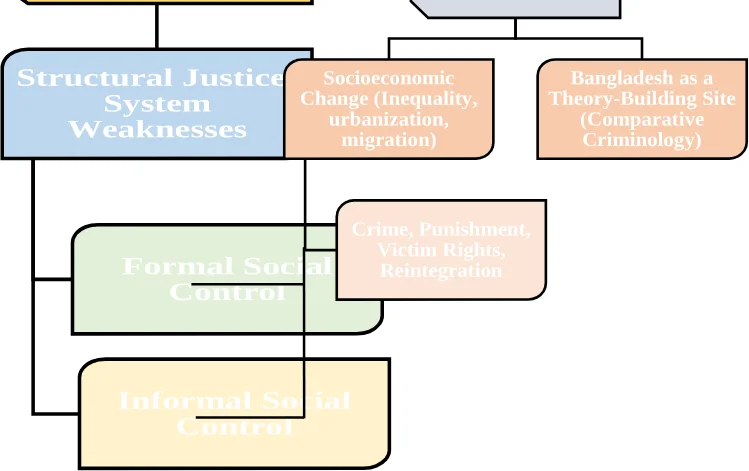
Bangladesh, thus, becomes the intersection of postcolonial legalism, structural inadequacies of the justice system, socioeconomic transformation, formal and informal social control, globalization and transnational crime in the context of this article. Comparative theory can be useful when it helps to explain the way that similar legal categories can have different impacts in different settings, and the way that apparently local practices will offer a broader understanding of the social regulation and inequality structure of the state. In this perspective, Bangladesh is used as a context to further develop comparative criminology and to challenge western based ideas about crime, punishment, justice and social control. This lens treats Bangladesh as a context for advancing the study of comparative criminology and as a challenge to western-based notions of crime, punishment, justice and social control.
3. Historical and Institutional Context
Bangladesh criminal justice system has evolved in layers. It was established during British colonial days in the Indian subcontinent, it was carried forward during the Pakistan era and it remained after Pakistan's independence in 1971. The Penal Code, 1860 is still the main substantive criminal law, defining offences and punishments. Colonial policing was set up as a state-directed structure, not one held accountable to the people, in the wake of the 1857 rebellion, through the The Police Act, 1861. Proof is regulated by The Evidence Act, 1872 and arrest, investigation, bail and trial are regulated by The Code of Criminal Procedure, 1898. Such laws provided administrative uniformity and introduced colonial ideas of order, control and authority.
The basic criminal justice system was not significantly modified to fit after the partition of India into the states of Pakistan and Bangladesh in 1947 when the newly established Bangladesh was renamed “East Pakistan.” A little bit of rehabilitative element is added by The Probation of Offenders Ordinance, 1960. The adoption of independence in 1971 did not result in the complete reconstruction of the criminal justice system, rather it is a constitutional state. While retaining colonial laws, Bangladesh has introduced new laws and institutions for the provision of legal aid, anti-corruption, cyber-crimes, anti-terrorism and women and children's protection. This gives rise to an institutionalized system that incorporates both old colonial laws and newer reforms.
The police are the first formal people to interact with in the criminal process. Their duties include the prevention, investigation and arrest of offences and maintenance of public order. The issues which continue to plague the system are politicization, inadequate investigation, custodial abuse, inadequate forensic capacity and lack of public trust (Fahim, 2026). The judicial component of the system is the adjudicative arm, however judicial delay and backlogs are a barrier to justice for the victim, accused, witness and poor defendant. The delay may lead to pretrial detention becoming punishment without test and to a loss of trust in formal law.
One of the issues of this nature that comes to mind is the prosecution system. A competent prosecution service should screen cases, evaluate evidence, coordinate with investigators, safeguard victims and witnesses and prosecute cases without the involvement of the victim or witness. Prosecution has been cited as weak, politically exposed and weak in Bangladesh, and lack of independence and case screening (The Business Standard, 2025). Cases that are not well investigated and/or influenced by politics may reach the court system and intensify delay, acquittal, backlog and lack of trust. Thus, reform in the prosecution process is a key component of the general criminal justice reform.
Prisons show up the magnified shortcomings of the system. The failure of rehabilitation and reintegration support is a result of many factors, including the poor management of prisons, arrest practices, the decision to release arrested individuals on bail, court delay, poverty, and limited legal aid. Legal assistance to disadvantaged claimants is set out in the Legal Aid Services Act, 2000, but the extent to which litigants can access legal assistance in practice depends on awareness, the quality of the legal assistance, funding, and institutional capacity. There is a lack of development of probation and correctional services, and the reunification process after probation or release is influenced by the acceptance of the family, the stigma, the job prospects and the support provided by NGOs.
Bangladesh has also established specific institutions such as anti-corruption institutions, specialized tribunals, border enforcement institutions and cybercrime institutions. These are indicative of the evolution of crime but can also lead to fragmentation when agencies are non-coordinated, lack resources, are under different control or lack accountability. The informal justice system adds to this. There are however other forums to resolve disputes that are not the formal courts, including through the hands of families, religious officials, local elites, community mediators, and neighborhood actors. These mechanisms can be available, but can also keep in existence gender inequality, class domination and a victim-blame culture.
The fields of Criminology and Criminal Justice are quite new in the academic arena in Bangladesh (University of Dhaka, 2026). In the vast majority of the country's history, the subject of crime and justice was explored in the law, sociology, public administration, the training of police officers and human rights. The establishment of science related to crime (Criminology), especially the department of Criminology at the University of Dhaka, is an important development towards Bangladesh scholarship. There remain restrictions on funding, the availability of data for the field, access to official records of victimization, victimization surveys, GIS-based analysis, and outlets for publication. Therefore a historical study on the criminal justice system in Bangladesh reveals that not only the law and the institutions need to be reformed but also the data, research capacity, rights of the victims, reintegration, informal control and knowledge production in the Global South.
4. Methodology
4.1 Research Design
This study employs a mixed methods design of contextual-comparative approach, based in Bangladesh. The design is contextual because it takes into consideration the context of Bangladesh's criminal justice system, which revolves around the legal, historical, social, and institutional framework in the country. It is comparative because of its comparison with the experience of Bangladesh and broader comparative criminology, criminal justice and Global South contexts. The study is qualitative dominated with secondary quantitative evidence. This method is appropriate for the purpose of description, not only for trends, but for explaining structures, professional experiences and practices of social control within the institutions.
4.2 Study Context
The main context of study is in Bangladesh. The choice of the country is due to the following: it was a colonial country, high population density, fast urbanization, inequality, migration patterns, vulnerabilities of the border, the management of refugees, the interaction of formal and informal social control. There are a number of sub-contexts included. Dhaka is the city and institutional hub of the world of crime control. The districts of the border, like Jashore, Sylhet, Rajshahi, Panchagarh, and Comilla are typical examples of smuggling, trafficking and informal movement. The refugee governance, humanitarian security and crimmigration converge in Cox's Bazar.
4.3 Methods and Data Sources
The study has three methodological elements. The documentary and legal analysis involves the examination of criminal laws, criminal procedure, police related laws and policies, documents about prosecution, court and prison reports, legal aid documents, government documents, NGO documents and human rights documents. A sample of 30 purposive study participants, including community actors, NGO/human rights workers, academic criminologists/legal professionals, judges, probation officers, police and prison officials, are suggested for semi-structured key informant interviews with. Secondary crime and justice data are analyzed between 2019 and 2025 to detect and track general trends in reported crime, case backlog, prison pressure, conviction, gender-based violence, trafficking, cybercrime and crime in the border areas. Multiple data sources are employed as official data can only report trends that are recorded, and cannot measure unreported crime, informal practices or victim experiences.
4.4 Analysis, Validity, and Ethics
There are three types of analyses that are applied. Documentary and legal analysis looks at continuities, institutional design and gaps for reform in the colonies. Interview data was analyzed using thematic analysis and coding was done on the following themes: policing; prosecution; judicial delay; prison conditions; victims' rights; restorative justice; informal social control; corruption; political influence; and reform priorities. Secondary Crime and Justice Data was analyses using descriptive and trend analysis. Triangulating across legal, media, official and NGO documents increases the trustworthiness. Several sources were not considered to be completely reliable due to the problems of underreporting, definitional variation, political sensitivity and poor data collection procedures. Ethical assurances involve institutional approval, informed consent, voluntary participation, confidentiality, anonymization, secure data storage, trauma-sensitive procedures, and researcher safe planning, as the study involves sensitive topics like policing, corruption, gender violence, trafficking, prisons and refugee governance.
4.5 Limitations
Official data on crime, courts, police, prisons and prosecution might be incomplete or restricted. Official statistics may not reflect informal practices or experiences of victims. Interviews may not reflect overall patterns, but rather institutional views. Secondary data on informal justice, reintegration, victim rights and restorative justice is still very limited. The results of the study should not be mechanically derived from previous patterns in all Global South contexts, due to the study's focus on Bangladesh. Though these restrictions, the design is suitable as it combines documentary, qualitative and secondary quantitative evidence in a single framework of analysis.
5. Contemporary Crime and Social Control in Bangladesh
The relationship between the formal institutions and informal mechanisms of crime and social control in Bangladesh is very close. The formal control is utilized by the police, the courts, the prosecution, prisons, legal aid institutions, border institutions, anti-corruption institutions, cybercrime institutions and specialized tribunals. They are the ones that offer the legal system that makes it possible for people to report, investigate, prosecute, try and sentence crimes. However, factors such as case backlog, poor case screening, politicization, insufficient forensic resources and unequal access to legal aid, and lack of trust in the system affect their effectiveness. By the end of 2025, the number of cases that have been halted in the lower courts reached over four million, adding to the delays and overstretched justice system (The Daily Star, 2026).
Fragmentation of institutions is also an influence on formal control. Often investigation, prosecution, court administration, prison administration and legal aid are considered to be distinct areas, but are very mutually bounded. Weak prosecution leads to acquittal and delay, court delay leads to pretrial detention, which leads to prison overcrowding and weak prosecution leads to the absence of prosecution. Formal social control is thus best seen as a series of interconnected institutions; if one part of the social control system fails in some way, then the consequences wavelet through the entire social control system.
Informal social control is also very effective and is in addition to the formal institutions. Behavior is controlled and conflict is managed by families, religious leaders, schools, neighborhood groups, peer networks and community elders and informal dispute resolution systems. These mechanisms can dissuade crime, through the power of moral expectations, collective supervision and accountability. Informal mediation could be more readily available than court in certain rural and peri-urban settings, where it is more culturally familiar, less expensive and faster than court. But it's not a simple thing with informal control. It can help to maintain inequity but it can also help to rehabilitate equity. Victims may feel forced to settle for a compromise in their communities, particularly when the violence is of a gender-based nature, the family is in conflict, there is a controversy over land, a dispute over dowry or sexual violence. There could be inequalities in voice, with local elites controlling decision-making processes, and women, children, the poor, migrants and marginalized groups having less voice. A Bangladesh focused criminology, therefore, has to critically analyse if informal social control is an effective tool to deal with criminality and what interests are being protected and what rights are being silenced.
The field of crime prevention is embryonic in the field of Bangladesh's criminological research. Far more discussion is given to punishment, than prevention. Far more discussion is given to punishment than prevention. But everyday there are families, schools, religious groups, neighborhood watch, youth supervision, community policing, peer supervision, and local leadership that engage in prevention. Community and beat policing have been recommended to create trust and mitigate violence, but the success of community policing requires accountability, engagement of communities, and linking community policing with broader justice reforms (UNODC, 2025). It was clear that a systematic documentation of the working of informal prevention practices, their success and failure in preventing harm is necessary as well as the reproduction of exclusion or local power hierarchies.
The rise of urbanization and unemployment, people moving into cities, inequality and digital change are all contributing to the growing significance of urban and youth crime. Opportunities for both legal and illegal activities are concerted at urban centers, such as Dhaka. Youth can become involved in drug markets, gangs, fraud over the Internet, and street violence, and/or engage in cyber offending. Meanwhile, numerous are denied opportunities, losing jobs, and having inadequate preventive services and recreational facilities. Substantive preventive and rehabilitative systems in place are weak, despite the presence of a legal framework to make justice a child friendly process in the Children Act, 2013. However, juvenile justice in Bangladesh needs to refined with regards to diversion, rehabilitation, family support, education based prevention and reintegration.
Gender Based Violence is one of the greatest matters with regards to crime control and access to justice (Wang et al., 2024). There are also several laws that bear on to domestic violence, rape, sexual assault, dowry related violence, trafficking, harassment and online abuse, such as the Women and Children Repression Prevention Act, 2000 and Domestic Violence (Prevention and Protection) Act, 2010. But it is not enough to put the law into being to ensure good justice. Stigma, victim blaming, pressure on the survivor, lack of evidence, inadequate investigation, delays during the trial, and intimidation are common issues faced by survivors (Jannat et al., 2025). Issues of colonial inheritance of law, limited definitions of consent, and delays in the process demonstrate that an analysis of GBV should not only be interpersonal but also legal, cultural, evidentiary, and institutional issues of power.
Further examples of the disproportionate nature of social control are made apparent by punishment and imprisonment. High level of overcrowding, poor rehabilitation, restrictive access to bail, weak reintegration and restricted access to legal assistance are related to poverty, court delay, and unequal access to bail. Reintegration of prisoners is a particular area that the research about is still under-researched. Former prisoners are frequently discriminated against, lose their jobs, are rejected by their families, suspected by the police and lack support. Reintegration is therefore often informal, and relies on the acceptance of the family, the support of the NGOs, tolerance of the community, and informal jobs. Imprisonment might compound exclusion, if not be directly linked to it, unless there is formal reintegration programming.
Lack of (underdeveloped) victim rights and restorative justice also. The criminal justice system is largely state oriented, and focuses on the offence, accused, evidence, trial, conviction and punishment of those found culpable, with victims being marginalized, particularly in gender and trafficking cases and in long trial processes. The practice of restorative justice may create opportunities for the inclusion of victims, accountability for offenders, community healing and reintegration. Voluntariness, protecting the rights of the victims, holding them accountable, being gender sensitive, and preventing the domination of local elites would all be key elements of a rights-based restorative justice process and would have to be separated from the idea of compelling informal compromise.
Table 1. Contemporary Crime and Social Control Issues in Bangladesh
| Issue | Main Control Mechanisms | Key Challenge | Research/Policy Need |
|---|---|---|---|
| Court delay and case backlog | Case processing, court or prosecution, case handling | Lack of justice delayed, prolonged detention | Prosecutor and court administration, case screening |
| Informal social control | Family, religious, community, local elites | May be used to deter crime and create inequality. | Record informal measures taken to prevent. |
| Youth and urban crime | Police, schools, family community actors | Urbanisation, drugs, unemployment and cyber offending. | The diversion and rehabilitation of youth. |
| Gender-based violence | Specialized tribunals, police, NGOs, family | Stigma, victim-blaming and legal delay. | Gender-sensitive investigation and victim protection |
| Prisoner reintegration | Prisons, probation, family, NGOs | Lack of social stigma and poor formal support | Reintegration and rehabilitation programmes. |
| Victim rights and restorative justice | The courts, NGO, informal mechanism | Victims remain peripheral | Restorative justice system of rights. |
6. Globalisation, transnational crime and border governance
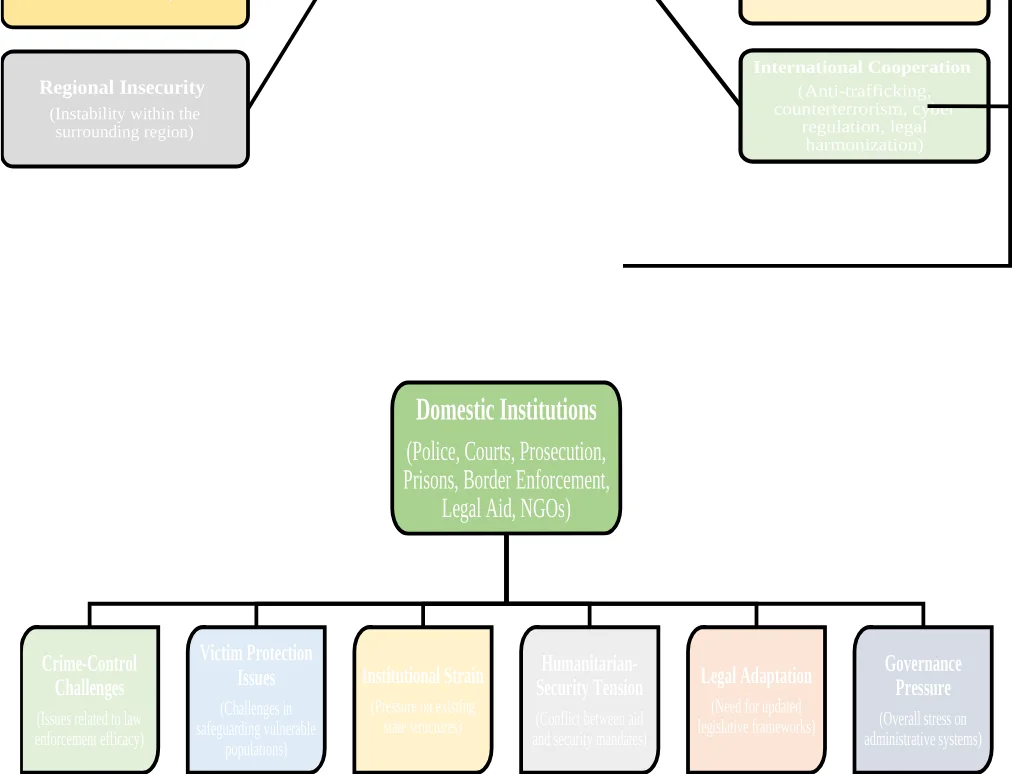
Violent and criminal activities are becoming globalized in Bangladesh. Local crime issues are connected to broader international flows such as migration and remittance economies, informal economies, cross-border trade, refugee flows, and regional security issues. The concept of crime in Bangladesh cannot be limited to the approach of local law enforcement and social control. It also needs to be examined in transnational lens, a border governance approach, digital infrastructure, humanitarian crises, and international cooperation.
Trafficking and smuggling in persons are key issues in transnational issues. Bangladesh is a source and transit ground for exploitation related to labour migration, sexual exploitation, forced labour and irregular migration. The Prevention and Suppression of Human Trafficking Act, 2012 aims to prevent trafficking in persons, punish, protect and promote safe migration. However, exploiting migration flows is not easy due to the informal process of recruitment, debt, false job promises, corrupt recruiting agents, and the lack of border oversight. Despite efforts to combat trafficking, Bangladesh remains a country of origin for trafficking, according to the U.S. Department of State, 2025.
Another major modern-day problem is Cybercrime. The rise of digital expansion has given rise to new opportunities for fraud, harassment, identity misuse, financial scams, misinformation and online gender-based abuse. In the context of cyber law, Bangladesh has amended its cyber legal structure, and subsequently the Cyber Security Act, 2023, was replaced by the Cyber Security Ordinance, 2025. The changes reflect that the control of cybercrime is not just a technical problem and it is also a rights problem. The regulation of cyberspace needs to be done in balance of providing digital security, investigation capacity, civil liberties, privacy, and freedom of expression.
Border regions have significance in terms of crime and social control. Border crossing, informal trade, smuggling, trafficking, drug trafficking and migration control is the feature of border areas of Jashore, Sylhet, Rajshahi, Panchagarh and Comilla. Border governance can also come with a clash between the livelihood needs of the local communities and the needs of national security. Local activities that appear to be “survival” or “informal trade” can be criminalized by border enforcement. In order to analyse the social production of criminalisation at the border, comparative criminology needs to look at border crime as well.
Cox's Bazar and the Rohingya refugee hosting areas are one of the most salient examples of crimmigration in the current times in Bangladesh. According to the UNHCR data, Bangladesh has more than 1 million Rohingya refugees, mainly residing in Cox's Bazar and other Rohingya refugee sites, such as Bhasan Char (UNHCR, 2026). Refugee governance integrates the humanitarian protection, policing, border control and camp administration, trafficking prevention, national security and international assistance. There is a strong interdependence between criminal justice and humanitarian governance. The relationship between migration control and crime control is demonstrated in issues of movement restrictions, camp violence, risk of trafficking, gender-based violence, documentation, dependency on aid and maritime migration.
Other forms of transnational crime include drug trafficking, money laundering, acts of terrorism and violent extremism, environmental, maritime and regulatory crimes. They put strains on the ability of any nation's justice system, as people involved in the offenses, victims, evidence, funds, communication, and legal jurisdiction might be in several countries. Hence, regional cooperation, international legal instruments, intelligence sharing, extradition, cyber capacity, anti-money laundering processes, and victim protection will all be critical to the response that can be put in place in Bangladesh. International cooperation and legal harmonization continue to be essential, but there needs to be a local approach to global standards. Cases that are not included in the imported models may not be resolved if they are not considered in the court backlog, limited resources, informal justice, political sensitivity, weak data systems, border livelihoods and public trust.
7. Criminal Justice Reform and Evidence-Based Policy
A criminal justice reform in Bangladesh needs to consider the criminal justice system as a whole, rather than look at it as a set of separate institutions. The four police reform, prosecution reform, court reform, prison reform, plus expansion of legal aid, protection of victims, restorative justice and reintegration are connected. Weak investigation destructively impacts prosecution, weak prosecution on conviction, court delay on imprisonment, overcrowding of prisons on rehabilitation, and weak rehabilitation on reoffending and social exclusion. The systemic, evidence-based and context-sensitive nature of reform must therefore be emphasized.
A major issue is to develop an independent case screening mechanism. Weak, politically influenced and/or inadequate cases could be brought into the court system if there were no effective screening, thereby increasing the case backlog. The case screening process would enable an early examination of evidence, public interest, diversion, victim and prosecutorial considerations. It ought to be connected to an existing and professional public prosecutor's office. There is a need to strengthen the independence and training of the prosecution system in Bangladesh, articulate accountability measures and coordinate with the police investigation. A professional prosecution service would have a positive effect on the quality of prosecution, speed of prosecution, victim protection and trust of the public in the prosecution service.
There needs to be accountability of police and reform in law enforcement as well. The following are reforms that need to be addressed: quality of investigations, forensic capabilities, respect for human rights, the protection of custody, the restoration of public confidence and community policing. Community policing can be used as an aid to preventive justice but in no way must it be 'symbolic. Should be connected to complaint mechanisms, local participation, gender sensitive protection, measurable outcome. The efficient processing of court cases and case management is also key. Lack of justice is not a matter of timing, it's a scale issue. Reform is needed in the areas of digital tracking of cases, tighter control over adjournments, more judicial capacity, specialized case management, alternative dispute resolution (where applicable), and better coordination between the courts, prosecution and legal aid and police.
Any improvement of the prison system must go hand-in-hand with bail, probation, legal aid and reintegration. The issue of overcrowding can't be resolved through the construction of additional prisons. It calls for a reduction in unnecessary pre-trial detention, an increase of non-custodial measures, a better system of probation, better legal representation and the creation of post-release programmes. A range of interventions for reintegration, such as employment assistance, family mediation, mental health, community supervision, vocational training, and NGO-state cooperation, should be included in prisoner reintegration.
There should be a significant area of reform in the criminal justice system for supporting individuals' rights as a victim and restorative justice. There is a need to provide the victims with well-defined victim support measures such as information rights, protection from intimidation, trauma sensitive processes, compensation mechanisms and access to legal assistance. There may be some cases where it can be helpful to use restorative justice if it is voluntary and the safety is high. It should not create an environment conducive to the creation of informal settlements and to forcing survivors to come to terms. There is also the need for a Gender-sensitive justice. Violence against women and children is punished by law, however there is stigma, poor investigations, delay and social pressure in the implementation of the laws. Special training, victim friendly reporting, capacity to digital evidence, witness protection, enhanced legal aid, trauma-informed courtroom practice, must be a part of reform. A prevention, diversion, rehabilitation and reintegration approach are needed in juvenile justice, not the use of punitive measures.
Evidence-based reform is needed because criminal justice policy can have a political undercurrent, can be focused on donor grant requirements, or can be influenced by public anger or imported from other countries. There is need to have better administrative data, victimization surveys, GIS based crime mapping, longitudinal studies, mixed method evaluation and pilots of policies in Bangladesh. Effectiveness, fairness, cost, feasibility of implementation and unintended consequences are all factors to consider when evaluating the effectiveness of reforms. It can be beneficial to learn from policies in other countries (such as England, India or elsewhere), but these must be tailored to the local legal culture, institutional capacity, informal social control, socioeconomic conditions and lack of data in Bangladesh.
Table 2. Criminal Justice Reform Priorities in Bangladesh
| Reform Area | Existing Weakness | Evidence Needed | Policy Direction |
|---|---|---|---|
| Case screening | Weak cases go to court. | Data on case outcome and case dismissed. | Independent screening mechanism |
| Prosecution | Dispersed and politically exposed | Prosecutorial performance data | Permanent professional prosecution service |
| Police reform | Inadequate investigation and public distrust. | Complaint, investigation and forensic data | Accountability and forensic capacity is of paramount importance. |
| Court management | A significant backlog and delay. | Case-flow information and adjourned information | Digital tracking and case management software. |
| Prison reform | Undertrial detention and overcrowding. | Prison population and bail data | Non-custodial and Probationary Sentences. |
| Reintegration | Weak post-release support | Post-release follow-up data | Work, family and the support of NGOs and the state. |
| Victim rights | Limited participation and protection of the population. | Victim experience data | The framework of victim assistance and protection. |
| Crime prevention | Poor documentation | GIS and community-level data. | Evidence-based prevention strategy |
8. Barriers to Comparative Criminological Research
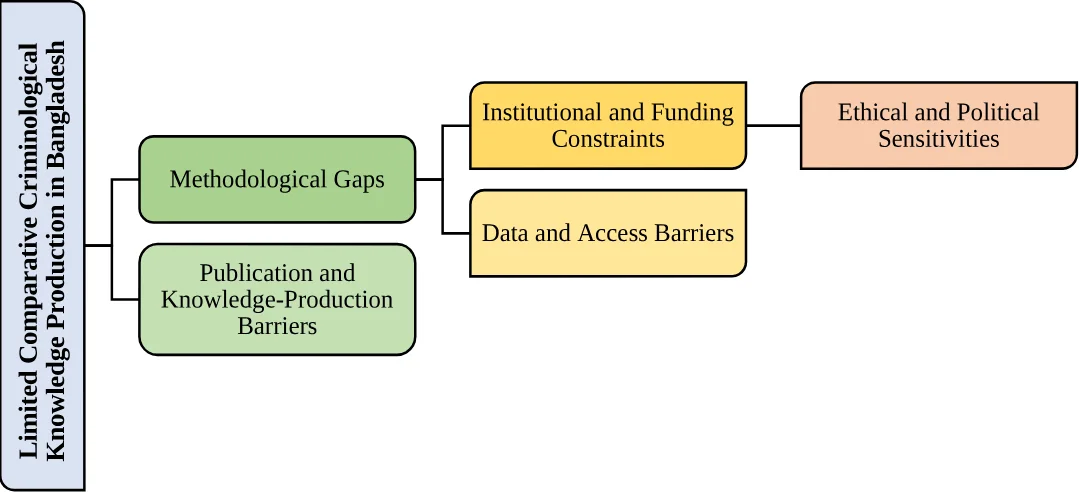
Thus, there are certain problems in conducting comparative studies on the crime situation in Bangladesh. The first one is the Data Access. There are limited, fragmented and difficult-to-come-by reliable crime and justice statistics. There are no shared traits between Police, Court, Prison, Prosecution, Legal Aid and Victim Support data (Islam et al., 2024). The definitions, recording and reporting vary among different agencies. It is a result of this that it is hard to follow a case through the entire criminal justice system up to reporting, investigation, prosecution, trial and sentencing, imprisonment and release.
Another serious issue is the underreporting. This is because many offences, in particular domestic violence, sexual violence, corruption, trafficking, police abuse, political violence and informal community disputes may never make the “statistics”. Often victims do not report due to stigma, fear, retaliation, mistrust, legal costs, family pressure, and/or lack of understanding about legal consequences. Official statistics are thus on the basis of recorded crime, which may not reflect actual crime.
Another limitation of the field is the lack of methodological approaches. There is limited documentation of informal social control, victimization surveys, self-report studies and longitudinal research in Bangladesh, as well as limited GIS-based crime mapping. The research on crime prevention is limited and the role of family control, religious control, neighborhood control, peer control and community mediation are under-researched. Researchers may otherwise be tempted to rely solely on official statistics to the detriment of their understanding of the everyday practices of social control that they may not have collected. The field is also understrength due to institutional and funding constraints. Limited funding for research, poor links between the university and the government and access to justice sector institutions which relies on one's networks. The country of Bangladesh does not have a robust national criminological database to help facilitate longitudinal, spatial and comparative analysis. Training on advanced quantitative methods is also uneven, as is training on qualitative research, GIS, mixed method design and on policy evaluation.
Publication and knowledge production barriers are both significant. Research work on Bangladesh could not be submitted to high impact factor journals, if it is considered as local, descriptive or not having a generalizable approach (Zaman et al., 2025). Meanwhile, the Northern theories of crime continue to prevail and Bangla language skills and a Global South perspective are underrepresented. This is what leads to the Creation of structural imbalance in which the issues of Bangladesh are studied but the country is not studied as a place for theory building. Ethical and political sensitivities also pose challenges for research on policing and corruption, political violence and terrorism, trafficking in persons, gender-based violence, victim rights, and prison conditions, border crime, and refugee governance, as it can put participants and researchers at risk. It is therefore crucial that the ethical guidelines are well enforced, such as informed consent, confidentiality, anonymity, safe interview environments, safe data storage, trauma-informed interview techniques, and researcher safety guidelines. These barriers do not preclude the possibility of criminological research that focuses on Bangladesh, but they highlight the need for proper designs, institutionalisation, and context-sensitive research techniques for the field of criminology.
9. Discussion
Bangladesh should not be considered just an empirical comparison case study. It needs to be perceived as a theory-building space that extends, refines and challenges criminological knowledge, which is based on Western country assumptions. A lot of the mainstream theory has been developed on the basis of the institutional experience from the Global North, particularly from the USA, the UK and Western Europe. Theories of crime, punishment, policing, prosecution, social control and reform are often presented as universal, when in fact they have a very limited basis in empirical studies that are geographically very limited. Comparative criminology can be most useful in revealing this limitation and in posing questions about the scope of crime and justice in various historical, legal, social and institutional settings (Nelken, 2010; Pakes, 2019).
Bangladesh plays its part in this as it is an outcome of the postcolonial legacy, weak institutionalization, fast urbanization, informal social control, gender disparities, migration pressures, refugee governance and susceptibility to transnational crime. These characteristics make it difficult to make traditional understandings about criminal justice modernization. For example, the influence of colonial criminal law and policing is still apparent, indicating that postcolonial justice systems are not merely "new" instances of western legal systems. They are overlaid systems in which colonial agendas and national sovereignty, political power and current reform demands are all present. This makes Bangladesh highly relevant to postcolonial criminology which looks at the impact of colonial legal and penal framework on the crime control in the postcolonial societies (Agozino, 2003).
Bangladesh also promotes the development of Southern criminology, the other side of the coin from Northern criminology, by eroding the power of the Northern criminological knowledge. Carrington et al. (2016), suggest that the field of criminology needs to look away from the theory from north to south "one-way street. Bangladesh is an example of how this is an issue. The formal law is not the sole determinant of crime and justice in Bangladesh but also family norms, religious laws, neighborhood power, power of local elites, informal justice, political influence, mobility, poverty and access to state institutions. These conditions need criminological theories to be more engaged with Global South conditions, rather than peripheral and/or exceptional.
The Bangladeshi case adds a new dimension to issues of prosecution reforms and delays in the judiciary and institutional legitimacy. Comparative criminal justice tends to look at police, court and prisons as standalone entities, but the criminal justice system is a weak system in Bangladesh and needs to be analyzed as a process. Weak investigation can negatively impact prosecution, weak prosecution can negatively impact acquittal, or delay in cases; court backlog can negatively impact pretrial detention; prison overcrowding can negatively impact reintegration; and weak reintegration can negatively impact social exclusion. This system-wide connection extends the scope of comparative criminology from those of isolated institutions to a approach that is process-oriented and considers a criminal justice failure.
Bangladesh has also been an important place in the context of the theories of informal social control. Family, school, community and moral control are concepts frequently highlighted in the social control theory as factors that restrain from offending. Such mechanisms are very apparent in Bangladesh but are not necessarily protective. Family, religion, the neighborhood, elites and community conflict mediation can both inhibit violence and help manage conflict, but can also muffle the voices of victims, perpetuate patriarchy, regulate class hierarchy and coerce oppressed populations into conciliation. This dual nature questions stereotypical notions of community justice and demonstrates the need to take a crime prevention and rights-based approach to informal means of justice.
An additional aspect in which Bangladesh can participate in comparative discussions is victim rights and Restorative Justice. When talking about restorative justice in the western perspective, it is often presented as an alternative to punitive justice. Informal dispute resolution is not necessarily in accord with restorative justice principles, but exists already in Bangladesh. Settlements in the community can seem like the good old days, but often are not voluntary, protective for victims, holding offenders to account, gender-inclusive, and well-proceduralized. These differences between informal compromise and restorative justice in the context of rights become more apparent when seen in the context of Bangladesh. This is important for Global South justice reform, where there is often access to community mechanisms but these are not always fair (Zehr, 2014).
Imprisonment and prisoner reintegration are also themes of discussion in the Bangladeshi context. Punishment is not only a function of crime, but also of inequality, labour markets, poverty and state capacity, as shown in the political economy approaches (Garland, 2002; Wacquant, 2009). In Bangladesh, the issues of overcrowding in prisons and difficulties in securing legal assistance, delays in court proceedings, social stigma and pretrial conditions are all closely connected to poverty and lack of reintegration capacity. Reintegration is particularly significant as it will be seen that the return to prison does not equate with becoming reintegrated in society. Past offenders could experience difficulties in finding a job, rejection by family and friends, and be targeted by police surveillance in the community. Bangladesh is then an example of punishment not being confined to the prison and to the social lives after release.
Bangladesh also is another contributor to the border criminology and crimmigration. The Rohingya refugee situation, border areas, trafficking corridors, irregular migration and refugee-humainitarian-security dynamics illustrate the intersection between the two fields of criminal justice and migration control and national security. Although the theory of 'crimmigration' helps to explain the convergence of criminal law and immigration control, there is also a Global South humanitarian aspect to the issue in Bangladesh (Aas & Bosworth, 2013). The refugee governance, policing, aid dependency, trafficking susceptibility and mobility constraints are a recipe for new forms of social control, as illustrated in Cox's Bazar.
The implications encompass the theoretical, methodological and policy levels. From the theoretical point of view, the roles of crime, justice and control in the context of the Global South, specifically in the context of Bangladesh, can be enriched by showing the theoretical perspectives of the theories of Bangladesh. In terms of methodology, triangulation, sensitivity to context, mixed methods, qualitative fieldwork, official data, and more spatial and longitudinal analyses are necessary for research that focuses on Bangladesh. The policy must be evidence-based, locally based, victim-sensitive and institutionally realistic reforms at the policy level. Prosecution, policing, restorative justice, or rehabilitation models can be imported but they need to be made Bangladesh specific, given limited resources, the informal nature of the justice system, and the social inequalities in Bangladesh. The contribution of Bangladesh to comparative criminology is not only to introduce another country into the comparative criminology literature, but also to the very concepts of comparative criminology.
10. Conclusion
In this article, it is suggested that the context of the study of Bangladesh is valuable but under-studied in comparative criminology and criminal justice. It is of contemporary relevance due to its postcolonial legal system, institutional problems, problems in prosecutions, case backlog, informal social control, gender-based violence, lack of rights for victims and issues of prisoner reintegration with transnational crime also being a problem. Bangladesh is not just a country of crime and justice issues but it has also become a platform to discuss theoretical, methodological and policy issues around crime and justice.
A comparative criminology that focuses on Bangladesh is typically central in breaking away from the Western-centered assumptions of the field. It demonstrates that the legal history, institutional capacity, poverty, migration, informal authority, gender relations, border governance and political economy have an influence on crime and social control. It further demonstrates that criminal justice reform is not just for the individual criminal justice institutions. All police, prosecution, court, prison, legal aid, victim protection, restorative and reintegration efforts must be thought of as elements of the same justice process.
For future studies, the need is for research to be conducted in areas where there is limited evidence. These relate to independent case screening, public prosecution reform, police accountability, court delay, prison overcrowding, prisoner reintegration, victim rights, restorative justice, gender-based violence, juvenile justice prevention, GIS-based crime mapping, trafficking, drug control, border crime, Rohingya refugee governance and informal justice. A comparative study can also be done between Bangladesh and other south Asian or other global south jurisdictions to a greater degree. Bangladesh has a need for developing better criminology curriculum, creating specialized research Centre, establishing partnership between University and Government, National criminology and Justice data bank, training in comparative criminology, training in GIS and mixed-methods, international collaboration and mentoring for early career scholars at the institutional level.
In the end, comparative criminology based on Bangladesh can help develop a more inclusive theory, bolstered with more empirical knowledge and informed by the context of Bangladesh for reform. A serious study of Bangladesh can help the field to develop a more authentic knowledge and understanding of crime, punishment, justice and social control in a global context.
Declarations
Author Contributions
Md. Bazlur Rahman is the sole author of this article. He designed the study, developed analytical framework, did the documentary and legal review, gathered and analyzed the interview data, analyzed secondary sources, wrote the manuscript and approved the final version submitted for publication.
Funding
This work has not been funded by any specific agency in the public, commercial or not-for-profit sectors.
Conflict of Interest
The author states that there are no conflict of interest relating to the research, authorship, or publication of this article.
Data Availability Statement
The analysis draws on public legal documents, government reports, NGO and human rights documents, academic publications, secondary crime and justice data (2019-2025) and 30 semi-structured key informant interviews. Sources that are made available to the public are referenced in the reference section and made available via government sites, public archives, or academic journals. Data collected during interviews are not available to the public due to confidentiality and ethical concerns.
References
- Aas, K. F., & Bosworth, M. (Eds.). (2013). The Borders of Punishment: Migration, Citizenship, and Social Exclusion. Oxford University Press. https://doi.org/10.1093/acprof:oso/9780199669394.001.0001
- Agnew, R. (1992). Foundation for a General Strain Theory of Crime and Delinquency*. Criminology, 30(1), 47–88. https://doi.org/10.1111/j.1745-9125.1992.tb01093.x
- Agozino, B. (2003). Counter-Colonial Criminology: A Critique of Imperialist Reason (1st ed.). Pluto Press. https://doi.org/10.2307/j.ctt18fsbt7
- Ali, S. H., & Rehman, T. U. (2025). The Police-Prosecution Nexus in Pakistan: Exploring Institutional Coordination and its Impact on Criminal Justice Outcomes. Regional Lens, 4(4), 1–7. https://doi.org/10.55737/rl.2025.44119
- Bennett, R. R. (2009). Comparative Criminological and Criminal Justice Research and the Data that Drive Them. International Journal of Comparative and Applied Criminal Justice, 33(2), 171–192. https://doi.org/10.1080/01924036.2009.9678804
- Carrington, K., Hogg, R., & Sozzo, M. (2016). Southern Criminology. British Journal of Criminology, 56(1), 1–20. https://doi.org/10.1093/bjc/azv083 Children Act. (2013). Act No. XXIV of 2013. http://bdlaws.minlaw.gov.bd/act-1119.html
- Cohen, L. E., & Felson, M. (1979). Social Change and Crime Rate Trends: A Routine Activity Approach. American Sociological Review, 44(4), 588. https://doi.org/10.2307/2094589 Cyber Security Act. (2023). Act No. 46 of 2023. Cyber Security Ordinance. (2025). Ordinance No. XXIV of 2025. http://bdlaws.minlaw.gov.bd/act-1538.html Domestic Violence (Prevention and Protection) Act. (2010). Act No. LVIII of 2010. http://bdlaws.minlaw.gov.bd/act-1063.html
- Evans, T. D., Lagrange, R. L., & Willis, C. L. (1996). Theoretical development of comparative criminology: Rekindling an interest. International Journal of Comparative and Applied Criminal Justice, 20(1), 15–29. https://doi.org/10.1080/01924036.1996.9678559
- Fahim, M. H. K. (2026). Arbitrary Arrest and Preventive Detention in Bangladesh: Law and Practice. Journal of South Asian Issues (JSAI), 1(1), 163–171. https://doi.org/10.65826/JSAI.1.1.2026.38
- Garland, D. (2002). The Culture of ControlCrime and Social Order in Contemporary Society. Oxford University Press. https://doi.org/10.1093/acprof:oso/9780199258024.001.0001
- Islam, M. J., Suzuki, M., & Mazumder, N. (2024). Promoting access to justice in Bangladesh: Towards a hybrid justice model. International Journal of Law, Crime and Justice, 77, 100655. https://doi.org/10.1016/j.ijlcj.2024.100655
- Jannat, A., Akter, M., Fahim, M. B., & Nabi, Md. M. (2025). Nature and Causes of Secondary Victimization of Rape Victims in Bangladesh: A Review Analysis. https://doi.org/10.5281/ZENODO.16952010
- Karstedt, S. (2001). Comparing cultures, comparing crime: Challenges, prospects and problems for a global criminology. Crime, Law and Social Change, 36(3), 285–308. https://doi.org/10.1023/A:1012223323445 Legal Aid Services Act. (2000). Act No. VI of 2000. http://bdlaws.minlaw.gov.bd/act-details-834.html
- Merton, R. K. (1938). Social Structure and Anomie. American Sociological Review, 3(5), 672. https://doi.org/10.2307/2084686
- Mia, T., Siraji, T. A., & Hossain, J. (2025). The Prison System of Bangladesh: From Recidivism to Reformation. 8. https://doi.org/10.37231/apj.2025.8.2.755
- Nelken, D. (2010). Comparative Criminal Justice: Making Sense of Difference. SAGE Publications Ltd. https://doi.org/10.4135/9781446251546
- Okikiola, N., & Oloyede, M. O. (2025). Informal Social Control Methods in Modern Societies; Social Order and Conformity in Nigeria. https://doi.org/10.13140/RG.2.2.27380.67201
- Pakes, F. (2019). Comparative Criminal Justice: Fourth Edition (4th ed.). Routledge. https://doi.org/10.4324/9781315175942 Prevention and Suppression of Human Trafficking Act. (2012). Act No. III of 2012. http://bdlaws.minlaw.gov.bd/act-1086.html
- Rana, S. (2025). Comparative Criminology, Victim Rights, and Restorative Systems in Bangladesh, India, and the United States. Journal of Criminology and Criminal Justice Studies, 3. https://doi.org/https://doi.org/10.47509/JCCJS.2025.v03i02.05
- Reichel, P. L. (2018). Comparative criminal justice systems: A topical approach (7th edition). Pearson.
- Sampson, R. J., & Wilson, W. J. (2013). Great American city: Chicago and the enduring neighborhood effect (Paperback edition). The University of Chicago Press.
- Shaw, C. R., McKay, H. D., & McCay, H. D. (1972). Juvenile delinquency and urban areas: A study of rates of delinquency in relation to differential characteristics of local communities in American cities (Rev. ed., 2. impr). The Univ. of Chicago Press. The Business Standard. (2025, February 1). Weak investigation, unprofessional prosecution hindering justice: Chief justice. The Business Standard. https://www.tbsnews.net/bangladesh/court/weak-investigation-unprofessional-prosecution-hindering-justice-chief-justice The Code of Criminal Procedure. (1898). Act No. V of 1898. The Daily Star. (2026). Over 40 lakh cases pending in lower courts, law minister tells Parliament. https://www.thedailystar.net/news/the-parliament-watch/parliament/news/over-40-lakh-cases-pending-lower-courts-law-minister-tells-parliament-4152846 The Evidence Act. (1872). Act No. I of 1872. The Penal Code. (1860). Act No. XLV of 1860. The Police Act. (1861). Act No. V of 1861. The Probation of Offenders Ordinance. (1960). Ordinance No. XLV of 1960. UNHCR. (2026). Bangladesh: Operational data portal. United Nations High Commissioner for Refugees. https://data.unhcr.org/ar/country/bgd/12112 University of Dhaka. (2026). Department of Criminology. https://criminology.du.ac.bd/ UNODC. (2025). Bangladesh: Strengthening community policing to counter violent extremism and promote peace and security. United Nations Office on Drugs and Crime. https://www.unodc.org/southasia/en/frontpage/2025/February/bangladesh_-strengthening-community-policing-to-counter-violent-extremism-and-promote-peace-and-security.html U.S. Department of State. (2025). 2025 Trafficking in Persons Report: Bangladesh. United States Department of State. https://www.state.gov/reports/2025-trafficking-in-persons-report/bangladesh/
- Wacquant, L. (2009). Punishing the Poor: The Neoliberal Government of Social Insecurity. Duke University Press. https://doi.org/10.2307/j.ctv11smrv3
- Wang, S., Elefante, M., & Bonfert, A. T. (2024, December 5). Ensuring women’s safety: Data insights on gender-based violence legislation and policies. World Bank Blogs. https://blogs.worldbank.org/en/opendata/ensuring-women-s-safety--data-insights-on-gender-based-violence- Women and Children Repression Prevention Act. (2000). Act No. VIII of 2000.
- Zaman, T. A. B., Haque, T., Gupta, H. S., Sameer, M., & Nofal, O. (2025). Computational review of disaster resilience research in Bangladesh. Progress in Disaster Science, 28, 100486. https://doi.org/10.1016/j.pdisas.2025.100486
- Zehr, H. (2014). The little book of restorative justice: Revised and updated. Good Books.
CITE THIS ARTICLE
Rahman, M. B. (2026). Crime, Justice, and Social Control in Bangladesh: A Contextual-Comparative Criminology Perspective. https://www.bazlurrahman.com/article/a5cb8f98-7b5f-47f6-8543-bdd08b8ea1c5
M. B. Rahman, “Crime, Justice, and Social Control in Bangladesh: A Contextual-Comparative Criminology Perspective,” 2026. [Online]. Available: https://www.bazlurrahman.com/article/a5cb8f98-7b5f-47f6-8543-bdd08b8ea1c5
Rahman, M. B. (2026) ‘Crime, Justice, and Social Control in Bangladesh: A Contextual-Comparative Criminology Perspective’. Available at: https://www.bazlurrahman.com/article/a5cb8f98-7b5f-47f6-8543-bdd08b8ea1c5
Rahman, Md. Bazlur. “Crime, Justice, and Social Control in Bangladesh: A Contextual-Comparative Criminology Perspective.” 2026, https://www.bazlurrahman.com/article/a5cb8f98-7b5f-47f6-8543-bdd08b8ea1c5.
Md. Bazlur Rahman. “Crime, Justice, and Social Control in Bangladesh: A Contextual-Comparative Criminology Perspective.” (2026). https://www.bazlurrahman.com/article/a5cb8f98-7b5f-47f6-8543-bdd08b8ea1c5.
Rahman MB. Crime, Justice, and Social Control in Bangladesh: A Contextual-Comparative Criminology Perspective. 2026. https://www.bazlurrahman.com/article/a5cb8f98-7b5f-47f6-8543-bdd08b8ea1c5
@misc{article_a5cb8f987b5f47f68543bdd08b8ea1c5,
  title = {Crime, Justice, and Social Control in Bangladesh: A Contextual-Comparative Criminology Perspective},
  author = {Md. Bazlur Rahman},
  year = {2026},
  url = {https://www.bazlurrahman.com/article/a5cb8f98-7b5f-47f6-8543-bdd08b8ea1c5},
}
TY - GEN AU - Md. Bazlur Rahman TI - Crime, Justice, and Social Control in Bangladesh: A Contextual-Comparative Criminology Perspective PY - 2026 UR - https://www.bazlurrahman.com/article/a5cb8f98-7b5f-47f6-8543-bdd08b8ea1c5 ER -