Public safety is often considered to be a problem-solving topic. The current study suggests that public safety would be best formulated as a negotiated regime a dynamic process of actors, resources, and practices that create, contest, and implement the urban order. The ideas of public safety regimes and negotiated social order are applied to analyze public safety governance in Dhaka, Bangladesh's capital. It adopts a qualitative case study approach that combines semi-structured interviews with police officials, local government officials, NGO workers, journalists, community leaders and residents (n=15) and policy and media documents analysis. Thematic analysis was used to analyse the data. The five themes were contending definitions of public safety; institutional tensions and fragmentation; political influences and local power; low levels of community engagement; and inconsistent safety outcomes. The findings expose that there is no single public safety provider in Dhaka. It comes into view from the interplay of formal institutions, political actors and communities, and is a product of informal relations, administrative boundaries and socioeconomic disparity. The study broadens negotiated order theory to a dense South Asian city, and illustrates that the analysis of regime cannot just focus on who coordinates and who doesn't, but it has to focus on the question of who is included and who is excluded. It draws conclusions about the requirement for inclusive governance, coordination of public safety efforts, accountability, and attention to lived experience to ensure a fairer public safety.
Research ArticlePolitical CriminologyIn progress
An Examination of Public Safety Regimes through the Lens of Negotiated Social Orders and Political Analysis in Contemporary Criminological Research
Correspondence: mdbazlurrahman186@gmail.com
Abstract
Keywords Public SafetyNegotiated Social OrderPolice GovernancePolitical CriminologyUrban SecurityDhakaBangladesh
1. Introduction
Public safety is recently a significant issue of criminology. It is no longer viewed simply as one of crime control. It is also a political and social process which is impacted by institutions, actors and the interactions between them. Existing literature demonstrates that the public safety concept can be understood as a regime, marked by a process of 'building up' the capacity to govern through the interactions between the state agencies, local authorities and community actors (Blair et al., 2021; Edwards & Hughes, 2012). One from this perspective, public safety regimes are not set in stone. They are evaluated to be negotiated orders, in which the power is involved, policies are devised and the day-to-day constraints of governing are in play (Carr, 2012; Da Cruz et al., 2019).
The concept of negotiated social order offers an understanding of the process of producing public safety through concession and coordination within institutions and management of conflict in everyday life. This is a step beyond the traditional belief of policing and emphasizes the political aspects of governance of safety. According to Edwards and Hughes (2012) regime theory is helpful for analyzing the organization of public safety among various actors and settings, particularly when there is a progression of formal and informal governance structures. Similarly, Carr (2012) illustrates how community crime control is dependent on the process of negotiation, legitimacy, and notions of order within the community. These arguments all suggest that public safety is not only a socially produced process, but a politically contested one as well.
Despite this progress, there is still few knowledge about the workings of public safety regimes in particular cities, particularly in the ‘Global South’. Public safety in Bangladesh is continually negotiated due to the enhanced pace of urbanization, inequalities, segmented institutions, and the challenges on the police. Dhaka, the capital, serves as a practical example as it is the seat of political power, its policing institutions, and a multitude of demands for security. The study of Dhaka can then provide perspectives into the dynamics between state institutions and local actors in a context of political tension and administrative complication, and therefore the methods of public safety.
This study explores public safety regimes from the point of view of negotiated social order and political analysis in the context of Dhaka. It investigates, through a qualitative case study, the definitions, negotiation and the implementation of public safety by various actors, and how these impact governance results. The overall purpose of the study is to describe the understanding, coordination and contestation of public safety among the various actors, as well as to demonstrates that this process results in differential outcomes throughout the city. This does so by advancing scholarship relating to urban security, governance and political order in a developing-country context. The literature review is followed by a summary of methods, five themes from the data, discussion of the themes with theory and conclusions for policy and practice.
2. Literature Review
Public safety is not only about controlling crime, but about negotiating and establishing order, and about the role of political and institutional processes in achieving that. Public safety is now recognised as more than simply the management of crime; it is a political and institutional process in which order is negotiated, defined and realised. The traditional approaches look at public safety as being achieved because of the ability of the police to be effective, the ability of the law to be enforced, and/or the ability of the crime-prevention policy to be applied. Recent research indicates, however, that public safety should be conceived as a regime, which is a dense, but not stable, constellation of actors, resources, concepts and governing procedures. Edwards and Hughes (2012) believe that public safety regimes are negotiated between state agencies, local government, private companies and community groups. This perspective detracts from the focus on sovereign power and moves to the more mundane political activities in which the power to govern is formed (Kythreotis, 2025).
Negotiated order is a key concept of the process of producing public safety in everyday settings. Carr (2012) demonstrates how the process of community crime control relies on a process of negotiation between the community and the police, particularly if the community are willing to be recognised as partners in establishing order. Therefore, NORT can be used to account for the fact that public safety can't be formalized or institutionalized into policy. Instead, it is through the interplay of actors with potentially unequal power and their interactions, compromises, conflicts, and selectiveness with one another that safety emerges. In this respect, public safety is not only provided by the police, it is socially created by the local relations and political negotiations (Shabir & Khabeer Fatima, 2024).
This is a way of relating with other discussion of indirect rule and plural governance. In the modern era crime control is becoming more indirect, as Garland (1997) suggests, by using risk management, delegating responsibility and coordinating agencies. Coercive policing is thus not the only factor influencing public safety; administrative thinking, expert knowledge and proactive approaches that promote risk management are also having an impact on it. There is a related argument that the rise of the regulatory state has altered criminology in that it has shifted control of governance beyond the direct control of the state made by Braithwaite (2000). The ideas are important for public safety regimes as they demonstrate that public safety is distributed, not just with the police.
Research on policing also shows that the nature of safety practices is influenced by the organisational setting, the culture and values of the organisation. Klinger (1997) proposes an ecological theory of police response which suggests that the behaviour of the police will differ across communities based on the amount of crime, deviance and the work rules employed in a community. Safety practices are thus not consistent throughout the urban environment, but vary with officers' perceptions of their environments, the conditions in the neighborhoods, and institutional routines. Both Whelan and Molnar (2019) demonstrate that within the sphere of public-order policing, internal tensions, risk perceptions, planning and agency relations all influence public-order policing. These studies are useful in the context of the Dhaka Metropolitan Police, as they illustrate the influence of negotiations as well as of reality and limitations on the nature of policing.
The public trust and legitimacy is also essential to safety. Instead of fearing specific crime, Jackson and Bradford (2009) say, people's trust in the police is more related to their wider worries about social order, cohesion and integrity of institutions. So, people make their moral and symbolic judgements about public safety, in addition to crime statistics. Public perceptions of fairness and responsiveness can have a significant influence on the sense of security as it can be perceived as protective or coercive in a city such as Dhaka where policing is embedded in the political, social and administrative dynamics (Ahsan, Hasan, & Rumi, 2024).
There is an expanding body of work that challenges the definition of public safety which is narrow and punishment, or punishment-like. There is an increasing amount of work that challenges narrow, punishment-based definitions of public safety. Dominant safety talk has been argued by Rabelo et al. (2024) to only acknowledge policing and punishment as normal ways of responding to insecurity while obscuring the potential harm that these practices can inflict on marginalized communities. However, it is clear that, as Wozniak (2023) illustrates, communities can support investment while simultaneously receiving criticism from politicians, indicating that they may also be more receptive to non-punitive safety approaches than politicians think. McDowell (2019) builds on this by highlighting visions of safety based in kinship, local knowledge, and collective care that are community based. Together these studies indicate that public safety is a political construct and subject of contestation; public safety is defined differently by different actors and the resulting policy priorities are as a result.
The other lens for the study of negotiated safety is urban public space. Barker (2016) suggests that order in public space is not just defined as being about exclusion, enforcement or reassurance policing. Mediated conviviality, on the other hand, focuses on basic rules based on harm, good mediation practices and facilitation of coexistence. The same helps the city of Dhaka, as it is not just about managing crime that makes a city safe, but also managing the movement, the informal sector, the protest, the street culture, the neighborhood conflicts, and the everyday interactions that take place on the streets. So there are two types of methods for making order in public safety regimes: coercive methods and non-coercive ones (Ghosh, 2023).
Research into criminal governance in the Global South adds to the typical perceptions. For Lessing (2021), criminal governance occurs when there are non-state and/or extralegal actors that govern everyday life and establish informal laws. Mantilla and Feldmann (2021) emphasize that there is no strict division between state and criminal actors that operate in order, as they may share, fight or alternatively govern it. Magaloni et al. (2020) demonstrate that policing can have different impacts when it is taking place within existing forms of local rule. While there are no parallels with Dhaka, this literature is relevant insofar as it helps to illustrate the nature of urban safety that sees connections between formal authority, informal power, political influence and community level governance.
The literature indicates that there are four interrelated processes that help to form public safety regimes. Safety is first of all a political production in terms of conflicting ideologies of order, risk and protection. Second, safety governance processes are negotiated with a number of actors such as the police, local government, community leaders, NGOs, residents and the media. Thirdly, safety practices are unevenly experienced by social groups and urban space and have differential outcomes. Fourth, local settings are important: regimes are not simply understood without a consideration of the ways in which the capacity to govern is gathered in the specific place.
Important gaps remain. The majority of the current research has a western perspective, particularly that of the USA, the UK and Latin America. Less focus has been on the working of public safety regimes in cities of South Asia, like Dhaka. Previous research also tends to take an either/or approach to policing, governance, community safety, and/or criminal governance, instead of an integrated one through the prism of negotiated order and political analysis. This is a gap in the knowledge of how public safety is shaped, challenged and enacted in complicated urban environments that are a space for formal authority, local politics, a divided administration and community needs to meet. This gap is sought to be filled in the present study by conducting a qualitative case study of Dhaka Metropolitan Police and the other actors involved in the study area.
3. Methods
3.1 Research Design and Case Selection
The focus in this study is public safety as negotiated regime and the design is qualitative, in a case study approach. The purpose of understanding meaning, interpretation, institutional practices and relationship between actors in relation to safety governance is best achieved by means of a qualitative design. The study does not just focus on the indicators of public safety, which are usually reported in the form of crime data or formal outputs, but rather explores the meanings of, the negotiations around, the contestations of, and the enactment of public safety. The case study approach is appropriate as safety governance is context-specific, contextually embedded in specific institutional, political and social contexts. Case study research can be helpful if the phenomenon being studied is currently occurring and the relationship between the phenomenon and its context is not evident (Yin, 2018).
The study is based in Dhaka with a special consideration of Dhaka Metropolitan Police (DMP) as a key player in urban safety. The city of Dhaka was chosen because it is the capital, a key center of political authority, rapid urbanization, institutional complexity and a variety of safety issues. The city convenes formal policing institutions, local government, community actors, civil society, media and community members impacted by safety policy. The DMP is a suitable case as it is a key component in keeping public places orderly, preventing crime, controlling space, responding to security concerns and in performing public facing policing. The study focuses on the DMP, but also examines the perspectives of other stakeholder groups, and so compares and contrasts the understanding of the concepts of safety, authority, coordination, conflict and accountability of different actors.
3.2 Participants and Sampling
The participants represented key stakeholders, directly or indirectly engaged in safety governance in the city of Dhaka. They comprised DMP officials, local government officials, ward councillors, community leaders, NGO workers, journalists and people impacted by policing and/or safety policy. Multiple groups matter because safety is created as a result of the interaction between state and non-state actors who have divergent understandings of safety, risk, order, legitimacy and responsibility.
The study used purposive sampling to be able to get those who had first-hand knowledge, first-hand experience and lived experience of safety governance. The purposeful sampling method is appropriate for qualitative studies for it is used to select participants that contain information that will be useful in developing a detailed understanding about the research problem (Patton, 2023). Police officials gave information about the way decisions are made in their institutions and their priorities; local government representatives and ward councillors provided information about the way safety is negotiated at the local government level; community leaders and NGO actors shared information about community concerns and gaps in official responses; journalists shared information about community discourse and community framing; and residents shared information about everyday experiences of policing, insecurity and unequal outcomes. Fifteen semi-structured interviews were carried out. The number of cases is appropriate for a qualitative case study, whose goal is to provide in-depth understanding and not statistical representation, and interviews were conducted until the same themes were starting to appear in the interviews.
3.3 Data Collection
Semi-structured interviews and document analysis were used for the study. Triangulation between stakeholder accounts and institutional and public documents was possible through using more than one source. Semi-structured interviews were primarily used as these enable the use of set questions, but also allow the participant to express their experiences and concerns in their own words. The interviews focused on the definitions of safety, decision making, coordination of actors, locations of conflict and implementation of policies. They also put questions regarding institutional authority, involvement of community, political influence, resource constraints, accountability and unequal outcomes. For instance, participants were asked to define what public safety meant in their understanding of Dhaka, who was most involved in public safety, how they coordinated with the police, etc. and if their groups faced public safety differently. Interviews were held in Bangla or English depending on the preference of the participants and, with their consent, any interviews were audio-recorded or detailed notes were taken and later translated into English (as necessary).
Document analysis was used as a method of support. According to Bowen (2009) documents can offer background, institutional evidence and document of official discourse. The relevant documents comprised of DMP Policy documents, Police statements, Crime reports, Government circulars, Meeting minutes, Safety guidelines, Media reports and Official communication. These were explored to uncover the meaning of 'safety' in official definition, what is emphasised and whether there are policy/practice differences. An analysis of the documents was compared with interviews and perceptual tension was revealed between the official discourse and lived experience.
3.4 Data Analysis
Thematic analysis, which enables the researcher to recognize, categories and understand meaning within qualitative data (Braun & Clarke, 2006), was used to analyses the data. Data was organized and coded using NVivo (Version 15). This process unfolded in a number of stages following repeated reading to familiarize oneself with the data, initial coding of key phrases, codes and ideas, structuring of codes into more overarching themes, reviewing and refining themes, and interpretation of themes within the context of public safety regimes and negotiated order. Both inductive and deductive logic was used in the analysis: some themes emerged from the data, while others were based on the concepts of regimes, negotiated order and political criminology.
3.5 Trustworthiness and Ethics
Several measures enhanced the trustworthiness. Triangulation involved cross-checking the information obtained from the interviews with the information in the various policy documents, police statements, and media reports. The thick description gave a detailed context of the situation of safety governance in Dhaka. Noting the researcher's assumptions and position was maintained to achieve reflexivity as safety is a politically sensitive issue and accounts may be strategic. A sampling and interview process, coding and development of themes were documented and tracked.
Ethics were paramount as human participants and sensitive issues are involved in the study. Participants were informed of the purpose of the study, the voluntary nature of participation, their right to withdraw from the study, before each interview and informed consent was obtained. Identifying information was de-identified and pseudonyms/general role descriptions used to ensure confidentiality. All recordings, transcripts and documents were kept in a safe place with only researcher having access to them and great care was taken to ensure that no sensitive information was revealed in a manner that could put participants in danger.
3.6 Limitations
There are limitations to the methodology. The findings are presented as qualitative case study, which cannot be statistically generalizable to all cities and institutions in Bangladesh, but can be analytically generalizable the working of safety regimes in a complex urban context. Interviews were used, which can lead to accounts being influenced by the position/ideas of the people being interviewed and their political sensitivities; this was addressed by comparing the interviews with documents and media. The access to some of the official documents or to senior decision makers may also be restricted, as safety governance is related to sensitive information, but the integration of multiple stakeholder groups and to the use of documents that are publicly available, helped to compensate for this restriction.
4. Findings
This section elaborates the results of the public safety regimes of Dhaka from the perspectives of negotiated order and political analysis. Semi-structured interviews were conducted with 15 participants and policy documents, police documents, public reports and media coverage were reviewed. The data do not reveal a single, coherent picture of safety governance, but rather than the presence of overlapping safety responsibilities, informal negotiating, political sensitivity, and inequitable access to protection to influence public safety in Dhaka. The five themes of the findings are: competing interpretations of public safety, institutional coherence and disintegration, political power and influence, community engagement and disengagement, and inequities in safety. The analysis was based on multiple sources of evidence to allow for comparisons with public and official documents and participant accounts. The respondents interviewed ranged from police officials, local government officials, ward councilors, actors from the NGO, journalists, community leaders to residents. Some of the participants were more positive about their own roles than about the roles of other people. Documents assisted to place these accounts in context, but failed to provide adequate information on how decisions were taken in practice. Table 1 summaries the data sources.
Table 1. Summary of Data Sources
| Data source | Participants / materials | Purpose |
|---|---|---|
| Semi-structured interviews | 15 participants | To gain insight into stakeholders' perceptions of the public safety governance |
| Police and government documents | Policy notes, circulars, reports | To analyze official presentation of public safety |
| Media reports | Newspaper and online reports | To understand public narratives and criticism |
| Field notes | Interview observations | To capture context, tone and reoccurring concerns. |
4.1 Theme 1: Competing Meanings of Public Safety
The one thing that was most evident was that a public safety experience differed for different participants, based on their institutional role and their own experiences. Police personnel tended to focus on safety issues in terms of crime prevention, police operation and traffic management, as well as oversee order. Administrative coordination, urban management, and service delivery were often the associations of local government representatives with it. Safety was discussed more broadly by residents and community actors, including in terms of harassment, political pressure, theft, drug-related issues, gender-based insecurity, and broad sense of insecurity when living in the community. With these differences, it can be said that the concept of public safety is not a common and constant one in Dhaka. For some, it's simply something they leave to institutional responsibility while for others it's a lived experiences with uncertainty, inequality and dependence on the authorities. Some of the participants mentioned that safety is relative to the circumstances one saying that traffic management is important in one context, another saying that harassment/extortion is important in another. These various understandings are summarized in Figure 1.
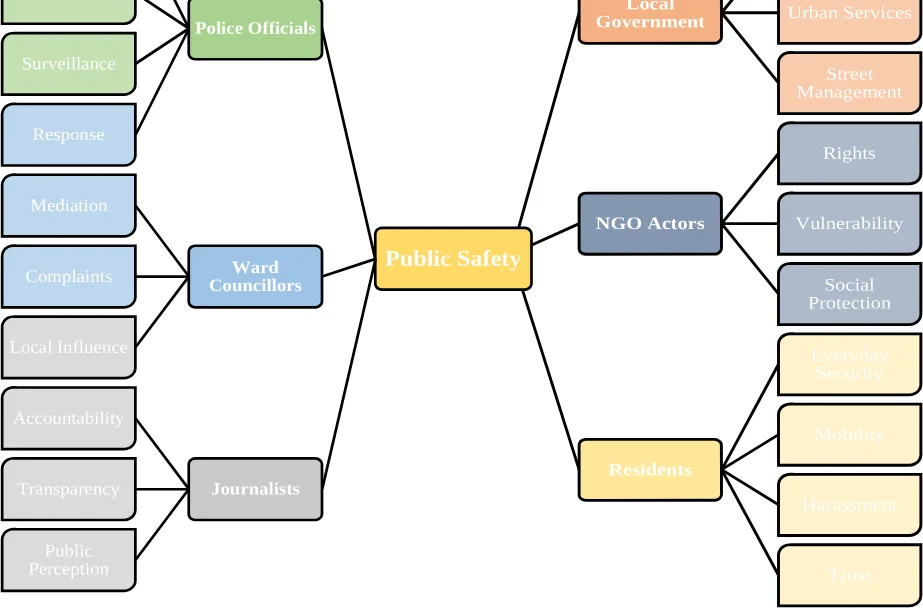
These meanings go beyond the literal meaning of the words. They influence the expectations of others of any actor, as well as what problems are considered pressing ones. The importance of priorities to safety governance was suggested by a number of participants as a source of the apparent inconsistencies and fragmentation in safety governance. Safety is thus 'negotiated' at the level of perceptions of safety and institutions in Dhaka.
4.2 Theme 2: Institutional Coordination and Fragmentation
Another key finding was that there are many institutions which need to coordinate for the purposes of safety governance, but this coordination is not equal and is not always formalized. The majority of participants felt that the DMP is at the heart of the process, but there was an expanded network identified by the participants, encompassing local government, ward level, NGOs, and community leaders. In practice, some indicated that coordination would typically take place primarily when problems become urgent and/or visible politically. There was some routine communication between police and local actors, particularly in the area of crime prevention, traffic control or public events, some described. Others pointed out that, typically, these mechanisms are not formal, but rather personal relationships are involved. Some said that, in areas of responsibility where there is overlap, each institution will assume that it has to deal with the other one doing the job, particularly in street management, complaint handling and in response to local disorder. These trends are summarized in table 2.
Table 2. Coordination Patterns in Public Safety Governance
| Area | Main actors involved | Reported pattern |
|---|---|---|
| Crime prevention | Police, residents, local leaders | Co-ordination via informal information sharing |
| Traffic and street order | Police, City services, local government | Overlapping authority and some delay |
| Public events and protests | Police, political actors, administration | Improved coordination in key times |
| Community complaints | Ward councillors, police, community leaders, | Frequently complaints sent through influential intermediaries |
| NGO and social support | NGOs, local government, police. | Cooperation is present but only for a specific issue. |
The overall scene is not a total disorganization, but “partial and situational” coordination. Cooperation that was explain as effective was due to some local cooperation, especially when there was personal trust. Meanwhile, fragmentation poses a challenge for accountability: If there is no resolution of a problem, it is not always easy to determine who is responsible. There are formal levels of authority, but little centralization of authority.
4.3 Theme 3: Political Influence and Local Power
The interviews also reveal that there are political influences and local power in shaping the way safety governance is done. This theme came out tentatively and participants did not talk too much about it. Most used the term direct interference to refer to the role of politics in safety decisions, rather than the term interference. There were several who said that resources and police attention is not provided based on need and crime rates.
Factors influencing the location of interventions and the timeliness of interventions were noted such as political events, influential local leaders and administrative priorities. It was argued that some neighborhoods and groups are served more quickly than others as a result of their political visibility and/or connections, whereas less influential neighborhoods or groups feel to be ignored. Nevertheless, there is no simple story behind how decisions are taken all decisions are not politically controlled. Limited resources, heavy workloads and competing demands were other constraints that were mentioned by many participants. Political influence is thus one aspect of more complex negotiation that is uneven. Figure 2 summaries these dimensions.
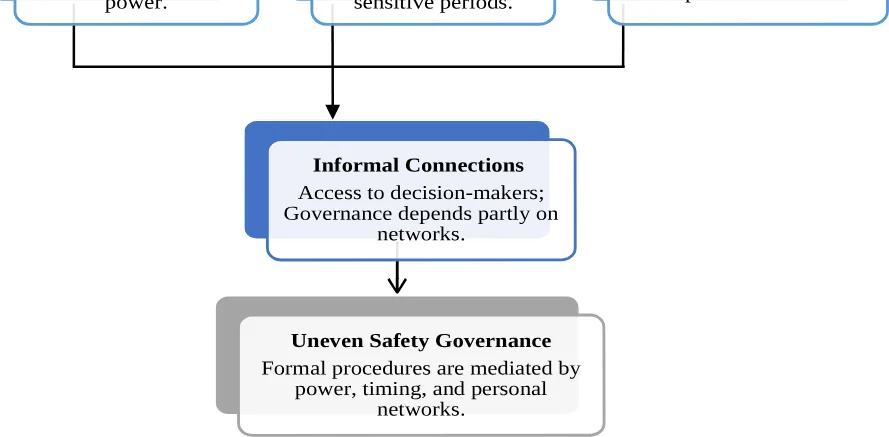
The finding is important because it reveals that there were other aspects to safety that could not be controlled only by formal rules. It is also subject to influences of local bargaining, strategic actions and unequal capacity of actors to have their issues heard. In this regard, the notion of safety governance in Dhaka is more of a negotiated process than a centralized one.
4.4 Theme 4: Community Participation and Exclusion
Another theme is the community participation (which is limited and not even). While a few noted the value and/or encouragement for community input, the participants' stories indicated that community involvement is more symbolic or indirect than purposeful. Ward councilors and NGO actors and some community leaders said that they are consulted/asked to carry messages of concern. The ordinary residents, however, were more likely to talk of receiving decisions than being part of the decisions. Some thought that there is typically an escalation to a problem before participation occurs. Some commented that people might not be able to voice their concerns freely as they might be afraid of being targeted, believe that nothing will happen as a result of their concerns, or think that access is contingent upon having connections. Several noted that participation is not completely open: more vocal, better connected, or politically engaged actors seem to wield more influence over participation than do less connected or less affluent residents. Participation and its restrictions are summarized in table 3.
Table 3. Participation in Public Safety Governance
| Actor group | Reported role | Main limitation |
|---|---|---|
| Community leaders | Relaying concerns, mediation | Limited formal authority |
| Ward councillors | Local complaint handling | Subject to political context |
| NGO actors | Advocacy and support | Weak link with policing |
| Residents | Reporting problems, seeking protection | Low influence in decision-making. |
There is participation but not a level one. It is not a regular mechanism of co-governance but is dependent on the nature of local relationships, the need for action on the issues and political opportunity. This does mean that the safety governance process is more responsive in some instances than others, and that in many cases, residents' voice is weak.
4.5 Theme 5: Unequal Safety Outcomes
The last major discovery is a sense of public safety that is felt differently by social groups and in urban environments. Safety was mentioned many times as not being equitably distributed in Dhaka. Some areas were rated as "fairly well monitored" and others were perceived as being more at risk from disorder, harassment, lack of formal control or lack of institutional response. A number of them added that women, poor people, migrants, street vendors and those in more densely populated and less visible communities in a particular area are more insecure.
Not all inequalities were made "explicit" as a direct discrimination. In many instances it was reported that it stemmed from the normal physical environment such as inadequate infrastructure, insufficient patrol, lack of lighting, overcrowding, lack of social influence, and informal settlement. However, a few residents and civil society actors indicated that to some degree, not all groups are heard equally, further facilitating this sense of safety negotiations being uneven. Participants also identified difference between official measures and lived experience: police and government measures can focus on operations, arrests, patrols, and public-order measures, while participants highlighted the “inconvenience, fear, and uncertainty” of having to deal with unsafe spaces. This is a gap which implies that the public safety is not something which can be captured formally only in the output of the public safety.
4.6 Cross-Cutting Patterns
In all five themes there were some common themes that emerged. First, the issue of public safety in Dhaka is to be understood as one that is negotiated and not one presumably carried out by the administration. First, the concept of public safety in Dhaka is one that is negotiated, and not one that is simply handled by the administration. Second, formal institutions do have an impact, but the decisions they make are influenced by informal relationships, political pressures and constraints. Thirdly, there are multiple actors who have varying interpretations of safety and this will impact prioritization and response to problems. Last, the impacts are not equal and some populations/neighborhoods are more affected than others. The interviews did not result in a single, cohesive story, rather, overlapping stories emerged, along with some inconsistencies and doubts about the actual process of decision making. This pattern itself is important, as is indicative of a form of safety governance that is fragmented and negotiated in the city.
5. Discussion
The results are presented here in the context of the public safety regimes, negotiated social order and political analysis. The results indicate that there is not any centralized system responsible for producing safety governance in Dhaka. Rather, it is created when institutional roles overlap, informal ties exist, local politics shape it, through the negotiation in the community and unequal protection access. This reinforces the idea that the concept of public safety should not just be seen as policing or crime control, rather a negotiated and politically negotiated governance.
5.1 Public Safety as a Negotiated Regime
The results are quite supportive of the concept of public safety as a negotiated regime. Edwards and Hughes (2012) suggest that these regimes are created through the processes of interaction between state agencies, local authorities, political actors and community groups, none of which can be considered to be a sovereign authority. The findings of this study support the results of the study done in New York by the researchers. The findings reveal, however, that the DMP is not the only institution that plays a key role in both defining and shaping, negotiating, contesting, and sometimes experiencing public safety; local government representatives, ward councilors, community leaders, NGOs, journalists and residents are also all involved.
This can be explained with the help of negotiated order as mentioned by Carr (2012). He says that for community crime control to take place, it is important for negotiations to take place between formal institutions and the residents, particularly when there is a struggle over legitimacy and over local notions of order. Safety and security are being crafted in Dhaka, as they are reflected through relationships between institutional authority and people's expectations (Ahsan, Hasan, Rumi, et al., 2024). However, this negotiation is not even. These have varied levels of authority, resource and access and the order that emerges are not even and are commonly dependent on current social and political hierarchy.
The study therefore further extends negotiated order theory into a thick South Asian context in which negotiation of safety is not only between the police and the citizens of the area, but also among police, the local politicians, the actors at the level of the wards or villages, the administrative bodies, NGOs, journalists and local residents. Authorities are formally centralized but in practice, they are decentralized.
5.2 Definitions, Coordination, and Legitimacy
It is important to note that safety is a complex and multi-faceted construct, and can mean different things to different actors, which relates to the construct's definition shaping priorities. Police officers focus primarily on crime control and order, which leads to an emphasis on patrol, arrests, surveillance and speedy responses to crimes. Residents' notions of safety may differ from those of official indicators, when the concepts of safety are based on fear, harassment, mobility and trust. This imbalance or difference brings tension. Garland's (1997) thesis applies: today's brand of crime control must be managed and must be a shared responsibility; it is not just a matter of police enforcement. In Dhaka, safety is not just limited to the security offered by the police, but also includes services in the urban realm, street management, political events, community grievances, and social protection. But wider definitions aren't necessarily accepted by institutions. Fear of crime is not the only factor that leads to public confidence, but also fairness, cohesion and institutional integrity (Jackson & Bradford, 2009). This is of particular significance when it comes to Dhaka where perceived safety is based on the responsiveness, fairness and trust in the institutions that residents interact with rather than on the basis of recorded crime.
Coordination’s are similar. Participants appreciated the importance of the DMP, but identified a larger set of actors that can be expected to play a role in the governance of the DMP, consistent with Braithwaite's (2000) claim about the governance of the modern world as being a regulatory state with distributed authority. But the coordination is situational, uneven and in an informal manner in Dhaka. This is likely to grow in intensity if the problem is urgent, or if it is a politically sensitive issue, such as a public event, but not so if it is a common complaint. Responsibility is spread out and accountability becomes evident when there are several institutions. This imbalancing can be explained, in part, by Klinger's (1997) ecological theory; police practices differ in communities based on their context, routines, and perceptions. Better safety governance needs to focus on improving the coordination of the safety management process, rather than just on the increased number of policemen.
5.3 Political Influence, Participation, and Inequality
One significant aspect that came into focus was political influence. The conservative vocabulary of the participants is significant too: it indicates that there is an awareness of political influence, but it is not easy to talk about openly. Resources and attention are not allocated solely on need, but the nature of resources and speed of action is determined by political events, influential figures, administrative priorities and informal connections. This helps to confirm the political analysis of safety regimes that Edwards and Hughes (2012) provide. This does not imply that all decisions are made by politics, as there are also real constraints on the officers' decisions. The term 'neutrality' and 'accountability' suggests that they are an integral part of reform; loss of trust if response is based on connections, impacts on whether residents report problems and/or cooperate with authorities. In another context Magaloni et al. (2020) make a similar point that the policing outcome is a result of formal authority and the local power structure.
Community involvement was based on a similar reasoning. The results corroborate Carr's (2012) assertion that the success of the negotiated process requires some kind of meaningful citizen participation, but they indicate that citizens' participation in Dhaka is constrained by fears, mistrust, political hierarchy and unequal access. Often participation is not pro-active, but is done as a reactive response in the wake of a problem escalating. A symbolic or selective form of participation can diminish legitimacy as suggested by Jackson and Bradford (2009). Participation can also create inequality in this situation as those who are better connected are over-represented, while women, migrants, street vendors and low-income people are under-represented. So it's not about having community decision making powers replace the police, it is about providing a clear and safe path for residents to express concerns and shape community priorities.
Lastly, the unevenness of experiencing safety reveals that public safety is an issue of social inequality, in addition to performance by institutions. Safety is unevenly dispersed in urban space, influenced by the infrastructure, the lighting, the presence of patrolling staff, the density of the population, the presence of informal settlements and the influence of social networks. This reinforces Garland's (1997) perspective of a relationship between crime control and other areas of governance and regulation. The official indicators do not reflect lived experience, indicating that other indicators of safety need to be considered: trust, accessibility and responsiveness, gendered mobility, and perceived fairness. While a city-level safety regime may seem to be working well, it might be not working for certain groups so it needs to be assessed from an equity perspective.
5.4 Implications
The study's theoretical and practical implications are discussed. In theory, it takes a negotiated order approach to public safety regimes, but also goes beyond negotiated order; it has been applied to a South Asian city; and it demonstrates the importance of taking into account inequality in addition to coordination when considering public safety regimes. In practice, it means that institutions should have a more comprehensive and inclusive understanding of safety, which should encompass the concepts of crime control and everyday issues of safety, including harassment, mobility, gendered insecurity and trust; institutions must have more systematic coordination, with clearer processes and protocols for handling complaints and delineating responsibilities; it means that there should be greater transparency in the complaint processes and more robust oversight of institutions; it means that community involvement should go beyond symbolic consultation to include regular and safe avenues for community engagement, particularly for marginalised groups; and it means that evaluation should take into account lived experience as well as institutional outputs.
6. Conclusion
The study explored the concept of negotiated social order and political analysis to understand the public safety regimes in Dhaka. It questioned the definition of public safety, negotiation, implementation and experience of public safety by various public safety actors in a city. Rather than of the concept of public safety being synonymous with policing/crime control, it saw safety as a multi-faceted social and political process of how institutions, local relations, political influence, participation in community and differential access to protection, contribute to public safety.
The results indicate that there is no uniform safety regime in Dhaka. It is developed by an atomized and context-specific system with actors' varying perceptions of safety. The police reinforce the concept of crime prevention and maintenance of order, surveillance, intervention, traffic control; local government officials relate crime to coordination, urban management and service provision; and residents and community actors think of crime in terms of harassment, fear, crime, mobility, political pressure, gender-based insecurity and trust. These divergent approaches meanings have an influences on the prioritization of problems and on the organization of the responses.
The coordination of a number of institutions also plays an significant role in safety governance, although this coordination is not even and is often informal. The DMP is at the heart of safety but it is not the only agency to influence it; ward councillors, NGOs, community leaders, journalists and residents all have a different influence on safety. In practice, it is a matter of personal relationships, of urgency and of political visibility to achieve coordination, but not of formal authority to achieve coordination. It is not by stable mechanisms of coordination, it is by the personal relationships, by the urgency and by the political visibility. But political influence has an impact on the direction of attention and the speed with which issues are dealt with, while institutions are also constrained in their actions. Whilst the importance of community participation is acknowledged, it tends to be limited or symbolic, with a lesser degree of voice for many community members. Safety outcomes vary between social groups and urban space women, low-income residents, migrants, street vendors and people in dense and less visible spaces are all less safe, and have a higher incidence of disadvantage that is often not due to direct discrimination but to structural issues.
This study makes a contribution to criminology in that it demonstrates the functioning of public safety regimes in a metropolitan setting in South Asia. It shows that concepts like negotiated order, political influence, plural governance and uneven outcomes are relevant to the analysis of safety in Dhaka, and that the experiences of people's everyday lives of fear, trust, mobility, responsiveness and fairness are key indicators of safety as well. On a practical level, extending the definition of security, creating more systematic coordination, establishing greater accountability, and extending participation to those groups and neighbourhoods that feel the brunt of insecurity but who have the least power over decision-making in particular would benefit the security governance of Dhaka. The role of public safety in Dhaka is not just provided by the State or the police but also is negotiated among public and private institutions, political actors, community representatives, and citizens. This can result in cooperation and responsiveness, but it can also be a re-production of exclusion and inequality. Building the necessary institutional capacity is only part of the equation for an effective public safety system; it will also need to be fair, transparent, incorporate community voice, and be sensitive to the inequities of how safety is perceived by different communities in different parts of the city.
Declarations
Author Contributions
Md. Bazlur Rahman is the sole author of this article. He was responsible for the design, analysis framework, documentary and legal review, data collection and analysis from interviews, interpretation of sources, writing the manuscript and approving the final version for publication.
Funding
This work was not funded by a specific grant from any funding agency in the public, commercial or not-for-profit sector.
Conflict of Interest
The author has no conflict of interest to declare concerning the research, authorship or publication of this paper.
Data Availability Statement
Data from this study are qualitative interview data of a politically charged topic. The data has not been made public thus protecting the anonymity of the participants, as the interviews contain confidential information and were recorded on the promise of anonymity. De-identified data will be made available from the authors upon reasonable request with ethical approval and subject to protecting the identity of the participants.
References
- Ahsan, A. H. M., Hasan, M. K., & Rumi, M. H. (2024). Citizens’ trust in Bangladesh Police: A cross-sectional survey on urban population. Policing: A Journal of Policy and Practice, 18, paae064. https://doi.org/10.1093/police/paae064
- Ahsan, A. H. M., Hasan, Md. K., Rumi, M. H., Ahmed, T., & Aunto, T. K. (2024). Students’ safety culture at tertiary level academic institutes in Bangladesh: A cross-sectional study. Heliyon, 10(22), e40155. https://doi.org/10.1016/j.heliyon.2024.e40155
- Barker, A. (2016). Mediated Conviviality and the Urban Social Order: Reframing the Regulation of Public Space. British Journal of Criminology, azw029. https://doi.org/10.1093/bjc/azw029
- Blair, G., Weinstein, J. M., Christia, F., Arias, E., Badran, E., Blair, R. A., Cheema, A., Farooqui, A., Fetzer, T., Grossman, G., Haim, D., Hameed, Z., Hanson, R., Hasanain, A., Kronick, D., Morse, B. S., Muggah, R., Nadeem, F., Tsai, L. L., … Wilke, A. M. (2021). Community policing does not build citizen trust in police or reduce crime in the Global South. Science, 374(6571), eabd3446. https://doi.org/10.1126/science.abd3446
- Bowen, G. A. (2009). Document Analysis as a Qualitative Research Method. Qualitative Research Journal, 9(2), 27–40. https://doi.org/10.3316/QRJ0902027
- Braithwaite, J. (2000). The New Regulatory State and the Transformation of Criminology. British Journal of Criminology, 40(2), 222–238. https://doi.org/10.1093/bjc/40.2.222
- Braun, V., & Clarke, V. (2006). Using thematic analysis in psychology. Qualitative Research in Psychology, 3(2), 77–101. https://doi.org/10.1191/1478088706qp063oa
- Carr, P. J. (2012). Citizens, Community, and Crime Control: The Problems and Prospects for Negotiated Order | Office of Justice Programs. Criminology and Criminal Justice, 12(4), 397–412.
- Da Cruz, N. F., Rode, P., & McQuarrie, M. (2019). New urban governance: A review of current themes and future priorities. Journal of Urban Affairs, 41(1), 1–19. https://doi.org/10.1080/07352166.2018.1499416
- Edwards, A., & Hughes, G. (2012). Public safety regimes: Negotiated orders and political analysis in criminology. Criminology & Criminal Justice, 12(4), 433–458. https://doi.org/10.1177/1748895811431850
- Garland, D. (1997). `Governmentality’ and the Problem of Crime: Foucault, Criminology, Sociology. Theoretical Criminology, 1(2), 173–214. https://doi.org/10.1177/1362480697001002002
- Ghosh, S. C. (2023). Conceptualizing student movements in Bangladesh post-2013: A qualitative and comparative case study of the Quota Reform Movement and the Road Safety Movement. Social Identities, 29(6), 534–554. https://doi.org/10.1080/13504630.2024.2320093
- Jackson, J., & Bradford, B. (2009). Crime, policing and social order: On the expressive nature of public confidence in policing. The British Journal of Sociology, 60(3), 493–521. https://doi.org/10.1111/j.1468-4446.2009.01253.x
- Klinger, D. A. (1997). Negotiating Order in Patrol Work: An Ecological Theory of Police Response to Deviance*. Criminology, 35(2), 277–306. https://doi.org/10.1111/j.1745-9125.1997.tb00877.x
- Kythreotis, A. P. (2025). The paradoxical (post-)politics of scale: Exploring authoritarian state environmental policymaking in Brunei. Territory, Politics, Governance, 13(7), 980–1000. https://doi.org/10.1080/21622671.2023.2262508
- Lessing, B. (2021). Conceptualizing Criminal Governance. Perspectives on Politics, 19(3), 854–873. https://doi.org/10.1017/S1537592720001243
- Magaloni, B., Franco-Vivanco, E., & Melo, V. (2020). Killing in the Slums: Social Order, Criminal Governance, and Police Violence in Rio de Janeiro. American Political Science Review, 114(2), 552–572. https://doi.org/10.1017/S0003055419000856
- Mantilla, J., & Feldmann, A. E. (2021). Criminal Governance in Latin America. In H. N. Pontell (Ed.), Oxford Research Encyclopedia of Criminology and Criminal Justice (1st ed.). Oxford University PressNew York, NY. https://doi.org/10.1093/acrefore/9780190264079.013.697
- McDowell, M. G. (2019). Insurgent safety: Theorizing alternatives to state protection. Theoretical Criminology, 23(1), 43–59. https://doi.org/10.1177/1362480617713984
- Patton, M. Q. Q. (2023). Qualitative Research & Evaluation Methods (4th ed.).
- Rabelo, V. C., Stewart, O. J., Snowden, W. C., & Fathallah, S. (2024). When safety for you means danger for me: The racial politics of carceral public safety discourse. Frontiers in Psychology, 15, 1347630. https://doi.org/10.3389/fpsyg.2024.1347630
- Shabir, G. & Khabeer Fatima. (2024). The Role of Non-State Actors in International Politics: Challenges to State Sovereignty. Unpublished. https://doi.org/10.13140/RG.2.2.14508.99208
- Whelan, C., & Molnar, A. (2019). Policing political mega-events through ‘hard’ and ‘soft’ tactics: Reflections on local and organisational tensions in public order policing. Policing and Society, 29(1), 85–99. https://doi.org/10.1080/10439463.2017.1282481
- Wozniak, K. H. (2023). The Politics of Crime Prevention: Race, Public Opinion, and the Meaning of Community Safety. NYU Press. https://www.jstor.org/stable/jj.13944156
- Yin, R. K. (with Campbell, D. T.). (2018). Case study research and applications: Design and methods (Sixth edition). SAGE Publications, Inc.
CITE THIS ARTICLE
Rahman, M. B. (2026). An Examination of Public Safety Regimes through the Lens of Negotiated Social Orders and Political Analysis in Contemporary Criminological Research. https://www.bazlurrahman.com/article/bef8d7a3-5135-4547-a06c-5cc894d59d61
M. B. Rahman, “An Examination of Public Safety Regimes through the Lens of Negotiated Social Orders and Political Analysis in Contemporary Criminological Research,” 2026. [Online]. Available: https://www.bazlurrahman.com/article/bef8d7a3-5135-4547-a06c-5cc894d59d61
Rahman, M. B. (2026) ‘An Examination of Public Safety Regimes through the Lens of Negotiated Social Orders and Political Analysis in Contemporary Criminological Research’. Available at: https://www.bazlurrahman.com/article/bef8d7a3-5135-4547-a06c-5cc894d59d61
Rahman, Md. Bazlur. “An Examination of Public Safety Regimes through the Lens of Negotiated Social Orders and Political Analysis in Contemporary Criminological Research.” 2026, https://www.bazlurrahman.com/article/bef8d7a3-5135-4547-a06c-5cc894d59d61.
Md. Bazlur Rahman. “An Examination of Public Safety Regimes through the Lens of Negotiated Social Orders and Political Analysis in Contemporary Criminological Research.” (2026). https://www.bazlurrahman.com/article/bef8d7a3-5135-4547-a06c-5cc894d59d61.
Rahman MB. An Examination of Public Safety Regimes through the Lens of Negotiated Social Orders and Political Analysis in Contemporary Criminological Research. 2026. https://www.bazlurrahman.com/article/bef8d7a3-5135-4547-a06c-5cc894d59d61
@misc{article_bef8d7a351354547a06c5cc894d59d61,
  title = {An Examination of Public Safety Regimes through the Lens of Negotiated Social Orders and Political Analysis in Contemporary Criminological Research},
  author = {Md. Bazlur Rahman},
  year = {2026},
  url = {https://www.bazlurrahman.com/article/bef8d7a3-5135-4547-a06c-5cc894d59d61},
}
TY - GEN AU - Md. Bazlur Rahman TI - An Examination of Public Safety Regimes through the Lens of Negotiated Social Orders and Political Analysis in Contemporary Criminological Research PY - 2026 UR - https://www.bazlurrahman.com/article/bef8d7a3-5135-4547-a06c-5cc894d59d61 ER -